
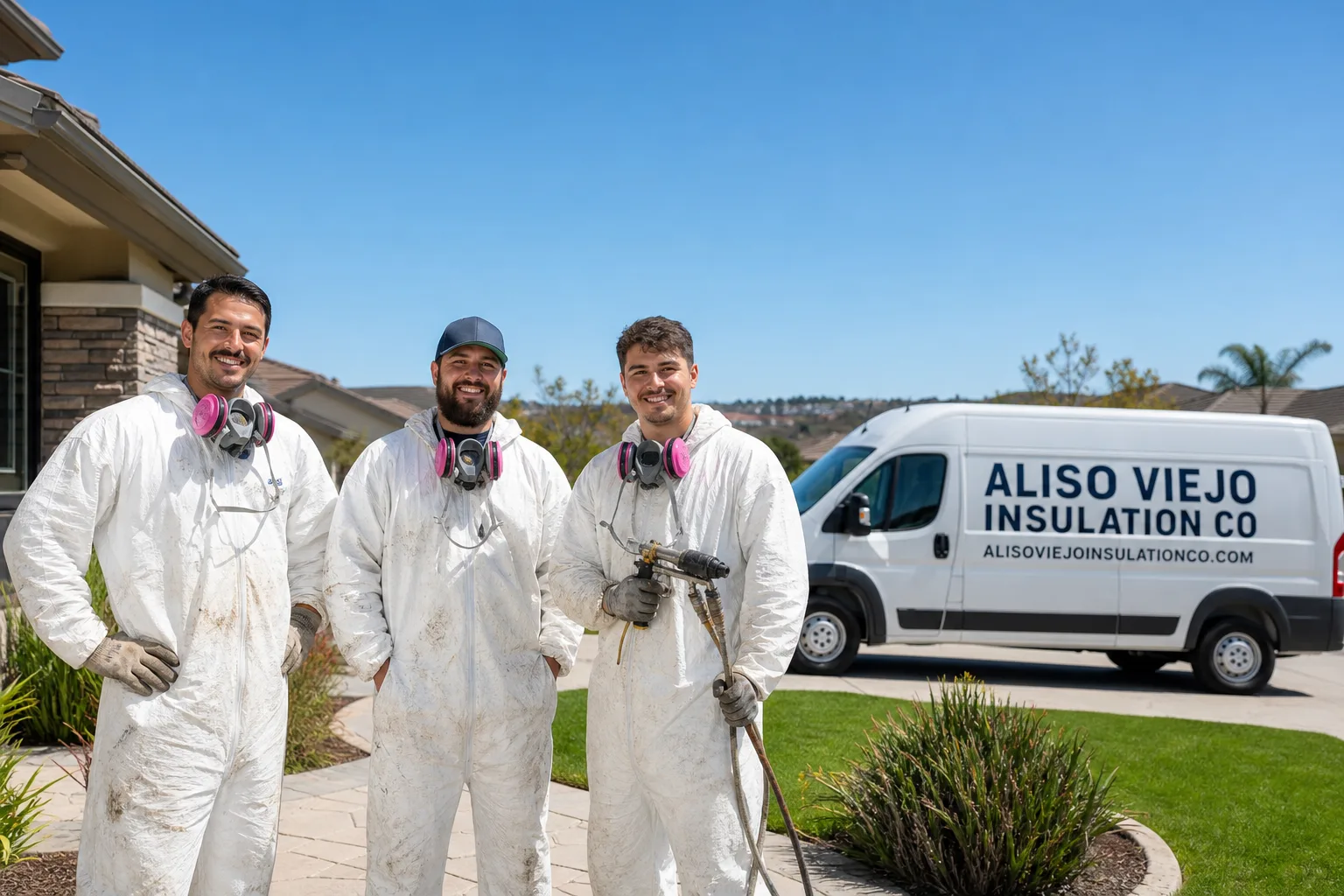
Fast, Reliable Attic Insulation Across Costa Mesa
Attic insulation in Costa Mesa costs $1,450 to $3,600 for a full retrofit, with top-ups running $700 to $1,900 depending on attic size and access. Most jobs are done in a single day. If you’re noticing upstairs rooms that never cool down, or your A/C runs constantly through August, your attic is likely the culprit. We serve Costa Mesa from our Aliso Viejo shop, and we know the Westside’s 1950s stucco tracts and the Eastside’s mid-century neighborhoods better than any crew driving in from Riverside or LA. Call (877) 352-4780 for a free attic assessment, and we’ll tell you exactly what’s going on up there.
Our Attic Insulation team handles blown-in cellulose, fiberglass batts, spray foam, and the ventilation work most Costa Mesa homes need before any of that goes in. We’re not tied to one brand or method, so what you get is what your attic actually needs, not what happens to be on the truck. More on that below.
Why Aliso Viejo Insulation Co Is Costa Mesa’s Preferred Attic Insulation Company
Costa Mesa homeowners call us because we understand the specific problems this city’s housing stock throws at insulation contractors. The Westside is dense with 1950s and early 60s stucco homes on low-slope roofs, many with original cavities that were never insulated to modern standards. The Eastside and areas around Fairview Park have their own mix of mid-century tracts and 1970s builds. We’ve worked in all of it, from 92626 up to 92628, and we know which houses need ventilation fixes before insulation can go in.
Nate Calloway built this company around the idea that insulation shouldn’t be a one-brand pitch. We’re authorized installers for Owens Corning, Johns Manville, Knauf, Rockwool, CertainTeed, Icynene, Demilec, and GreenFiber. That’s eight manufacturers, and it means our recommendation comes from building science, not from whatever product we’re incentivized to move. For a Costa Mesa homeowner, that typically means blown-in cellulose or fiberglass for retrofits, and open-cell spray foam only where the attic geometry and moisture profile call for it. You won’t get a spray foam upsell on a house that needs a simple top-up.
Response time to Costa Mesa is usually same-day or next-day for assessments. Call (877) 352-4780 and we’ll schedule a time that works around your schedule, not the other way around.
Attic Ventilation in Costa Mesa
Attic Ventilation in Costa Mesa is not optional on most of the city’s older homes; it’s the difference between an insulation job that works and one that rots your roof deck. The original attic vents on 1950s Westside homes were sized for almost no insulation. Original builders weren’t thinking about R-38 or R-49. When you blow in a foot of cellulose on top of a low-slope roof with undersized vents, warm moist air gets trapped up there, condenses on the sheathing during the June gloom marine layer, and you end up with mold and rotting plywood. We see this pattern constantly in 92627.
Adding Vents Before Insulation
Most Costa Mesa homes built before 1970 need one or two additional roof vents, a gable vent, or soffit vent upgrades before we blow anything in. The cost for vent additions typically runs $350 to $900 depending on roof type and how many are needed. We don’t skip this step, because skipping it guarantees a callback in two years when the decking shows mold.
Smoke Testing and Airflow Verification
After adding vents, we run a smoke test to verify air actually moves through the attic. It’s a simple step that tells us whether the airflow path is working, and it’s part of every ventilation job we do in Costa Mesa. Without verified airflow, the best insulation in the world becomes a damp sponge by late summer.
Radiant Barrier in Costa Mesa
Radiant Barrier in Costa Mesa is worth considering if your attic is a low-slope, tight-framed space where conventional ventilation alone won’t knock down the heat coming through the roof deck. A radiant barrier is a reflective material installed under the rafters that reflects radiant heat away from the living space. In Costa Mesa’s summer heat spikes, especially when Santa Ana winds push offshore and the marine layer burns off, attic temperatures can hit 140°F or more. A radiant barrier drops that surface temperature enough that your A/C doesn’t have to fight as hard.
When Radiant Barrier Makes Sense
Radiant barrier works best on older Costa Mesa homes with dark composite shingles and little or no existing roof insulation. The cost for a typical radiant barrier installation in Costa Mesa runs $900 to $2,200 depending on attic square footage and access. It’s not a replacement for insulation; it’s a complement that reduces radiant heat gain from above.
Pairing Radiant Barrier with Blown-In Insulation
We often pair a radiant barrier with blown-in cellulose or fiberglass on the attic floor, which addresses both radiant heat from the roof and conductive heat through the ceiling. This combination is particularly effective on the Eastside mid-century tracts in 92626 where attic spaces tend to be a bit more accessible. The sequence matters: ventilation, then radiant barrier on the rafters, then insulation on the floor. Do it in the wrong order and you trap moisture.
Coastal salt air is another Costa Mesa-specific factor that most insulation guides ignore. We’ll get into that below, but know this: corrosion in attic hardware is a real thing here, and it affects how fast your vents fail and how well your insulation performs over time.
Trusted Brands We Service in Costa Mesa
We’re authorized to install products from eight nationally recognized manufacturers, but for Costa Mesa’s climate and housing stock, three tend to do most of the heavy lifting. GreenFiber recycled cellulose is our go-to for Westside retrofits because it packs tight into old framing and provides better air sealing than batts. Owens Corning fiberglass batts work well in accessible attics on the Eastside and in newer additions. Johns Manville and Knauf give us quality options when the job calls for fiberglass with specific thermal performance characteristics. Because we stock these materials locally and can pull from our Aliso Viejo warehouse, turnaround for Costa Mesa jobs is fast. You’re not waiting a week for product to ship in.
Common Attic Insulation Problems We See in Costa Mesa Homes
- Undersized original vents causing mold on the roof deck. The 1950s Westside tracts in 92627 were built with vents sized for zero insulation. Top up to R-49, trap the moisture, and June gloom condensation starts growing mold on the sheathing. We add vents before blowing in insulation, every time.
- Coastal salt air corroding attic fasteners and vent hardware. Standard galvanized nails and screws don’t last a decade a few miles from the Pacific. When fasteners corrode, vents loosen, air leaks develop, and the whole attic envelope starts failing. We specify stainless hardware where the salt exposure calls for it.
- Blown-in insulation that trapped damp and lost its R-value. We see too many attics where a previous contractor blew cellulose into an unvented low-slope roof without addressing airflow. The material absorbed moisture, settled, and now delivers a fraction of its rated R-value. The fix is removing the old material, correcting ventilation, then blowing in fresh insulation properly.
- 1960s and 70s apartment buildings with zero attic separation. A large share of Costa Mesa’s rental stock near Harbor Boulevard and the commercial corridors are flat-roofed apartment buildings where attic space is minimal or nonexistent. These buildings need a different approach: spray foam on the underside of the roof deck, which we can do with Icynene or Demilec open-cell systems.
Pricing for Attic Insulation in Costa Mesa, CA
Here’s what you can expect to pay for attic insulation work in Costa Mesa. An attic top-up on a typical 1,000 to 1,300 square foot home runs $700 to $1,900. A full attic insulation replacement, which includes removing old material, air sealing, and blowing in new insulation, typically goes for $1,450 to $3,600. Attic batt insulation for accessible attics falls in the $1,200 to $2,800 range. Attic baffles and ventilation prep add $350 to $900. Attic Insulation Replacement with ventilation work on an older Westside home can reach $4,500 when we’re dealing with low-pitch roofs, narrow access hatches, and undersized existing vents. These ranges account for Costa Mesa’s older framing, roof geometry, and the ventilation work most homes need. Call (877) 352-4780 for a precise quote, and our estimator will walk your attic and give you a number you can take to the bank. Estimates are free.
We Also Serve Cities Near Costa Mesa
Our service area includes Newport Beach, Fountain Valley, Huntington Beach, and San Joaquin Hills. If you’re in any of these nearby communities and need attic insulation work done right, Attic Insulation in Costa Mesa is a short drive from our Aliso Viejo shop, and we schedule appointments across the area Monday through Saturday.
Serving Costa Mesa, CA — Our Local Coverage Area
We’re based in the Costa Mesa area and know this community well. Use the map below to see our service coverage — if you’re nearby, we can almost certainly help.
FAQs About Attic Insulation in Costa Mesa
Costa Mesa’s 1950s Westside homes have original attic vents that were sized for almost no insulation, so adding modern insulation levels traps moisture and causes condensation on the roof deck during the marine layer. You need to add vents before blowing in insulation to maintain airflow. Call (877) 352-4780 and we’ll assess your current venting as part of the free estimate.
Salt air accelerates corrosion on attic fasteners, vent hardware, and any exposed metal components, which causes vents to loosen and air leaks to develop years earlier than they would inland. We specify galvanized or stainless hardware and coated vent components on Costa Mesa jobs to counteract this. The insulation material itself also needs to stay dry, which is why ventilation is the first step.
For most Costa Mesa homes, blown-in cellulose from GreenFiber or blown-in fiberglass provides the best balance of air sealing, moisture tolerance, and thermal performance for this climate. Open-cell spray foam from Icynene or Demilec is appropriate for flat-roofed apartment buildings with minimal attic space. The right answer depends on your roof geometry, not a brand preference.
Yes, most 1960s and 70s apartment buildings in Costa Mesa have flat or low-slope roofs with little or no attic cavity, so conventional blown-in insulation doesn’t apply. These buildings typically need spray foam applied directly to the underside of the roof deck, which we install using Icynene or Demilec systems. The approach also differs for the rental-heavy 92627 Westside stock versus owner-occupied 92626 tracts.
The clearest signs are upstairs rooms that stay hot in summer even with the A/C running, visible mold or water stains on the underside of the roof deck, and insulation that has settled or appears damp when you look in the attic. In Costa Mesa’s marine layer, even slight condensation on roof sheathing is a warning sign that your ventilation or insulation is compromised. Call (877) 352-4780 for an inspection and we’ll tell you what’s actually going on.
If you’re in Costa Mesa and your attic hasn’t been inspected in five years, it’s worth having a professional look. On a 1955 Westside stucco home near 19th Street, our crew found the original attic vents were too small for the R-49 top-up the owner wanted. We added two low-profile roof vents and a gable vent before blowing in GreenFiber cellulose, then verified airflow with a smoke test to prevent condensation during the marine layer. The homeowner reported noticeably fewer morning dampness issues and a more consistent indoor temperature. That’s what doing it right looks like.
Written by Nate Calloway, Owner at Aliso Viejo Insulation Co, serving Costa Mesa from Aliso Viejo, CA.