
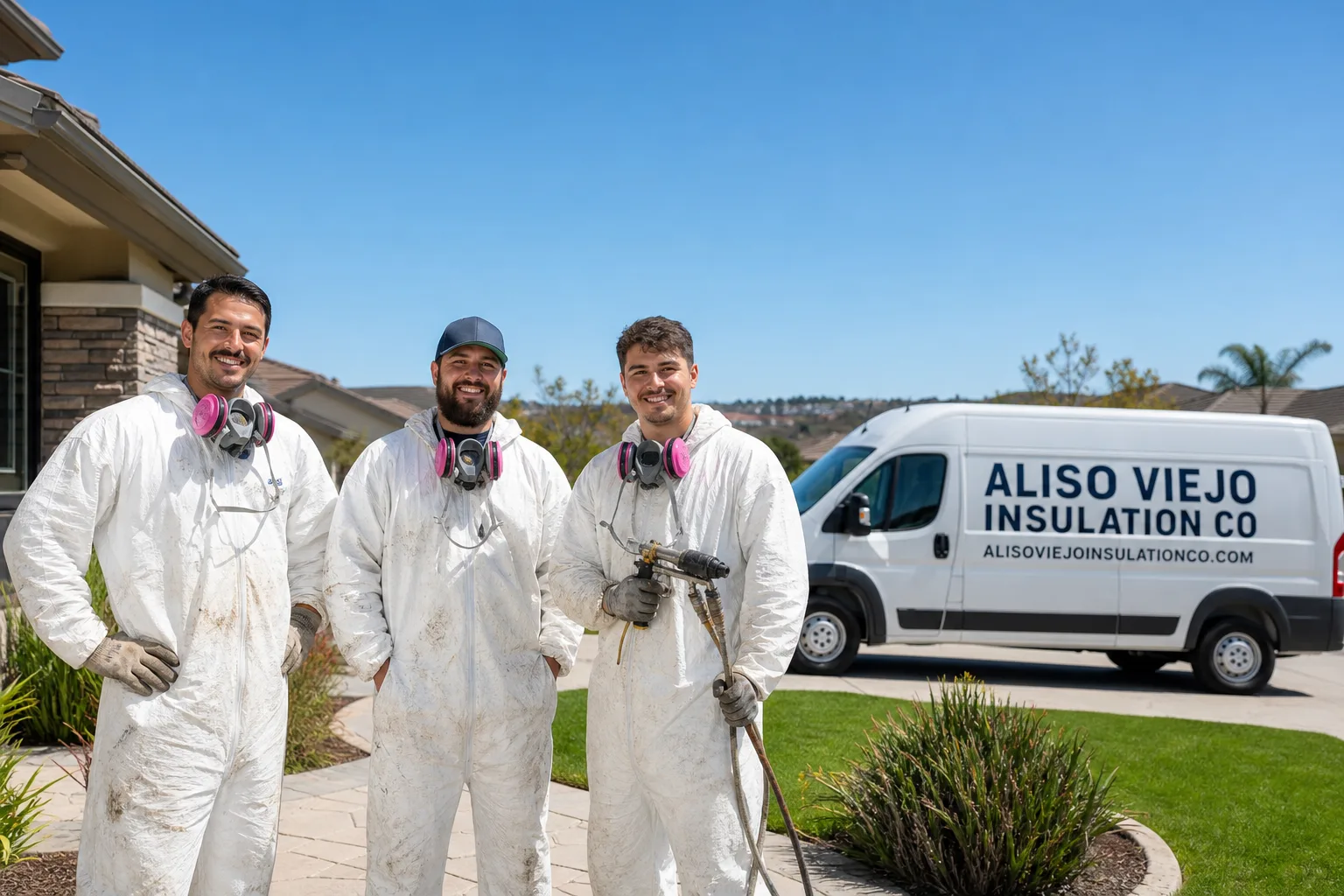
Trusted Spray Foam Insulation for Aliso Viejo Homeowners
Spray foam insulation in Aliso Viejo homes solves a problem most other insulation can’t: the city’s coastal-inland temperature swings that push heat through every unsealed gap in your attic, walls, and rim joists. On July afternoons when thermostats climb past 90 degrees and January nights when marine-layer dampness seeps into building cavities, air leakage becomes the main reason your energy bill spikes and certain rooms never feel comfortable. As a full-method contractor authorized to install Icynene and Demilec spray foam alongside fiberglass, mineral wool, and cellulose, we match the chemistry to your specific structure rather than selling you whatever’s on the truck. Nate Calloway leads every consultation with one principle: the right insulation for your home’s specific conditions. Call (877) 352-4780 to schedule a no-obligation assessment, often available within 48 hours for Aliso Viejo residents.
Closed Cell Spray Foam Insulation
Closed Cell Spray Foam Insulation is a dense, rigid foam that cures to roughly 2 pounds per cubic foot and delivers approximately R-6.5 to R-7 per inch, making it the highest R-value per inch of any commonly installed insulation in Aliso Viejo. Closed cell acts as an air barrier, vapor barrier, and structural reinforcer in a single application, which matters when you’re dealing with the moisture that rolls in from Laguna Beach on summer mornings or the occasional heavy rain that tests your home’s envelope. We install closed cell from Demilec when the job calls for maximum moisture resistance, or when you need high R-value in a shallow cavity like a 2×4 wall or a tight rim joist. If you’re wondering how much Spray Foam Insulation costs, closed cell runs roughly $1.50 to $3.50 per board foot installed, depending on cavity depth, access, and total square footage.
Moisture-Blocking Performance
Closed cell’s Class II vapor retarder rating means it resists the humid air that creeps up from crawl spaces and through foundation walls in Aliso Viejo’s older tract homes. In neighborhoods like Westridge and Glenwood, where homes sit on varying elevations and some crawl spaces hold moisture after rains, closed cell prevents that dampness from migrating into living spaces.
Structural Bonding Strength
When applied to roof decks, closed cell bonds to the sheathing and effectively glues the roof assembly together, adding measurable racking strength. For Aliso Viejo homeowners in Saddleback-adjacent areas that get higher wind gusts through the canyon passes, that added rigidity matters.
Open Cell Spray Foam
Open Cell Spray Foam is a lighter, semi-flexible foam that expands dramatically on application and cures at roughly half a pound per cubic foot, delivering about R-3.5 to R-4 per inch with excellent air-sealing properties but no vapor barrier. It’s the smart choice for Aliso Viejo in areas where you want sound absorption as much as thermal performance, or where you want the foam’s expansion to fill irregular cavities completely. We use Icynene open cell for many attic roof decks because it lets moisture pass through, which means a roof leak will show itself rather than hide behind a vapor-closed barrier and rot the sheathing silently. Budget around $1.00 to $2.50 per board foot for open cell, with larger attic projects often landing at the lower end of that range.
Air Sealing Without the Vapor Lock
Open cell’s permeability is a feature, not a limitation, when applied to vented attics and above-grade walls. In Aliso Viejo’s climate zone, where drying potential toward the interior matters during winter months, open cell lets wall assemblies breathe while still cutting air changes per hour dramatically.
Sound Attenuation Value
Homeowners along the 73 toll road or near El Toro Road tell us open cell noticeably quiets traffic noise inside bedrooms and bonus rooms. The foam’s open-cell structure breaks up sound waves far more effectively than fiberglass batts do.
Spray Foam Insulation Contractors
Spray Foam Insulation Contractors are the licensed specialists who apply two-component foam that mixes on-site and expands into cavities, and choosing the right one in Aliso Viejo comes down to product access and installation discipline more than anything else. A contractor locked into one foam brand will steer you toward that brand whether or not it fits the job; a contractor with both Icynene and Demilec can recommend honestly. Nate Calloway’s team installs both open and closed cell, and we’re equally comfortable quoting fiberglass, mineral wool, or cellulose when those serve your home better. Expect contractor labor to account for 40 to 60 percent of any spray foam quote, with the rest going to material volume.
The Eight-Brand Advantage
Most spray foam crews in south Orange County are authorized to install one, maybe two products. We source from eight manufacturers including Owens Corning, Johns Manville, and GreenFiber, which means our recommendation is built around building science, not brand loyalty.
What to Ask Before You Hire
Ask any contractor which foam system they’re certified to install, how many board feet their rig puts out per minute, and what their re-entry protocol is. If they can’t answer those three questions precisely, keep looking.
Spray Foam Attic Insulation
Spray Foam Attic Insulation transforms a typical vented attic into a conditioned or semi-conditioned space by applying foam either to the attic floor or directly to the underside of the roof deck, and it’s often the single highest-impact upgrade an Aliso Viejo home can get. Heat collects in attics all day and radiates into living spaces all evening; foam on the roof deck stops that heat at the source and brings ductwork into the conditioned envelope. We install both open cell from Icynene and closed cell from Demilec on roof decks, depending on whether your climate and building assembly benefit more from permeability or from a vapor barrier. An attic spray foam job in Aliso Viejo typically runs $4,500 to $12,000, with roof deck applications on the higher end and floor applications lower.
Roof Deck Versus Floor Application
Spraying the roof deck keeps your attic within a few degrees of house temperature, which matters when your HVAC ducts run through that space. Floor application is less expensive and works well when ductwork is already sealed and the attic has proper ventilation.
Why Ductwork Placement Decides the Method
If your furnace and duct runs sit in the attic, you’re losing conditioned air to a 130-degree space in summer. Foam at the roofline brings that ductwork inside the thermal boundary, and that’s when the energy numbers actually show up on the bill.
Spray Foam Wall Insulation
Spray Foam Wall Insulation applies expanding foam directly into wall cavities during new construction or as a retrofit through drilled holes, delivering air sealing and R-value in one step and eliminating the gaps and compression that make batts perform below their rated value. In Aliso Viejo’s older neighborhoods, where homes built in the 1970s and 1980s often have fiberglass batts that have sagged or settled, foam retrofit through the drywall brings walls back to full thermal performance. We use closed cell foam in 2×4 walls to maximize R-value in a shallow cavity, and open cell in 2×6 walls where added depth makes the lower cost per board foot more economical. Wall retrofit spray foam typically costs $2.00 to $4.00 per square foot of wall area.
Retrofit Versus New Construction
New construction lets us foam from the inside before drywall goes up, which is faster and cleaner. Retrofitting existing walls means drilling access holes and patching after, which adds labor but pays back in comfort for decades.
Eliminating Thermal Bridging
Wood studs conduct heat through walls at roughly three times the rate of insulation. Foam that fills every cavity and seals against each stud face reduces the impact of thermal bridging far more effectively than fiberglass batts can.
Rim Joist Spray Foam
Rim Joist Spray Foam addresses the space where your floor framing meets the foundation wall, which is consistently one of the leakiest and most overlooked areas in Aliso Viejo homes. Air moves into the house through the rim joist band from the crawl space or basement, bringing moisture, dust, and unconditioned air with it. We apply closed cell foam to rim joists because that area sits close to the ground and needs the vapor resistance and rigidity closed cell provides. A typical Aliso Viejo rim joist job runs $1,500 to $3,500 depending on linear footage and access, but it’s one of the cheapest ways to cut air infiltration quickly.
Crawlspace Envelope Connection
When combined with crawl space encapsulation, rim joist foam completes the bottom boundary of your home’s thermal envelope. Air sealing here means the difference between a crawl space that conditions itself and one that constantly pulls outdoor air through the floor above.
The Overlooked Energy Drain
Energy audits show the rim joist band can account for 10 to 15 percent of total air leakage in a typical home. Sealing it with foam is a targeted fix that pays for itself faster than almost any other insulation improvement.
Crawl Space Spray Foam Insulation
Crawl Space Spray Foam Insulation targets the underside of your home, where damp, unconditioned air constantly works against everything your HVAC system is trying to do. Aliso Viejo homes with vented crawl spaces pull moisture from the soil into the floor framing, and that moisture shortens the life of insulation and invites mold. We recommend closed cell foam on crawl space walls and rim joists to create a sealed, conditioned space that keeps the floor above warmer in winter and dryer year-round. Budget $4,000 to $9,000 for a full crawl space foam project in Aliso Viejo, with smaller spot treatments available for less.
Encapsulation Synergy
Spray foam on crawl space walls works with the vapor barrier on the floor to create a sealed envelope below the house. The result is a crawl space that stays dry and within 10 degrees of the living space temperature above it.
Floor Insulation Alternative
If you prefer to keep the crawl space vented rather than encapsulated, we can foam the underside of the floor deck instead. That approach keeps the floor warmer while letting the crawl space stay open to the outdoors, though it doesn’t solve moisture the way wall foam does.
Garage Spray Foam Insulation
Garage Spray Foam Insulation turns an unconditioned space that bakes in the Aliso Viejo sun into a workable, comfortable extension of your home. We see garage temperatures hit 110 degrees or more in August, and if you have a bedroom or living space above the garage, that heat loads the floor above all evening. Foam on the garage ceiling and common walls drops heat transfer dramatically and makes the garage usable as a workshop, gym, or storage space without sweating through every project. Expect to pay $2,500 to $6,000 for a typical two-car garage, depending on whether you foam the ceiling only or include the exterior-facing walls.
Fire Separation Requirements
When we foam the shared wall between garage and living space, we follow California building code for thermal barriers and ignition barriers. That means a code-approved covering over the foam, not exposed foam left in place.
Bonus Room Comfort
If your Aliso Viejo home has a bedroom above the garage, that room is probably always five to ten degrees off from the rest of the house. The floor cavity above a hot garage is a direct heat pathway, and foaming the garage ceiling is the fix.
Brands We Service
We’re authorized installers for Icynene open cell and Demilec closed cell, the two spray foam systems we use most often in Aliso Viejo because their formulations cover almost every residential scenario we encounter. Icynene’s open cell gives us the breathability and sound control that attic roof decks and interior walls need, while Demilec’s closed cell delivers the high R-value, vapor resistance, and structural strength that crawl spaces, rim joists, and exterior walls demand.
Beyond spray foam, our manufacturer roster includes Owens Corning fiberglass for batts and blown-in applications, Johns Manville products when builders specify them, Knauf for commercial-grade fiberglass solutions, and GreenFiber recycled cellulose for homeowners who want an eco-forward option. Whether you have a brand preference already or want us to recommend the right product for the job, we can source from eight manufacturers so the answer is never limited by what’s on the truck.
Signs You Need a Pro Right Now
- Upstairs rooms run 8 to 10 degrees hotter than downstairs. That differential almost always points to an attic heat load or poorly insulated roof deck. The fix isn’t running your AC longer; it’s stopping the heat at the source, and foam handles that best.
- Energy bills jump 30 percent or more year-over-year without a rate increase. Air leakage through the rim joist, walls, and attic is the usual culprit, and foam seals those pathways permanently. Waiting means paying the higher bill every single month until it’s fixed.
- You can smell musty odor coming from the crawl space or garage. That’s moisture sitting where it shouldn’t, and it’s degrading whatever insulation is down there. Closed cell foam on crawl space walls stops the moisture pathway and protects the floor system above.
- Carpenter ants or termites keep appearing near the foundation. Damp, unsealed rim joists invite insects into the structure. Foam fills the gap and dries out the joist area, removing the conditions pests seek out.
- Dust collects on surfaces within days of cleaning. Lots of airborne dust in a home often means air is being pulled in from unconditioned spaces like the crawl space or attic. Sealing those leaks with foam stops the dust at the entry point.
Our Process, Step by Step
- 1
Site Walk and Diagnostic Review. Nate or a senior installer walks the attic, crawl space, garage, and accessible wall cavities. We look at existing insulation depth, rim joist condition, venting, and any moisture staining that tells us where the building envelope is failing.
- 2
Thermal and Moisture Assessment. We use an infrared camera during the walk to locate temperature anomalies in walls and ceilings, and a moisture meter to check framing and sheathing. This shows us exactly where air moves through your home, not just where we’d guess it does.
- 3
Material Recommendation. Based on the assessment, we recommend open cell, closed cell, or a non-foam option like GreenFiber cellulose with a clear explanation of why it fits your home’s construction, budget, and goal. You’ll see the product names and the R-value targets in writing before any work starts.
- 4
Prep and Protection. We mask floors, cover belongings, and set up ventilation as needed before spraying begins. Our crew runs containment lines where overspray could reach finished surfaces, and we verify the foam mix ratio before the first board foot goes in.
- 5
Application and Post-Install Verification. We spray to the specified depth, then re-check with the infrared camera and confirm R-value by depth gauge before we pack out. You get a walkthrough of the finished work and a written summary of what was installed and where.
How Much Does Spray Foam Insulation Cost in Aliso Viejo?
A typical spray foam insulation project in Aliso Viejo runs between $2,500 and $12,000, with the wide range driven by which part of the home you’re foaming and how much square footage we’re covering. A rim joist seal on a two-story home comes in around $1,500 to $3,500, while a full attic roof deck application often lands between $4,500 and $9,000. Crawl space encapsulation with foam typically spans $4,000 to $9,000, and garage projects are usually $2,500 to $6,000. Closed cell runs $1.50 to $3.50 per board foot because it delivers more R-value per inch and acts as a vapor barrier; open cell is $1.00 to $2.50 per board foot and works well where permeability matters.
Several things move the price: access to the cavity (a tight Aliso Viejo attic with low pitch costs more in labor), the condition of existing insulation that must be removed first, and whether the application area is new construction or retrofit. Avoid overpaying by asking for the board-foot price, the total board feet planned, and the expected R-value per inch for the foam system being quoted. A free estimate from us includes an infrared scan, a written material recommendation, and a line-item quote so you know exactly what you’re paying for. Call (877) 352-4780 for a no-obligation quote based on your home’s actual conditions.
Our Service Area Near Aliso Viejo
We serve Aliso Viejo and the surrounding south Orange County communities, with most jobs scheduled within two to four business days of the initial call. Homeowners in Laguna Hills, Laguna Woods, Mission Viejo, Ladera Ranch, Lake Forest, and Irvine call us for the same full-method insulation work Aliso Viejo residents get. If you’re considering spray foam insulation in Aliso Viejo or a neighboring city, we’ll bring the same product depth and the same diagnostic approach. See our home page for the full scope of attic, blown-in, and spray foam services available across our territory.
Serving Aliso Viejo, CA — Our Local Coverage Area
We’re based in the Aliso Viejo area and know this community well. Use the map below to see our service coverage — if you’re nearby, we can almost certainly help.
Frequently Asked Questions About Spray Foam Insulation in Aliso Viejo
Spray foam insulation is a two-component mixture that expands on contact and cures into a continuous thermal and air barrier inside wall cavities, attics, rim joists, and crawl spaces. It fills every gap and crack that fiberglass batts leave open. We install both open cell and closed cell foam in Aliso Viejo homes.
Most Aliso Viejo spray foam projects finish in one to two days. A rim joist treatment takes half a day, and a full attic roof deck application might run two days with prep. We’ll give you a clear time window during the estimate.
Spray foam in Aliso Viejo ranges from $1,500 for a small rim joist job to $12,000 for a large attic or crawl space project. Open cell runs $1.00 to $2.50 per board foot and closed cell $1.50 to $3.50. Call (877) 352-4780 for an exact quote, and our estimates are free.
Yes, we’re authorized to install Icynene open cell foam and Demilec closed cell foam. Icynene is our go-to for attic roof decks where vapor permeability matters, and we’ve installed it in homes throughout Aliso Viejo and our Spray Foam Insulation in San Joaquin Hills.
We keep appointment slots open for Aliso Viejo homeowners with active problems like visible mold in the crawl space or pest entry at the rim joist. Most calls can be scheduled within 48 hours, and we’ll tell you honestly if the job can wait a few weeks. Call (877) 352-4780 and describe what you’re seeing.
Icynene and Demilec both stand behind their foam systems with manufacturer warranties that cover product performance when installed by an authorized contractor. Our workmanship follows the manufacturer’s installation specs, which keeps the warranty intact. We’ll walk you through the specific warranty terms for the foam we recommend.
Move vehicles out of the garage if it’s being foamed, clear a path to the attic hatch or crawl space access, and plan to stay out of the home while the foam cures, usually four to eight hours. We protect surfaces and run ventilation during the process, and we’ll tell you exactly when it’s safe to re-enter.
Schedule Your Spray Foam Insulation Service in Aliso Viejo Today
If your Aliso Viejo home runs hot upstairs, smells musty near the floor, or burns through energy dollars every season, we’ll find the real cause and recommend the right fix from eight manufacturer lines. Call (877) 352-4780 today for a free, no-obligation estimate and a clear written recommendation. The right insulation for your home’s specific conditions is one phone call away.
Written by Nate Calloway, Owner at Aliso Viejo Insulation Co, serving Aliso Viejo and south Orange County since 2005.