Fast, Reliable Attic Insulation Across Desert Hot Springs
Most attic insulation in Desert Hot Springs fails quietly. The batts look fine from the hatch, but after a few summers of 160°F attic temps and San Gorgonio Pass wind pushing grit into every gap, they’ve lost most of their rated R-value. That’s why a cooling bill that keeps climbing is usually the first sign. We diagnose the real problem, seal the ceiling plane, and install the right material for extreme dry heat, not just whatever’s on the truck. Serving all of 92240 and 92241 with free estimates and same-week scheduling. Call (877) 352-4780.
Why Aliso Viejo Insulation Co Is Desert Hot Springs’s Preferred Attic Insulation Company
Homeowners in Desert Hot Springs call us because we don’t push one product. We install from eight manufacturer lines: Owens Corning, Johns Manville, Knauf, Rockwool, CertainTeed, Icynene, Demilec, and GreenFiber. That breadth matters here. A stucco ranch off Hacienda Road needs something different from a manufactured home in 92241, and both need something different from a coastal tract house in Orange County. We carry the full spectrum so the recommendation comes from building science, not inventory.
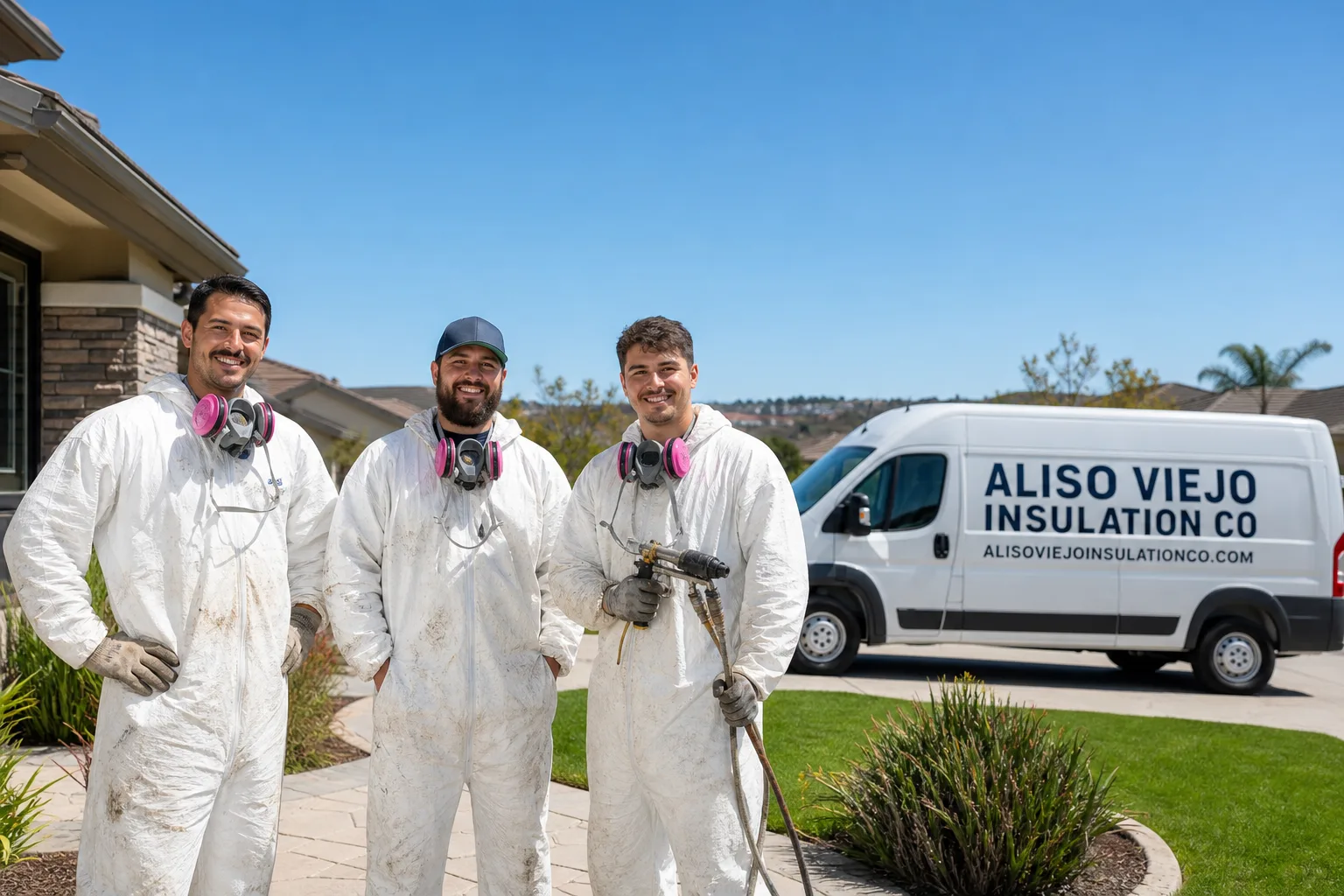
Our crews know the 92240 and 92241 housing stock: mid-century ranches, 1980s – 2000s single-family homes, and a large share of manufactured homes, most with original builder-grade R-11 batts and attics that were never upgraded for cooling loads. We schedule Desert Hot Springs jobs in one trip where possible. Nate Calloway runs our insulation division and makes sure every Desert Hot Springs job gets a tech who understands pass-wind grit and 160°F attic conditions before they ever set foot in your attic. We’re not guessing. We’ve seen these attics.
Attic Insulation Removal in Desert Hot Springs
Attic Insulation Removal in Desert Hot Springs usually means pulling out old, dust-clogged fiberglass batts that have sagged away from the ceiling line and stopped doing their job. The telltale in 92240 and 92241 is batts that look intact but feel dense and gritty when handled. Pass wind forces fine desert dust through unsealed penetrations, and after a decade or two, the batts are caked. You can’t top up over compromised material. Removal comes first, then sealing, then new insulation suited to cooling-load performance.
A typical removal job in Desert Hot Springs runs $1.20 – $2.50 per square foot depending on attic access, depth, and whether there’s vermiculite or other contamination to handle. A 1,500-square-foot attic often lands between $1,800 and $3,700. That includes bagging, extraction, and cleanup. It does not include sealing or new insulation, which we scope separately so you know exactly what you’re paying for.
When Removal Makes Sense
If your home was built before 1990 and the attic has never been touched, the original batts are almost certainly R-11 or less, compressed, and dust-clogged. Removal is the right call. It’s also necessary when there’s rodent activity, water staining from a past roof leak, or when you’re switching to spray foam and need a clean deck to bond to.
One-Trip Removal and Replacement
We plan most Desert Hot Springs removals as single-trip jobs. The crew pulls old material in the morning, air-seals top plates and penetrations midday, and blows or installs new insulation before they leave. Pass wind doesn’t wait, and an open attic is an invitation for more grit. You want the new material in before the next wind event pushes more dust into your ceiling plane.
Insulation Contractors in Desert Hot Springs
Insulation Contractors in Desert Hot Springs should know the difference between a heating-load problem and a cooling-load problem. Desert Hot Springs is overwhelmingly a cooling-load market. Winter nights dip near freezing, but the dominant challenge is stopping 105 – 110°F summer heat from radiating through the roof deck into living space. A contractor who learned their trade in coastal Southern California will often spec R-38 fiberglass and call it done. In this climate, that’s half the answer. The other half is sealing, venting, and in many cases a radiant barrier under the roof deck.
We’ve been called to Desert Hot Springs attics where a previous contractor blew R-38 over unsealed duct boots and top plates. The homeowner saw almost no change in cooling costs because hot air and grit were moving through the ceiling plane regardless of what sat on top of it. That’s not an insulation failure. That’s a sealing failure. We fix both. Our approach with any Desert Hot Springs job is to treat the attic as a system: seal first, vent correctly, then insulate.
What We Look For First
We start with the ceiling plane. In 92240 and 92241 homes, the most common problem is unsealed top plates, wire penetrations, and duct boots. San Gorgonio Pass wind is persistent. It drives fine dust and superheated air through any opening. Sealing those gaps with foam or caulk costs a few hundred dollars and does more for comfort than adding R-10 in many cases.
Choosing the Right Material
For a vented stucco ranch, blown cellulose like GreenFiber works well because it settles into irregular cavities and resists air movement better than fiberglass batts. For a manufactured home with limited attic depth, closed-cell spray foam from Demilec can deliver high R-value in a thin profile and air-seal in the same pass. For fire resistance near can lights or furnace flues, Rockwool mineral wool is the right call. We carry all three categories, so the recommendation matches your attic, not our truck.
Trusted Brands We Service in Desert Hot Springs
We’re authorized to install products from eight manufacturers: Owens Corning, Johns Manville, Knauf, Rockwool, CertainTeed, Icynene, Demilec, and GreenFiber. For Desert Hot Springs homeowners, the names that matter most are usually Rockwool (fire resistance and sound attenuation), GreenFiber (recycled cellulose that settles well in irregular attic cavities), and Demilec or Icynene (closed-cell and open-cell spray foam for sealing and thin-profile R-value). We keep these materials in stock for 92240 and 92241 jobs, so scheduling doesn’t stall waiting on a distributor. If your job calls for John Manville fiberglass or Knauf batts, we’ll have those ready too. The point is we don’t make your attic fit one brand, our Attic Insulation team matches the brand to your attic’s actual conditions.
Common Attic Insulation Problems We See in Desert Hot Springs Homes
- Dust-clogged builder batts. Original R-11 fiberglass in 1980s stucco homes and manufactured units reads far below its stamped R-value after years of pass wind pushing grit through unsealed gaps. The batts look fine from the hatch. They’re not.
- Attic temps above 160°F. With no radiant barrier and poor ridge/soffit balance, heat gain overwhelms whatever R-value is already up there. Cooling bills stay high no matter what you do to the thermostat.
- Unsealed ceiling penetrations. Top plates, wire drops, and duct boots left open let hot air and fine dust move straight into the living space. This is the single most common fixable problem we find in 92240 attics.
- Sagged, compressed batts over duct runs. After a summer of 110°F days, fiberglass pulls away from the ceiling line and collapses around ducts. The gap becomes a thermal bypass, and the air you paid to cool warms up on its way to the register.
Pricing for Attic Insulation in Desert Hot Springs, CA
Attic insulation in Desert Hot Springs prices out differently than coastal markets because sealing and cooling-load performance drive the scope. A basic top-up of blown cellulose over existing, still-viable batts in a 1,500-square-foot attic runs $1,500 – $2,800. Full removal of old builder batts, air-sealing, and new blown-in cellulose runs $3,500 – $6,500 depending on attic size and access. Adding a radiant barrier under the roof deck adds $1,200 – $2,200 for a typical single-story ranch. Closed-cell spray foam in a manufactured home with limited attic depth runs $4,500 – $8,000. Those are real Desert Hot Springs ranges, not national averages. Call (877) 352-4780 for a free estimate. We’ll measure, inspect, and give you a written number before any work starts.
We Also Serve Cities Near Desert Hot Springs
Our crews cover the surrounding desert communities, including Desert Edge, Sky Valley, Garnet, and Thousand Palms. If you’re in Desert Hot Springs proper or one of the unincorporated pockets nearby, we’ll schedule you the same way: one trip, done right, with the right material. Call (877) 352-4780 to check availability in your area.
Serving Desert Hot Springs, CA — Our Local Coverage Area
We’re based in the Desert Hot Springs area and know this community well. Use the map below to see our service coverage — if you’re nearby, we can almost certainly help.
FAQs About Attic Insulation in Desert Hot Springs
It’s not your imagination. San Gorgonio Pass wind forces fine desert grit through unsealed penetrations in your ceiling plane, and that dust loads into fiberglass batts, compressing them and destroying their R-value. Attic temps above 160°F accelerate the breakdown. Most Desert Hot Springs homes built before 2000 have original builder batts that are now reading far below their stamped R-value. The fix is removal, air-sealing, and new material spec’d for cooling load. Call (877) 352-4780 for an attic inspection and we’ll tell you exactly what condition yours is in.
Yes. Desert Hot Springs is a cooling-load market. Summer highs over 105°F and intense UV mean heat gain through the roof is the dominant problem, not winter heat loss. That changes the materials we recommend. Blown cellulose for irregular cavities, closed-cell foam for thin profiles, and radiant barrier under the roof deck when attic temps spike above 150°F. A heating-first insulation plan will leave you hot and paying for it. We spec every Desert Hot Springs job for the cooling season.
In most cases, yes. Removal of old builder batts, air-sealing of top plates and penetrations, and installation of new insulation can usually be completed in a single day for a typical 92240 or 92241 single-family home. Manufactured homes with tight access may take a second morning. We plan the job so your attic isn’t left open to pass wind longer than necessary. Call (877) 352-4780 to get a timeline for your specific address.
We install from eight manufacturers: Owens Corning, Johns Manville, Knauf, Rockwool, CertainTeed, Icynene, Demilec, and GreenFiber. For Desert Hot Springs specifically, we lean on GreenFiber cellulose for blown-in applications, Demilec and Icynene for spray foam, and Rockwool mineral wool where fire resistance or sound attenuation matters. The brand follows the building science, not the other way around.
Yes, and it’s one of the most common jobs we do in 92241. Manufactured homes often have shallow attic cavities and original R-11 batts that were marginal when new. The challenge is limited depth, which makes closed-cell spray foam from Demilec or Icynene a good fit. It delivers high R-value in a thin profile and air-seals in the same pass. We’ve upgraded dozens of manufactured homes in Desert Hot Springs and can show you what’s possible in yours. Free estimates – call (877) 352-4780.
One Trip, Done Right
On a low-slung stucco ranch off Hacienda Road in 92240, our tech pulled original R-11 batts that had collapsed around the duct runs and found grit packed into every top-plate gap left by the pass wind. We air-sealed the ceiling plane, baffled the soffits for venting, and blew GreenFiber to a deep cooling-load R-value with a radiant-barrier layer under the roof deck, restoring the attic in one trip. That’s the standard we bring to every Desert Hot Springs job. Sealing before topping up. The right material for the heat. One trip, no dangling follow-ups.
If your cooling bills have crept up and you suspect your attic is the problem, call us. We’ll inspect, explain what we find in plain language, and give you a written estimate. No pressure, no brand pushing. Just the right insulation for a desert attic. Call (877) 352-4780 today.
Written by Nate Calloway, Owner at Aliso Viejo Insulation Co, serving Desert Hot Springs and the Coachella Valley.