
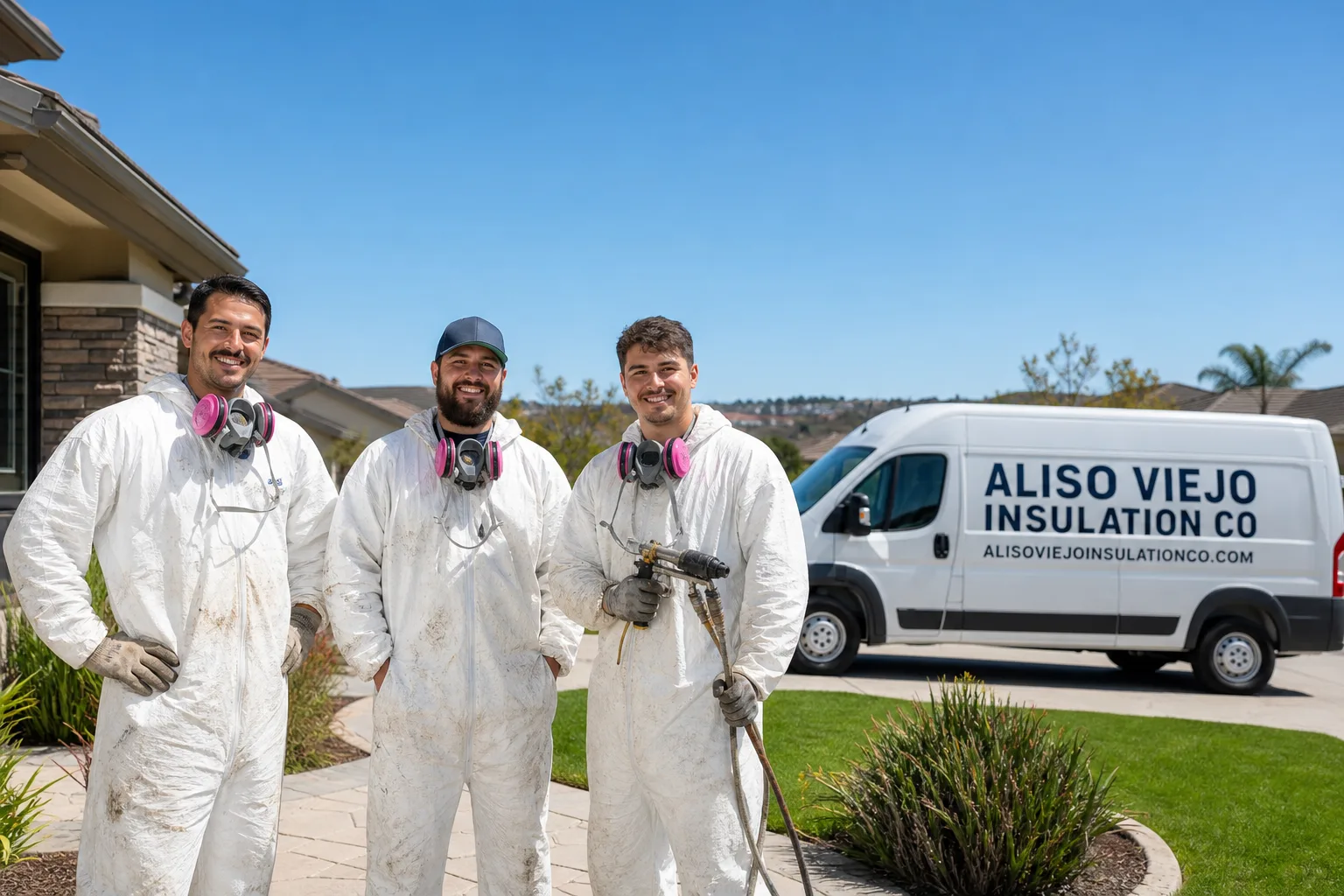
Fast, Reliable Attic Insulation Across Topanga
Attic insulation in Topanga typically costs $2,400 – $6,800 depending on whether you need blown-in fiberglass, batts, or a full thermal envelope upgrade with air sealing. Most jobs take one to two days once we’ve assessed the existing cavity. If you’re wondering whether your canyon home’s attic is the reason your upstairs rooms bake in August and freeze in January, call us at (877) 352-4780. We know Topanga’s housing stock well, and we’ll give you a straight answer about what’s actually going on up there.
Topanga isn’t tract housing. The homes here were built by hand, often without permits, and the attics reflect that. We’ve worked in cabins off Saddle Peak Road, remodels above Topanga Canyon Boulevard, and converted outbuildings near Fernwood Pacific Drive. The insulation questions in Topanga start with the building itself, not a product catalog. That’s the job we do.
Why Aliso Viejo Insulation Co Is Topanga’s Attic Insulation Contractor of Choice
Nate Calloway built this company around a simple principle: install the material the house needs, not the one the truck happens to carry. That matters more in Topanga than almost anywhere else in Los Angeles County. We source from eight manufacturers, Owens Corning, Johns Manville, Knauf, Rockwool, CertainTeed, Icynene, Demilec, and GreenFiber, because a hand-built cedar cabin with irregular framing needs different insulation than a 1960s ranch with standard truss spacing.
Homeowners across Topanga reach out to us for the same reason. They’ve had contractors tell them spray foam is the only answer, or that fiberglass is dead, and they want someone who isn’t tied to one brand. Our Attic Insulation team works across the full spectrum, blown-in, batts, and both open-cell and closed-cell spray foam. We don’t push. We measure the cavity, figure out the ventilation situation, account for the fire hazard zone requirements, and recommend accordingly.
Response time to Topanga runs same-day for assessments in most cases, and we schedule installation within the week whenever material availability allows. We carry attic insulation supplies sized for Topanga’s older framing depths, so we aren’t running back down the canyon mid-job. That’s the kind of local operational detail that doesn’t show up in a corporate brochure, but it’s why jobs finish on schedule.
Attic Ventilation in Topanga
Attic ventilation in Topanga carries a set of requirements that most other cities never have to think about. This area sits inside a Very High Fire Hazard Severity Zone, which means standard soffit and foundation vents can become ember entry points during a wildfire event. When we add insulation to a Topanga attic, we’re looking at whether the existing vents meet WUI-approved ember-resistant standards, and if they don’t, the insulation work can’t proceed responsibly without addressing them.
The job itself involves evaluating existing vent placement, calculating net-free vent area against attic square footage, and replacing undersized or non-compliant vents before insulation goes in. That sequencing matters. Adding a thick layer of blown-in insulation to an attic with blocked or inadequate airflow is a recipe for moisture buildup, deck rot, and reduced insulation performance within a few years. In Topanga, where canyon winds and inland heat already stress roof assemblies, ventilation isn’t optional.
Signs your Topanga attic is under-ventilated
Bathroom exhaust fans that drip condensation in winter, even with the fan running, are a classic sign of trapped moisture. Hot ceiling surfaces in upstairs rooms during summer evenings, long after outdoor temperatures drop, indicate heat is sitting in the attic instead of escaping. Both are common in Topanga’s older cabins and additions, where original owners often closed off vents during remodels without understanding what they were doing to the assembly.
What ventilation remediation costs
Replacing standard soffit vents with WUI-approved ember-resistant designs on a typical Topanga cabin runs $900 – $2,200 depending on linear footage and access. Adding a ridge vent or powered attic ventilator, when the roof geometry allows it, typically adds $600 – $1,500. We include ventilation assessment in every attic insulation estimate, so you’ll know before any work starts whether the $2,400 – $6,800 figure for insulation needs a vent line item added.
Radiant Barrier in Topanga
Radiant barrier installation in Topanga answers a specific problem: attic temperatures that climb past measurable comfort levels during inland heat waves from May through October, radiating down through ceilings and forcing you to run AC harder than the home’s square footage should require. Radiant barrier is a reflective foil material stapled to the underside of roof rafters. It reflects radiant heat before it can transfer into the attic airspace.
For Topanga specifically, a radiant barrier makes sense when the roof deck gets direct sun exposure without significant tree canopy. Homes along exposed ridgelines above Old Topanga Canyon Road or on south-facing slopes off Saddle Peak gain more from this than heavily shaded creekside properties. We assess sun exposure during the estimate, because installing a radiant barrier in a fully shaded canyon home delivers marginal benefit and isn’t an honest recommendation.
Adding a barrier to older exposed framing
Topanga’s older attics often have exposed rafter framing, which is actually the ideal setup for radiant barrier. We staple the foil across the rafter faces, maintaining a small air gap that the reflective surface needs to function. In attics with cathedral ceilings or very confined rafter bays, closed-cell spray foam may accomplish more thermal protection than a foil layer. This is exactly where having multiple methods available shapes the recommendation.
Radiant barrier cost ranges
A radiant barrier install in a Topanga attic with standard rafter spacing runs $1,800 – $3,500 depending on attic square footage and access difficulty. When combined with attic insulation replacement or top-up, the marginal cost often drops because we’re already working in the space and the team is on site. That combined approach is where Topanga homeowners tend to see the best return.
Trusted Brands We Service in Topanga
We install materials from Owens Corning, Johns Manville, and Knauf for fiberglass applications, plus GreenFiber recycled cellulose when a Topanga homeowner wants an eco-forward option with good fire resistance. Because we’re authorized across multiple manufacturers, you aren’t locked into whatever one distributor has in stock. For Topanga jobs, we keep common R-30 and R-38 batts and blown-in bags stocked locally, which means fewer delays for material runs down to the valley. If a job calls for Rockwool mineral wool for its fire rating, which makes real sense in a Very High Fire Hazard Severity Zone, we can source it without switching contractors.
Common Attic Insulation Problems We See in Topanga Homes
- Standard vents left in place during prior insulation work. A previous owner or contractor blew in insulation but never addressed the open soffit vents. In Topanga’s fire zone, those vents are ember pathways, and any new insulation installed without fixing them compounds the risk. We flag this on nearly every older assessment.
- Unpermitted cavity assemblies with unknown framing. Yurt walls, converted garages, and additions tacked on decades ago don’t have permit files describing what’s inside the wall or attic cavity. We use cavity inspection before recommending any insulation type, because the wrong material in a nonstandard depth wastes money and performs poorly.
- Batt insulation pushed against wood siding with no air sealing. Older Topanga cabins often have batts crammed between exposed framing members directly against exterior sheathing. Without air sealing, canyon wind moves through those gaps and defeats the thermal performance entirely. The insulation looks fine from the hatch, but it isn’t doing its job.
- Old, compressed insulation under heavy roof deck heat. Years of inland summer heat degrade fiberglass batt loft and R-value. When we pull old material and find it flattened to half its original thickness, the homeowner is effectively running with half the insulation they think they have.
Pricing for Attic Insulation in Topanga, CA
A basic blown-in attic insulation top-up in Topanga runs $2,400 – $3,800 for a typical 1,200 – 1,800 square foot attic. Full attic insulation replacement, including removal of old material, air sealing, and new blown-in fiberglass, lands between $3,800 and $5,400. If the job includes WUI vent replacement, radiant barrier, or closed-cell spray foam on the roof deck, expect $5,400 – $6,800 or more depending on scope. What moves the number most in Topanga is the condition of the existing assembly, not the square footage alone. Irregular cavities, unpermitted framing, and vent remediation all add labor. Estimates are free, and we’ll walk you through the actual condition of your attic before you commit to anything. Call (877) 352-4780 to schedule.
We Also Serve Cities Near Topanga
Our team works throughout Topanga and the surrounding canyon and valley communities. If you’re in Encino, Santa Monica, Northridge, or Sherman Oaks and need attic insulation assessed or replaced, we bring the same eight-brand, building-science-first approach to your project. Canyon homes and valley tract houses have different needs, and we adjust accordingly. Give us a call at (877) 352-4780 and we’ll schedule a walkthrough.
Serving Topanga, CA — Our Local Coverage Area
We’re based in the Topanga area and know this community well. Use the map below to see our service coverage — if you’re nearby, we can almost certainly help.
FAQs About Attic Insulation in Topanga
In many Topanga homes, yes. Topanga is in a Very High Fire Hazard Severity Zone, and standard soffit or foundation vents do not meet current WUI ember-resistant requirements. If your vents are the older open style, we recommend replacing them before or during insulation work. Adding insulation behind non-compliant vents can increase fire vulnerability instead of reducing it. We’ll assess your specific vents during the estimate, and the replacement cost is itemized separately so you know exactly what you’re paying for. Call (877) 352-4780 to have us look at your attic vents.
Yes, and this is actually one of the most common scenarios we handle in Topanga. With no permit file describing the framing, we start with a cavity inspection to determine what’s actually inside the walls and attic before recommending any insulation. The key is matching the insulation method to what the structure actually is, not what a standard home would have. Irregular cavities in yurt walls or converted outbuildings often need blown-in insulation rather than batts, because it fills nonstandard depths evenly. We’ve worked on dozens of unpermitted Topanga structures, and we’ll give you a straight assessment of what’s possible.
Yes. Topanga’s inland canyon heat pushes attic temperatures into the 140°F range during summer, while winter nights in the Santa Monica Mountains drop low enough that heating demand is real. Proper attic insulation addresses both directions of thermal transfer: keeping heat out during the day and keeping heat in at night. The dual seasonal load is also why air sealing matters so much here. Without it, canyon wind moves through gaps and defeats the insulation’s performance regardless of R-value. A sealed, insulated attic handles both ends of Topanga’s temperature swings.
We install Owens Corning, Johns Manville, and Knauf fiberglass products, plus GreenFiber recycled cellulose. For spray foam applications, we’re authorized with Icynene and Demilec. For Topanga specifically, many homeowners request Rockwool mineral wool because of its fire resistance, which makes legitimate sense in a Very High Fire Hazard Severity Zone. The brand choice should follow the building’s needs and your priorities, not our inventory, and we’re set up to make that recommendation objectively.
Yes, exposed rafter framing is actually well-suited to radiant barrier installation. We staple the reflective foil across the rafter faces with an air gap that allows the reflective surface to work properly. Older Topanga attics with open framing are often easier to retrofit than newer truss systems, because we don’t have to work around complex webbing. If your attic has cathedral ceilings or very tight rafter bays, we may recommend closed-cell spray foam instead, and we’ll explain why during the on-site assessment. Call (877) 352-4780 for a free estimate on radiant barrier or full attic insulation in Topanga.
Written by Nate Calloway, Owner at Aliso Viejo Insulation Co, serving Topanga and the surrounding canyon communities.