
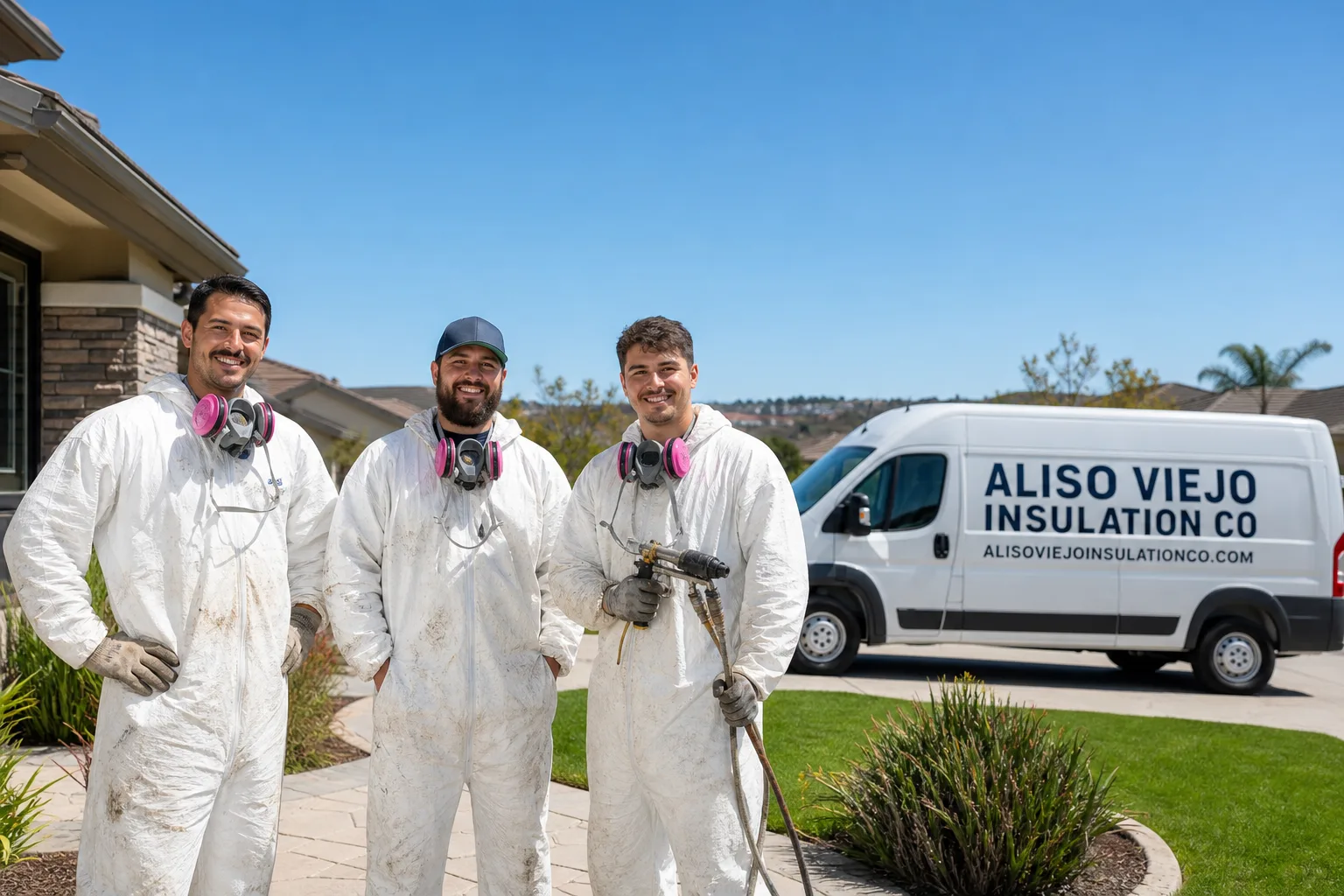
Fast, Reliable Spray Foam Insulation Across Downey
Spray foam insulation in Downey typically costs $1.80 – $3.60 per board foot for open-cell and $2.50 – $5.50 for closed-cell, with most whole-attic retrofits landing between $4,800 and $9,600 depending on square footage and existing conditions. Most jobs are completed in one day once our crew is on site. Our team knows Downey’s housing stock well: the 1950s tract homes off Lakewood Boulevard, the ranches near Stonewood Center, and the newer infill construction in the northeast corner of town. We answer the phone at (877) 352-4780 and schedule free attic assessments throughout 90239, 90240, 90241, and 90242.
Why Aliso Viejo Insulation Co Is Downey’s Preferred Spray Foam Insulation Company
Downey homeowners keep calling us back because we diagnose the actual thermal problem before recommending a product. We’re material-agnostic: we install eight manufacturer brands spanning fiberglass, mineral wool, cellulose, and both open- and closed-cell spray foam, so the recommendation is driven by building science, not inventory. Built around building science, not brand loyalty. In Downey, that means we often recommend different foam chemistry for a shallow-heel 1950s attic near downtown than we would for a 2005 infill home in the northeast ZIP codes. The right insulation for your home’s specific conditions, every time.
Nate Calloway, who leads our crews, has walked hundreds of attics across the LA Basin and knows exactly what Downey’s mid-century framing looks like before the ladder even goes up. Our teams arrive in fully stocked trucks, so the job happens in one visit unless we discover something structural that warrants a follow-up conversation. Spray foam, blown-in, or attic batts, we install all three because not every home needs the same answer.
Closed Cell Spray Foam Insulation in Downey
Closed Cell Spray Foam Insulation in Downey is the product we reach for most often on the city’s original tract homes because it delivers R-6.5 to R-7 per inch, adds structural rigidity to aging framing, and acts as an air and vapor barrier in a single application. That matters here because so many postwar attics have shallow heel heights that can’t hold enough open-cell to hit code without foaming over the roof deck. A typical closed-cell retrofit in a Downey 3-bed/2-bath ranch runs $5,500 – $9,000 depending on attic geometry and access.
Shallow-Heel Attic Retrofits
In Downey’s 1950s ranches off Florence Avenue and Telegraph Road, the roof pitch often leaves less than 18 inches of clearance at the eaves. Closed-cell foam applied at 2 to 3 inches stays within that shallow heel height while still sealing the thermal envelope. The same R-value in open-cell would eat twice the depth and risk condensation where the foam meets the roof deck.
Air Sealing in Older Framing
Original 2×4 ceiling joists spaced 24 inches apart are common across Downey’s 90240 – 90242 neighborhoods. Closed-cell foam fills those cavities and bonds to the framing, cutting the air leaks that let furnace-season heat escape and AC-season attic heat bleed into living space. For homes with knob-and-tube wiring near downtown, we always inspect and coordinate electrical clearance before spraying.
Open Cell Spray Foam in Downey
Open Cell Spray Foam in Downey is a smart choice when attic depth allows a thicker application and the priority is sound control and air sealing at roughly half the material cost of closed-cell. Open-cell runs 25 – 35 percent less per board foot, so a full attic spray on a larger Downey home might land closer to $4,200 – $6,800. It’s not a vapor barrier, which actually works in its favor in certain LA Basin retrofit scenarios where the wall assembly needs to dry toward the interior.
Second-Story Temperature Control
Downey’s warm, smoggy summers push attic temperatures past 140°F on August afternoons. Open-cell foam on the underside of the roof deck keeps that heat from radiating down through ceiling joists into upstairs bedrooms. We’ve measured 15 – 20°F upstairs reductions after retrofit, especially in unshaded homes along the major arterials.
Sound Dampening Between Floors
Older Downey tract homes have almost zero airborne sound isolation between the first and second floors. Open-cell foam’s porous structure absorbs noise better than closed-cell or fiberglass batts. For homeowners near Firestone Boulevard or the 105 corridor, that means road noise drops noticeably too.
Trusted Brands We Service in Downey
We’re authorized to install spray foam from Icynene and Demilec, two of the industry’s leading closed- and open-cell systems, plus fiberglass from Johns Manville and CertainTeed, and mineral wool from Rockwool when a Downey homeowner wants added fire resistance or sound attenuation. Because we carry eight manufacturer lines total, you get one objective recommendation rather than whatever’s on the truck. From Owens Corning fiberglass to Icynene spray foam, we carry the full spectrum so you don’t have to compromise. We keep both Icynene and Demilec foam systems stocked and ready for Downey jobs, which means most estimates turn into installs within the same week.
Common Spray Foam Insulation Problems We See in Downey Homes
- Foamed-over recessed can lights: Downey’s original attics are full of non-IC-rated can lights. When spray foam buries them without baffling, heat builds inside the fixture and can trip the thermal cutoff or damage wiring. We baffle and air-seal around every can before spraying, a step cheap installers skip.
- Open-cell in shallow-heel attics: Some contractors sell open-cell foam because it’s cheaper, then realize the required R-value won’t fit the heel height. That leaves the roof deck exposed and creates condensation risk in Downey’s warm season. We specify closed-cell in those attics for a reason.
- Clogged slatted attic vents: The original slatted vents on 1950s Downey homes are easily blocked by careless foam overspray. Once ventilation is compromised, attic humidity climbs and the LA Basin’s summer heat turns the space into a sauna. We mask and protect every vent before we spray.
- Ignoring knob-and-tube wiring: The oldest pockets of downtown Downey still have active knob-and-tube circuits in attic cavities. Spray foam over live K&T wiring is both dangerous and against code in many LA County jurisdictions. We identify and address electrical clearance with the homeowner before any foam goes down.
Pricing for Spray Foam Insulation in Downey, CA
Here’s what Downey homeowners can expect to pay in 2026:
- Open-cell attic spray, 1,000 sq ft: $3,800 – $5,200
- Closed-cell attic spray, 1,000 sq ft: $5,800 – $7,400
- Rim joist spray foam (crawlspace or garage rim): $900 – $1,800
- Garage ceiling spray foam (finished garage under living space): $1,200 – $2,600
- Rafter bay air sealing with foam (punctual, not full spray): $600 – $1,500
What moves the number: access (a low-slope roof with 18 inches of clearance costs more than a walkable attic), existing insulation removal, can-light baffling count, and whether the attic has knob-and-tube wiring that needs an electrician’s sign-off. Estimates are free, and we give you a written quote before any work is scheduled. Call (877) 352-4780 to book one.
We Also Serve Cities Near Downey
Our Spray Foam Insulation crews cover the full Downey area plus Bell Gardens, Santa Fe Springs, Paramount, and Pico Rivera. If you’re browsing Spray Foam Insulation in Downey but live just over a city line, call anyway, we’re likely already working your street next week. Most of the mid-century tract homes in those neighboring cities share the same attic geometry and heat-load problems we see in Downey every week.
Serving Downey, CA — Our Local Coverage Area
We’re based in the Downey area and know this community well. Use the map below to see our service coverage — if you’re nearby, we can almost certainly help.
FAQs About Spray Foam Insulation in Downey
Yes, and in fact closed-cell foam is the only spray-foam option that reliably works in those attics. Because Downey’s postwar tract homes often have such a shallow heel height, our crews frequently switch from open-cell to closed-cell just to hit R-value without foaming over the roof deck, a workaround rarely needed in newer Inland Empire construction. A 2-inch lift of closed-cell fits within the available depth and still seals the envelope. Call (877) 352-4780 for an on-site assessment of your specific attic.
Spray foam directly addresses the two mechanisms causing that heat gain: radiant transfer through the roof deck and air leakage around ceiling penetrations. Downey sits in the warm, smoggy LA Basin with long dry summers that push attic temperatures past 140°F. Foam on the roofline keeps that heat out of the conditioned space and reduces the cooling load on your AC. In a 1950s ranch off Florence Avenue near downtown Downey, our techs found original 2×4 ceiling joists with old slats and recessed can lights poking through. The homeowner complained of 95°F upstairs rooms by noon, so we baffled and air-sealed around each can, then applied Icynene closed-cell foam at a thin 2-inch lift to stay within the shallow heel height. The next week’s heat wave had the second floor holding 78°F with the AC cycling half as often. That’s the kind of result we work for.
It can be, but only after the wiring has been assessed and cleared or replaced. Spray foam over active knob-and-tube circuits is a fire hazard because the foam traps heat around conductors designed to dissipate into open air. In Downey’s oldest pockets near downtown, we often coordinate with a licensed electrician before foam goes into any cavity containing K&T. If the wiring has been decommissioned or replaced, closed-cell foam can be applied safely around the abandoned remnants. We don’t spray over live knob-and-tube, period.
Yes. Our crews work out of smaller-footprint setups than many full-size insulation teams, and we’re used to alley-load homes and tight parking across Downey’s denser neighborhoods. We typically need one vehicle bay or a clear alley easement for the duration of the job, usually four to six hours for a standard attic. If parking is the limiting factor, we’ll schedule early-arrival slots to beat street sweeping so the job doesn’t stall. Call ahead and we’ll plan access with you before we show up.
Open-cell makes sense when the attic has sufficient depth to hold the needed thickness, the budget is tight, and air sealing and sound control matter more than structural reinforcement. It runs roughly 25 – 35 percent less than closed-cell per board foot and is an excellent sound barrier, which matters on busy streets like Firestone Boulevard or near the 105. But open-cell is not a vapor barrier, so in shallow-heel Downey attics where condensation is a real risk, we specify closed-cell instead. The call depends on your roof geometry, existing insulation, and ventilation, and we’ll walk you through it honestly. Estimates are free at (877) 352-4780.
Schedule Your Free Spray Foam Assessment in Downey
If your Downey home still has original insulation, or none at all, the problem isn’t going to fix itself. Nate Calloway and our crews are familiar with every roof pitch, framing style, and access quirk in the 90239 – 90242 ZIP codes. We’ll assess your attic, take measurements, and give you a written quote with the exact foam chemistry and depth we recommend. Call (877) 352-4780 to schedule. Free estimates, no obligation, and we’ll tell you straight what your home actually needs.
Written by Nate Calloway, Owner at Aliso Viejo Insulation Co, serving Downey and the surrounding LA Basin since day one.