
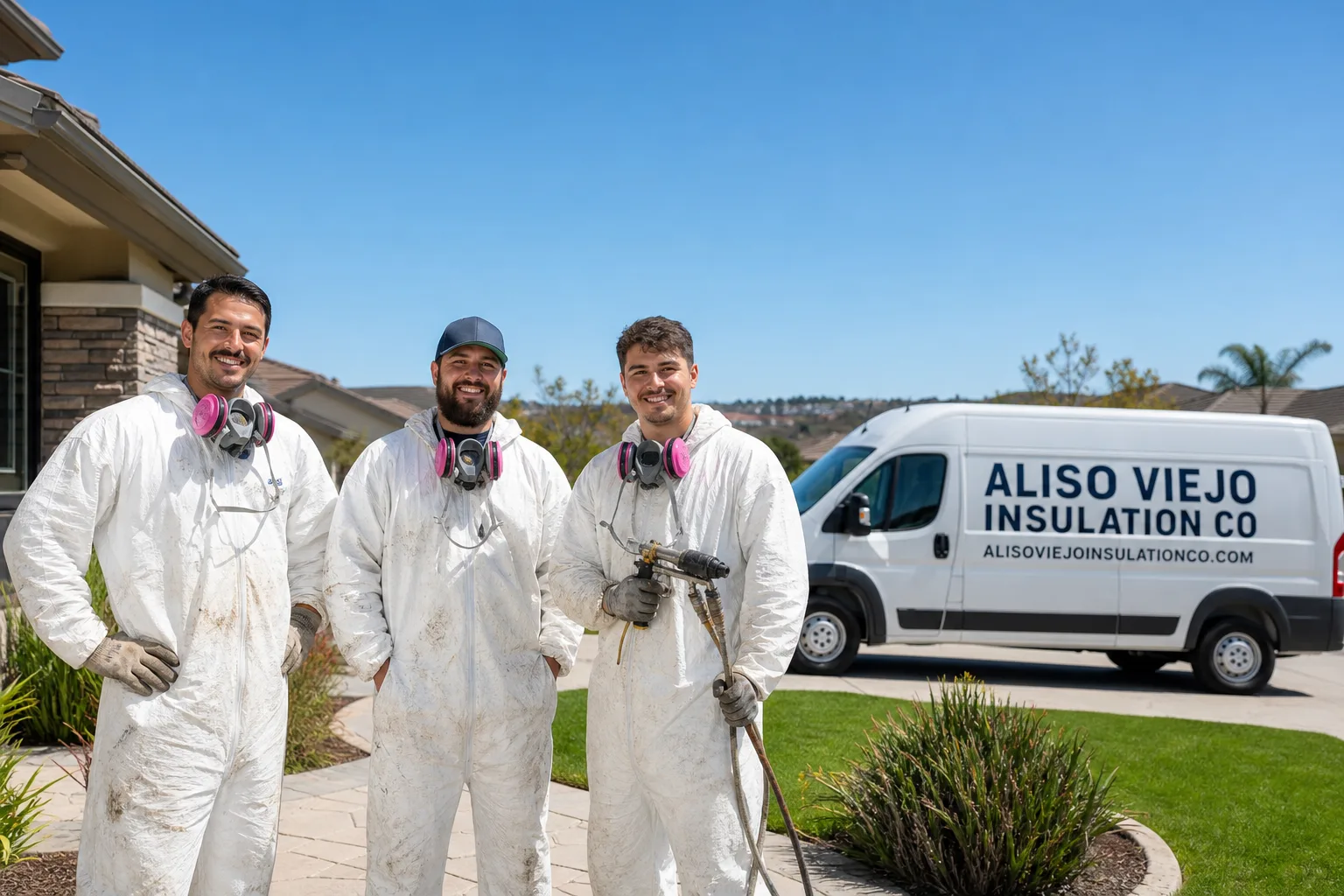
Fast, Reliable Spray Foam Insulation Across Eastvale
Spray foam insulation in Eastvale typically costs $2.50 to $6.50 per square foot installed, with most garage ceiling jobs landing between $1,800 and $4,200 depending on open-cell versus closed-cell chemistry and square footage. We run crews into Eastvale every week, usually within 48 hours of your call. If you’re fighting a bedroom above the garage that won’t hold temperature during a 100°F Inland Empire afternoon, the problem is rarely your HVAC. It’s the builder-grade insulation package your Eastvale home came with, and we can fix it. Call (877) 352-4780 for a free estimate.
The homes out here were built fast, between roughly 2000 and 2020, and almost all of them share the same original attic package: code-minimum blown fiberglass that has now settled, compacted, and stopped doing its job. When we pull back the insulation over an attached garage in Eastvale, we see the same thing block after block. That’s why we know exactly what your house needs before we even climb the ladder.
Why Aliso Viejo Insulation Co Is Eastvale’s Preferred Spray Foam Insulation Company
We’re the contractor Eastvale homeowners call when the first company that came out tried to sell them one product and one product only. That’s not how we work. We source from eight manufacturers – Owens Corning, Johns Manville, Knauf, Rockwool, CertainTeed, Icynene, Demilec, and GreenFiber – so the recommendation you get matches your house, not our inventory. For spray foam specifically, we install both Icynene and Demilec systems, which means we can pair open-cell or closed-cell chemistry to the exact conditions in your attic, garage ceiling, or rim joist.
Our crews know the Eastvale housing stock intimately. Near the 15/91 interchange and through the tracts off Archibald and Schleisman, it’s the same story: two-story production builds, attached garages, wood-frame construction, and original attic insulation that hasn’t been touched since the day the builder’s sub walked off. When you’ve worked on dozens of the same model home, you learn where the leaks are before you even open the attic hatch. That local knowledge means faster diagnostics and a tighter scope of work. No guessing, no padding the quote.
Garage Spray Foam Insulation in Eastvale
Garage Spray Foam Insulation in Eastvale is, in our experience, the single highest-impact upgrade for these production-built homes, because the attached garage is where the thermal envelope almost always fails first. The builder framed the garage, hung drywall, and moved on. Nobody air-sealed the top plates. Nobody addressed the massive heat bridge between the unconditioned attic and the garage ceiling. The result: superheated air bleeding down into the garage all afternoon, then radiating into the bedroom above it all night. In Eastvale, where summer highs routinely top 100°F and the attic can spike to 140°F or more, this is not a minor comfort issue. It’s a measurable energy drain.
Where the Heat Gets In
The biggest culprit we find in Eastvale garages is the open top plate. In a code-minimum build, the gap where the wall framing meets the attic floor is just left open, and attic air pours through. Add unsealed electrical penetrations, can light housings, and the chase where the water heater vent passes through, and you’ve got a steady convection current pushing 130°F air into your garage. Closed-cell foam seals every one of these pathways in a single pass.
Typical Garage Ceiling Project
A standard two-car garage ceiling in Eastvale runs roughly 400 to 500 square feet. Closed-cell foam installed to 3 inches – enough to air-seal and hit around R-21 – lands between $2,000 and $3,200. Open-cell foam at 5 to 6 inches is somewhat less per board foot and excels at sound dampening, but it doesn’t offer the same air-sealing strength at the top plate. For Eastvale’s heat, we lean closed-cell on the garage ceiling and the rim joist band, where the temperature differential is most severe.
Closed Cell Spray Foam Insulation in Eastvale
Closed Cell Spray Foam Insulation in Eastvale is the right call for any surface where you need air sealing and thermal resistance in a thin profile, and that describes most of the problem areas in these tract homes. At about R-7 per inch, closed-cell foam stops air movement completely while adding structural rigidity and a Class II vapor retarder. In a climate as dry as Eastvale’s, moisture isn’t your primary concern, but vapor control still matters where conditioned space meets a 140°F attic. Closed-cell keeps that boundary honest.
The Rim Joist Problem
Every Eastvale home with a second story has a rim joist band running around the perimeter between floors, and in most cases, it’s a bare piece of OSB with fiberglass batts stuffed loosely against it, if anything at all. This is a direct leak path from the outside into the wall cavity and up into the attic. Spraying the rim joist with closed-cell foam takes a two-story home from leaky to tight in a single afternoon. A typical rim joist job in Eastvale runs $900 to $1,800 depending on linear footage and access.
When Closed-Cell Is Worth the Premium
Closed-cell costs 30 to 50 percent more than open-cell per board foot. In Eastvale, we recommend it for garage ceilings, rim joists, and any roof deck application where the attic is semi-conditioned or where space is tight. For large open attic floors where you’re simply adding R-value over an existing layer, open-cell or blown options often make more sense on a cost-per-R basis. That’s the material-agnostic approach: match the foam to the job, not the job to the foam.
Trusted Brands We Service in Eastvale
We install Icynene and Demilec spray foam systems, and we stock both open-cell and closed-cell chemistries so a single visit can handle every surface in your thermal envelope. For Eastvale attics where blown fiberglass or cellulose is the better fit, we carry Owens Corning and GreenFiber products, and we regularly recommend Rockwool for garage walls and interior partitions where fire resistance and sound attenuation matter. Because we’re authorized across eight brands, you get an objective recommendation. We don’t push the one foam we happen to stock in the truck. We spec what the building science calls for.
Common Spray Foam Insulation Problems We See in Eastvale Homes
- Settled builder-grade attic insulation over the garage. After 15 to 20 years of Inland Empire heat, that original blown fiberglass has compacted from an R-30 rating to something closer to R-18 or R-20. The garage ceiling turns into a radiant heater pushing into the room above.
- Open top plates and unsealed penetrations at the garage-to-house wall. Production builders didn’t air-seal these seams. Superheated attic air migrates through the open framing, and the garage never drops below ambient attic temperature until well after midnight.
- Degraded radiant-barrier sheathing. Newer eastern Eastvale builds got radiant-barrier roof sheathing from the builder, which worked great for a few years. UV exposure and extreme dry heat degrade the foil over time, and reflectivity drops quietly while homeowners assume it’s still performing.
- Inconsistent attic coverage across the same model home. Because Eastvale blocks went up fast and were insulated by multiple crews, the actual coverage varies wildly, even within the same house. One end of the attic might have 14 inches of blown fiberglass while the other has 6. We map it, measure it, and bring it to spec.
Pricing for Spray Foam Insulation in Eastvale, CA
We Also Serve Cities Near Eastvale
Beyond our regular Eastvale service area, our crews are out weekly in Norco, Home Gardens, Corona, and Jurupa Valley. Many of those neighborhoods share the same production-builder housing stock and the same settled-insulation problems we see across Eastvale, so if you’re nearby and dealing with a hot garage or a bedroom that won’t cool down, we’re already working in your area. The scheduling is usually faster when we’re already on a block nearby.
Serving Eastvale, CA — Our Local Coverage Area
We’re based in the Eastvale area and know this community well. Use the map below to see our service coverage — if you’re nearby, we can almost certainly help.
FAQs About Spray Foam Insulation in Eastvale
My Eastvale home is only about 15 years old – why would it need spray foam already?
Because 15 years is exactly when the builder-grade insulation in most Eastvale production homes starts failing. The original blown fiberglass over your attached garage has been baking in 130°F-plus attic temperatures every summer since the home was built, and that heat cycling causes the material to settle and compact well below its original R-value. Combine that with the unsealed top plates and penetrations that were never addressed at construction, and you have a house that leaks conditioned air from day one. Fifteen years isn’t early. It’s the point where the original package has given back most of what it had.
Can spray foam in the garage help the bedroom above it stay cooler?
Yes, and in Eastvale this is the single most common reason we get called out. The bedroom above an attached garage sits on top of a ceiling cavity that’s been absorbing attic heat all day. Closed-cell foam air-seals the garage ceiling and stops that heat transfer at the source. We’ve had Eastvale homeowners report the room above the garage finally holding temperature through an Inland Empire August after years of running the AC just to keep it tolerable. Not a modest improvement. The difference between an 80°F bedroom and a 74°F one, with the same thermostat setting.
Which brands do you use for spray foam and attic upgrades in Eastvale?
We install Icynene and Demilec spray foam systems, both open-cell and closed-cell chemistries. For blown attic insulation, we carry Owens Corning and GreenFiber products, and we stock Rockwool mineral wool for applications needing fire resistance or sound attenuation. Our position is simple: we’re authorized across eight manufacturer lines because no single brand is right for every Eastvale house. The recommendation comes from the conditions in your attic and garage, not from what happens to be loaded on the truck that week.
Does Eastvale’s dry climate mean I don’t need to worry about spray foam moisture issues?
Eastvale’s aridity does reduce the risk of trapped moisture that coastal homes deal with, but it doesn’t eliminate it. Closed-cell foam acts as a vapor retarder, and any time you’re separating a hot attic from cooler conditioned space, condensation at the boundary layer is a real possibility if the air sealing is incomplete. The bigger concern in Eastvale is thermal, not moisture: the dry heat degrades fiberglass binders and radiant-barrier foil over time, and eventually the insulation stops performing even though it hasn’t gotten wet. Dry climate does not mean maintenance-free.
Is it worth spraying foam if my whole street has the same builder-grade setup?
That’s actually the reason it’s worth doing sooner rather than later. Entire blocks of same-model Eastvale homes hit their insulation failure point at the same time because they were built with identical materials by the same crews at the same pace. On a block of newer eastern tract homes, we pulled back the builder-grade blown insulation over a garage and found it settled well below its stamped R-value, with 100°F attic air bleeding through open top plates into the ceiling below. We air-sealed the seams, sprayed closed-cell along the garage ceiling and rim, and capped the attic with fresh blown to bring the assembly back to spec. The homeowner reported the garage and the room above it holding temperature through the worst stretch of summer. Your neighbors are probably dealing with the same issue right now, whether they’ve connected the dots yet or not.
For a free, line-item estimate on Spray Foam Insulation for your Eastvale home, call (877) 352-4780. We’ll inspect your attic and garage, measure what’s actually up there, and give you a straight recommendation, whether that’s closed-cell spray foam, open-cell, blown-in, or a combination. No pressure, no single-brand push. Just what your house needs.
Written by Nate Calloway, Owner at Aliso Viejo Insulation Co, serving Eastvale and the surrounding Inland Empire communities.