
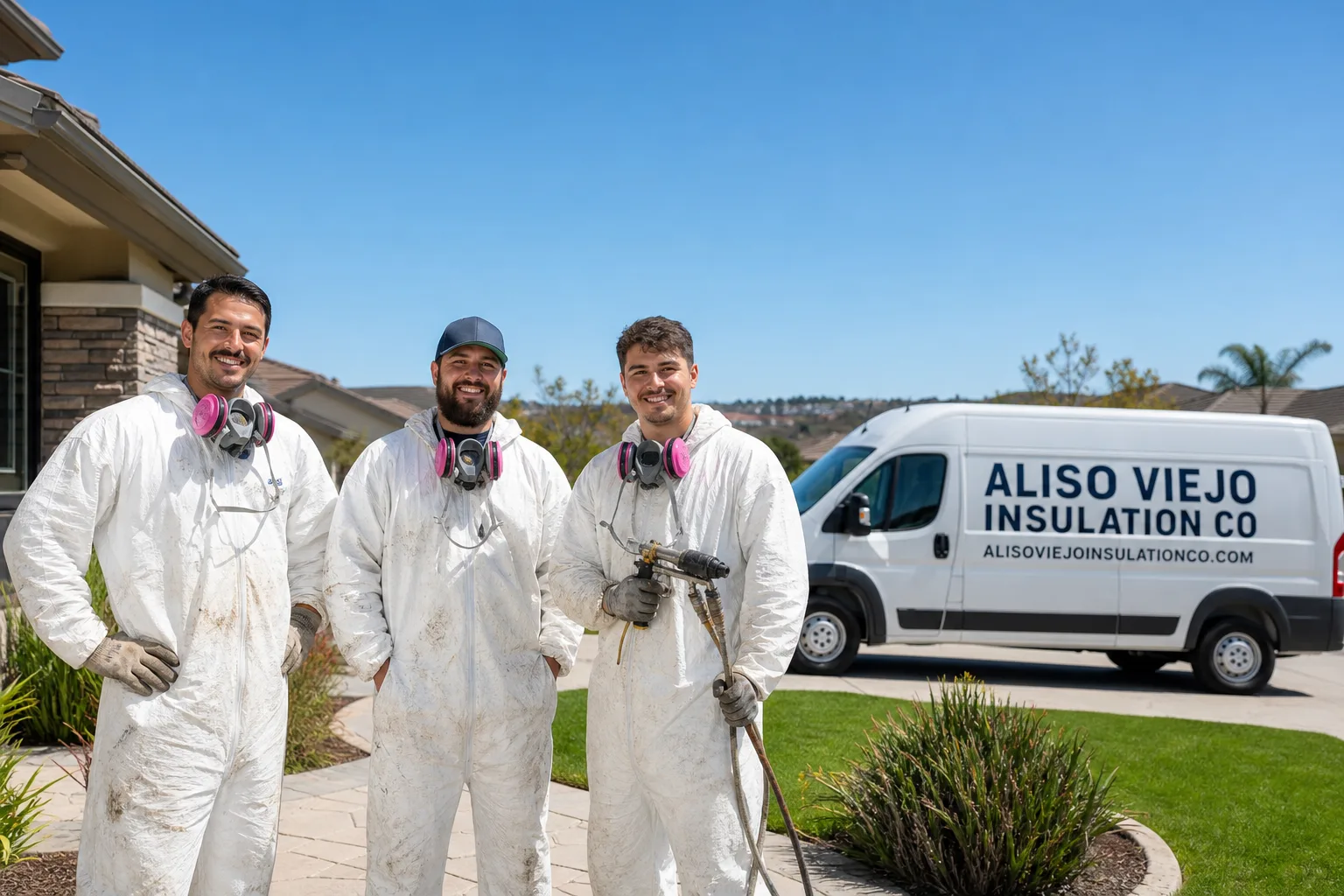
Fast, Reliable Spray Foam Insulation Across Good Hope
Spray foam insulation in Good Hope addresses one thing above all else: a summer attic that hits 140 to 150 degrees and pushes that heat straight down into your living space. In ZIP 92572, near Perris and Moreno Valley, we see mid-century tract homes and rural ranchettes where original R-11 batts have sagged, been tunneled by rodents, and lost half their rated value. That’s not an insulation problem coastal contractors understand. It’s the daily reality of inland Riverside County, and it’s exactly what our crews work with. If your AC runs all afternoon and the house still won’t hold temperature, the attic is usually the culprit. Call (877) 352-4780 and we’ll schedule a look at what’s actually happening above your ceiling.
Why Aliso Viejo Insulation Co Is Good Hope’s Preferred Spray Foam Insulation Company
We’re not a single-product contractor pushing one brand. Nate Calloway built this company around an eight-manufacturer roster, Owens Corning, Johns Manville, Knauf, Rockwool, CertainTeed, Icynene, Demilec, and GreenFiber, so the recommendation is driven by the house, not the truck. That matters in Good Hope because older tract homes need different work than newer ranchettes with detached shops. Our spray foam expertise anchors on Icynene and Demilec, two of the industry’s strongest open-cell and closed-cell systems, and we match each to the home’s moisture, R-value, and budget needs.
Response time to Good Hope is something homeowners ask about first. We service the entire 92572 area, and our crews are on local roads regularly throughout the week. When a Good Hope customer calls about a sun-baked attic or a detached shop that’s unusable by noon, we don’t treat it as a generic appointment. We know the housing stock, the typical decking temps in July, and what original insulation in those 1970s builds looks like after fifty years. That’s the difference between a quote and a diagnosis.
Our approach is material-agnostic. We install spray foam, blown-in, and attic batts under one roof because not every home needs the same answer. A Good Hope manufactured home may need closed-cell on the roof assembly while a mid-century tract house may need open-cell in the attic floor. We carry the full spectrum so you don’t have to compromise.
Garage Spray Foam Insulation in Good Hope
Garage Spray Foam Insulation in Good Hope is one of the most overlooked fixes for a hot, uncomfortable attached or detached garage. On larger inland lots, the garage door catches the western sun, the roof sheathing radiates heat, and the space becomes a furnace by early afternoon. Closed-cell foam applied to the garage ceiling or roof deck stops that radiant path at the source. We regularly spray garages and workshops on Good Hope ranchettes where the original fiberglass never fit the assembly properly and was doing almost nothing.
Closed-Cell for Detached Shops
Detached shop buildings in Good Hope often have thin walls and minimal roof structure. Closed-cell spray foam gives those shops an air seal and a vapor barrier in one pass, which matters when daytime temps climb past 140 degrees on the roof deck. It also stiffens the structure slightly and keeps dust and road grit from finding its way through gaps.
Garage Ceiling Edge Sealing
Where the garage ceiling meets the house wall, air leaks pull in hot air from the garage attic. Spray foam seals that joint completely. For Good Hope homes with a room above the garage, this is often the single highest-impact fix for a room that never cools down.
Closed Cell Spray Foam Insulation in Good Hope
Closed Cell Spray Foam Insulation in Good Hope is the go-to material for roof decks, kneewalls, and detached structures that take direct sun. It has a higher R-value per inch than open-cell, usually around R-6.5 to R-7, and it acts as an air barrier and moisture barrier. That matters in a semi-arid climate with big day-night temperature swings. When the decking cooks all afternoon and cools fast after dark, closed-cell keeps the thermal envelope stable without trapping condensation the way a poorly installed batt can.
Roof Deck and Attic Assemblies
On a 1970s Good Hope tract home with original R-11 batts, closed-cell foam sprayed directly to the underside of the roof deck turns the attic into conditioned space. It seals the radiant heat path before it enters. We check deck temps before spraying because after about 11 a.m. in July and August, those surfaces are too hot to work on safely. That’s why we schedule Good Hope attic jobs in the early morning.
Kneewalls and Rim Joists
Older ranchette designs often have kneewalls that form part of the thermal boundary. Closed-cell seals those vertical surfaces completely, eliminating the air bypass that lets 150-degree attic air slip around the insulation. Rim joists, where floor framing meets the foundation, get the same treatment, stopping both heat gain and pest entry points common in larger-lot Good Hope properties.
Trusted Brands We Service in Good Hope
We’re authorized to install products from eight nationally recognized manufacturers, and for Good Hope spray foam work we lean heavily on Icynene and Demilec systems. Our relationship with those two brands means we can pull open-cell or closed-cell chemistry depending on the job. We also carry GreenFiber cellulose for blow-in applications and Owens Corning fiberglass where a batt retrofit makes more sense. Because we maintain local inventory for the 92572 area, we aren’t waiting on a regional warehouse when a Good Hope job needs parts or material. That shortens turnaround, especially during the hot season when everyone’s attic is failing at once. Built around building science, not brand loyalty. Nate Calloway insists on that, and our recommendations reflect it.
Common Spray Foam Insulation Problems We See in Good Hope Homes
- Sagging, rodent-tunneled R-11 batts: Mid-century and 1970s Good Hope tract homes often still have their original attic insulation. By now it’s compressed, dust-coated, and full of rodent tunnels. Foam has to go over or replace it, never trap moisture against it.
- Sun-baked roof decks hitting 140-150°F: In July and August, decking temps in 92572 make attics dangerous to enter after late morning. We schedule early and verify substrate temperature before spraying. Closed-cell handles that heat load once properly applied.
- Detached garages and shops with no insulation at all: Many Good Hope ranchettes have a separate structure that’s never been insulated. The roof-only assembly bakes, and the builder-grade fiberglass, if any exists, was never cut to fit. Spray foam seals it air-tight.
- Manufactured homes with thin roof assemblies: These units need careful product selection. Closed-cell gives the highest R-value per inch without adding the bulk that the original assembly wasn’t designed to carry. We check the structure before recommending it.
Pricing for Spray Foam Insulation in Good Hope, CA
A garage ceiling spray foam job in Good Hope typically runs $1,400 to $2,800 depending on square footage and access. Closed-cell roof deck applications on a standard tract home usually land between $3,200 and $5,800. For a detached shop, you’re looking at $1,800 to $4,000 depending on the size of the structure and how much of the roof assembly needs treatment. The biggest cost drivers are foam thickness, access difficulty, and whether we’re removing failed legacy insulation first. Open-cell runs less per board foot but delivers lower R-value per inch. Estimates are free, and we quote the job before work starts. Call (877) 352-4780 for an exact number on your Good Hope property.
We Also Serve Cities Near Good Hope
Our crews work throughout the inland Riverside corridor. If you’re in Good Hope or the surrounding communities, we cover Perris, Romoland, Sun City, and Mead Valley on regular routes. That means faster scheduling and crews who already know the housing patterns. For Spray Foam Insulation work anywhere in the region, give us a call and we’ll slot you in.
Serving Good Hope, CA — Our Local Coverage Area
We’re based in the Good Hope area and know this community well. Use the map below to see our service coverage — if you’re nearby, we can almost certainly help.
FAQs About Spray Foam Insulation in Good Hope
Yes, and in most cases it’s the best available fix. The original R-11 batts in those homes have sagged, been compressed by years of heat, and lost much of their rated value. Closed-cell spray foam applied to the roof deck or attic floor replaces that failed thermal boundary and seals the air leaks that were making the AC work harder. We do recommend removing the old batts rather than foaming over them, because trapping rodent-contaminated insulation against the deck is a moisture and air-quality problem. Call (877) 352-4780 and we’ll tell you what your attic actually looks like.
Because by about 11 a.m. in July and August, the roof decking on a Good Hope home can hit 140 to 150 degrees. Spray foam needs a substrate within the manufacturer’s temperature range to cure and bond properly. We start at first light, check the deck temp with an infrared gun, and get the foam down before the sun turns the attic into an oven. It’s a safety issue for the crew and a quality issue for the installation. Early scheduling is simply how inland Riverside County work gets done right.
Yes, we do it regularly. Many Good Hope ranchette owners have a detached garage, a shop building, or both on the property. We bring enough material and crew time to foam multiple roof assemblies in one day, which saves you a second mobilization and keeps the total cost down. That’s especially common in 92572 because the shop is often the space people are trying to keep usable in summer.
Yes, it will. A vented attic still benefits from closed-cell on the attic floor because it seals the ceiling plane and stops the air leaks that let 150-degree air into the house. You won’t get the full conditioning effect of a sealed attic, but you’ll cut the radiant and convective load significantly. For homes where the roof structure doesn’t suit an unvented assembly, this is the right call.
It does, but the approach changes. Manufactured homes have thinner roof assemblies, so closed-cell is often the smart choice because it delivers more R-value per inch than any other option. Older tract homes usually need the legacy batts removed and the assembly air-sealed before or during the foam application. We’ve done both across Good Hope, and the method always follows the structure, not the other way around.
Written by Nate Calloway, Owner at Aliso Viejo Insulation Co, serving Good Hope and the surrounding inland Riverside County communities.