
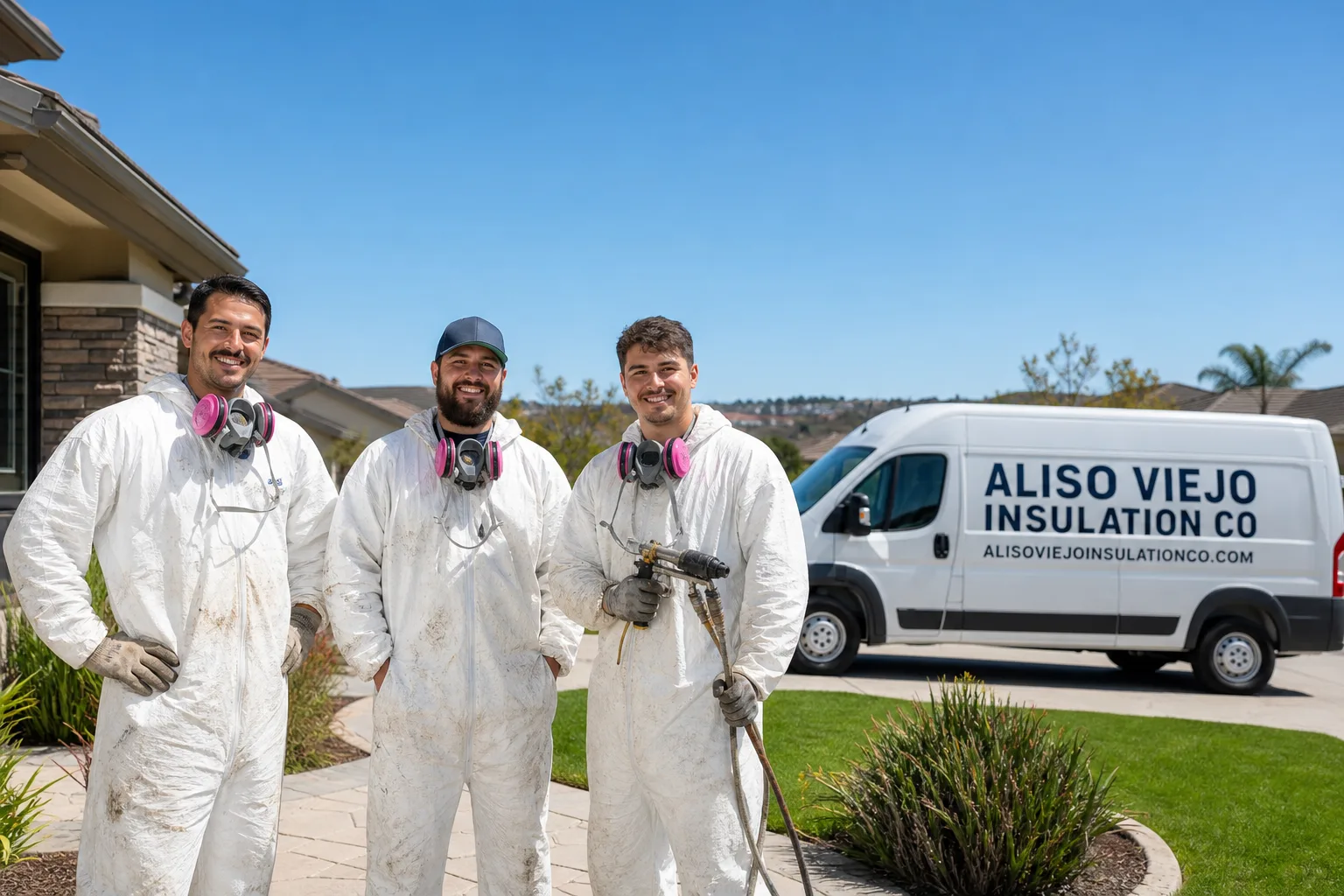
Fast, Reliable Spray Foam Insulation Across Grand Terrace
Spray foam insulation in Grand Terrace typically runs $3.50 to $7.50 per board foot installed, depending on whether the job calls for open-cell or closed-cell chemistry, and most retrofits on the city’s older ranch homes are completed in one to two days. If you’re dealing with a hot upstairs bedroom or an attic that turns your ceiling into a radiator by mid-afternoon, the issue isn’t your air conditioner. It’s the thermal envelope, and in Grand Terrace’s near-zero new construction market, that almost always means retrofitting an aging home rather than building one right the first time.
We work in Grand Terrace constantly. The homes here, most of them built between the 1950s and 1970s along the I-215 corridor, have predictable failure points: settled attic batts, uninsulated rim joists, and west-facing kneewalls that cook against the Blue Mountain foothills. Our crews know the tight street grid, the older wall assemblies, and which parts of this city need which foam chemistry. Call us at (877) 352-4780 and we’ll give you a straight answer about what’s happening in your specific house.
Why Aliso Viejo Insulation Co Is Grand Terrace’s Preferred Spray Foam Insulation Company
Grand Terrace homeowners call us because we carry material depth that single-brand contractors simply can’t match. When a house on the slope side near Blue Mountain needs a west-facing kneewall insulated, we’re not trying to force oven-cell foam into a condensation-prone assembly just because that’s the only product on the truck. We spec closed-cell from Icynene or Demilec when the physics demands it, and open-cell when the application calls for it. That material-agnostic approach matters in a city where every job is a retrofit.
Our local reputation is built on diagnosing the actual problem, not upsizing a quote. We’ve worked on dozens of Grand Terrace homes, from small 1,100-square-foot ranchers off Michigan Street to larger two-story builds on the terrace steps heading toward the hills. Homeowners here tend to be research-minded, and they ask sharp questions about R-value, air sealing, and moisture risk. That’s the conversation we want to have. Our response time to Grand Terrace is typically same-week for estimates, and emergency retrofit slots are often available within days, not weeks.
Nate Calloway runs our team, and his approach is simple: build the recommendation around the house, not the inventory. With eight manufacturer brands sourced, from Owens Corning fiberglass to Icynene and Demilec spray foam, we’ll tell you honestly when foam is the right call and when blown-in would serve you better. That’s why homeowners in Grand Terrace call us first and call us back for the garage or shop next.
Spray Foam Wall Insulation in Grand Terrace
Spray foam wall insulation in Grand Terrace is almost always a retrofit into a 1950s-to-1970s wall assembly, which means we’re working around existing drywall, old wiring, and framing that rarely matches modern stud spacing. The first sentence tells you the job: opening wall cavities or working from the attic and crawlspace to inject or spray foam into walls that were built before anyone in the Inland Empire thought much about cooling loads. On the hot inland side east of the marine layer, these walls absorb summer heat all afternoon and radiate it indoors long after sunset.
Closed-Cell in West-Facing Walls
West-facing walls in Grand Terrace, especially on homes that back up to the foothills, are the hottest assemblies in the entire house. The sun pounds them from early afternoon through evening, and when we open them up on older ranches, the original batt insulation is often sagged, thinned, or completely missing. We install closed-cell foam here because it adds structural rigidity and acts as a vapor retarder, not because it’s our default product. Open-cell in these assemblies traps heat and can condense moisture when the cool indoor air meets the hot wall cavity.
Wall retrofit work in Grand Terrace generally falls between $4.50 and $7.50 per board foot depending on access, existing insulation removal, and whether we’re working from inside or outside the wall plane.
Kneewall and Slope-Side Assemblies
Homes on the terraces rising toward Blue Mountain have another problem: kneewalls behind finished attic bedrooms. These short vertical walls separate conditioned living space from an unconditioned attic that hits 140°F or more in August. We’ve seen original 1960s batts in these walls reduced to a thin gray blanket that couldn’t stop a summer draft, let alone radiant heat. Closed-cell spray foam at 2 to 3 inches is the fix, and we’ve been doing these kneewall retrofits on Grand Terrace ranches for years.
Rim Joist Spray Foam in Grand Terrace
Rim joist spray foam in Grand Terrace addresses the single most overlooked thermal leak in the city’s older housing stock: the band board where your floor framing meets the foundation wall. In a 1960s ranch, that rim joist is often completely uninsulated, drilled through with plumbing and electrical penetrations, and connected directly to both the crawlspace and the exterior wall. On a hot afternoon, we’ve measured 130°F air bleeding through unsealed rim cavities straight into living spaces.
The Cavity-Fill Difference
A quick one-inch pass over the rim joist looks fine on a quote and does almost nothing in reality. The convective loop continues behind the foam, and you’ve paid for an R-value that never performs. In Grand Terrace, where summer cooling is the dominant load, we do a full cavity fill with closed-cell foam, working backer rod into large penetrations before spraying so the seal is real, the air movement stops, and the R-value holds under actual conditions.
Expect rim joist spray foam work in Grand Terrace to fall in the $2,500 to $4,800 range for a typical 1,200 to 1,800-square-foot ranch on a crawlspace, depending on footage and access. Smaller garages and additions run less.
Garage Rim Joists and Conditioned Additions
If you’ve converted a garage or built a bonus room over one, the rim joist under that space matters more than anywhere else. We’ve worked on several Grand Terrace homes where a finished garage had zero thermal break at the rim, and the floor felt like a skillet in July. Closed-cell at the entire rim perimeter fixes the floor temperature and cuts the cooling load on that space dramatically.
Trusted Brands We Service in Grand Terrace
We install and service spray foam from Icynene and Demilec, two of the industry’s leading manufacturers for open-cell and closed-cell chemistry. Alongside the foam lines, we carry Owens Corning fiberglass and Rockwool mineral wool for jobs where foam isn’t the right answer, and Johns Manville and Knauf products round out the attic and wall options. Because we stock local inventory for Grand Terrace projects, we can typically quote a retrofit on the first visit and schedule the spray work without a second wait for materials. That’s the advantage of a contractor working across eight brands rather than one.
Common Spray Foam Insulation Problems We See in Grand Terrace Homes
- Settled and thinned original batts in 1960s attics. Most Grand Terrace homes still have the insulation the builder put in fifty-plus years ago, and it’s not doing much. When we open these attics, the batts are compressed, dusty, and often sitting below the top plate, which means the ceiling itself is the thermal weak point.
- Uninsulated or thinly foamed rim joists with open penetrations. Plumbing holes, wiring runs, and old gas lines leave the rim joist wide open. A thin spray foam pass over the top without cavity fill leaves those air paths live, and the homeowner pays for R-value that never shows up on the bill.
- West-facing kneewalls baking finished attic bedrooms. On the slope side of Grand Terrace, we regularly measure kneewall cavities above 130°F in summer. Open-cell foam installed in those spaces is a liability: it traps heat and can condense moisture when it contacts the cool drywall on the interior side. Closed-cell is required, not optional.
- Air-sealing skipped before spray foam installation. Any installer who sprays foam without first sealing top plates, wire penetrations, and plumbing chases is trapping heat and moisture behind the foam layer. In Grand Terrace’s retrofit market, this is the most expensive corner to cut, because the entire job looks finished but performs like the original batt.
Pricing for Spray Foam Insulation in Grand Terrace, CA
A typical spray foam retrofit in Grand Terrace lands between $3.50 and $7.50 per board foot installed. Rim joist work on a standard ranch runs $2,500 to $4,800, while a full west-facing kneewall retrofit with closed-cell foam typically runs $1,800 to $3,200. Attic spray foam on the roof deck for a 1,200-square-foot home falls in the $6,000 to $9,000 range depending on rafter depth and access. What moves the number: existing insulation removal, how much of the framing is exposed, whether we’re working from inside or outside, and the chemistry required. Closed-cell always costs more than open-cell, but in Grand Terrace’s hot-side assemblies, it’s often the only correct option. Estimates are free, and the quote you get is the number we build the job from. Call (877) 352-4780 for an exact figure on your house.
We Also Serve Cities Near Grand Terrace
Our crews run the I-215 corridor regularly, so in addition to Grand Terrace, we handle spray foam and full insulation work in Highgrove, Colton, Loma Linda, and Rubidoux. If you’re just outside the city limits, you’re still in our standard service area. For a closer look at how we approach the full Spray Foam Insulation process from diagnosis to final walkthrough, see our dedicated service page. And for everything specific to this area, our Grand Terrace city hub covers the homes, the climate, and the retrofit work we do here.
Serving Grand Terrace, CA — Our Local Coverage Area
We’re based in the Grand Terrace area and know this community well. Use the map below to see our service coverage — if you’re nearby, we can almost certainly help.
FAQs About Spray Foam Insulation in Grand Terrace
Because the problem in these houses isn’t just depth, it’s air movement. Blown-in cellulose or fiberglass adds R-value but doesn’t stop the convective loops that pull hot attic air through rim joists, top plates, and kneewalls. In a 1960s Grand Terrace ranch on the hot inland side, spray foam seals the air paths while adding R-value, and closed-cell adds structural strength to older framing. Blown-in can work for a straight attic floor, but for walls, rim joists, and kneewalls in this housing stock, foam is the only answer that solves the actual physics. Call (877) 352-4780 and we’ll tell you which assemblies in your house actually need foam before you spend on anything.
Yes, in most cases. We access rim joists from the crawlspace or from the garage side below the drywall line, and we can usually complete the entire rim without opening finished walls. On some Grand Terrace homes, especially those with additions or converted garages, we may need to remove a small strip of drywall at the rim height to get full access. The work takes less than a day on most ranches, and the garage is usable the next morning.
Closed-cell is the only spec we recommend for west-facing kneewalls in Grand Terrace. It has higher R-value per inch, it stops air movement completely, and it acts as a vapor retarder, which prevents condensation on the cool interior side when the wall cavity hits 130°F in summer. Open-cell is cheaper and works well in some attic and interior applications, but in a hot west-facing assembly it traps heat and risks moisture damage. If a quote for kneewall foam in this city doesn’t specify closed-cell, ask why.
For most retrofit insulation work, no permit is required. Spray foam into existing wall cavities, rim joists, and kneewalls is standard retrofit work and does not require a building permit in Grand Terrace. If the job involves structural changes like removing sheathing or reframing, that’s a different scope and may need city review. We handle the paperwork when it’s needed and will tell you upfront if your project crosses that line.
Most single-story ranch retrofits are done in one to two days. Rim joist work is a one-day job. A kneewall plus attic roof deck may run two days depending on access and existing insulation removal. We schedule spray work in Grand Terrace with a target of disrupting your house as little as possible, and we’ll give you a specific timeline when we quote the job. Estimates are free at (877) 352-4780.
Written by Nate Calloway, Owner at Aliso Viejo Insulation Co, serving Grand Terrace insulation retrofit work since our first job in the Inland Empire.