
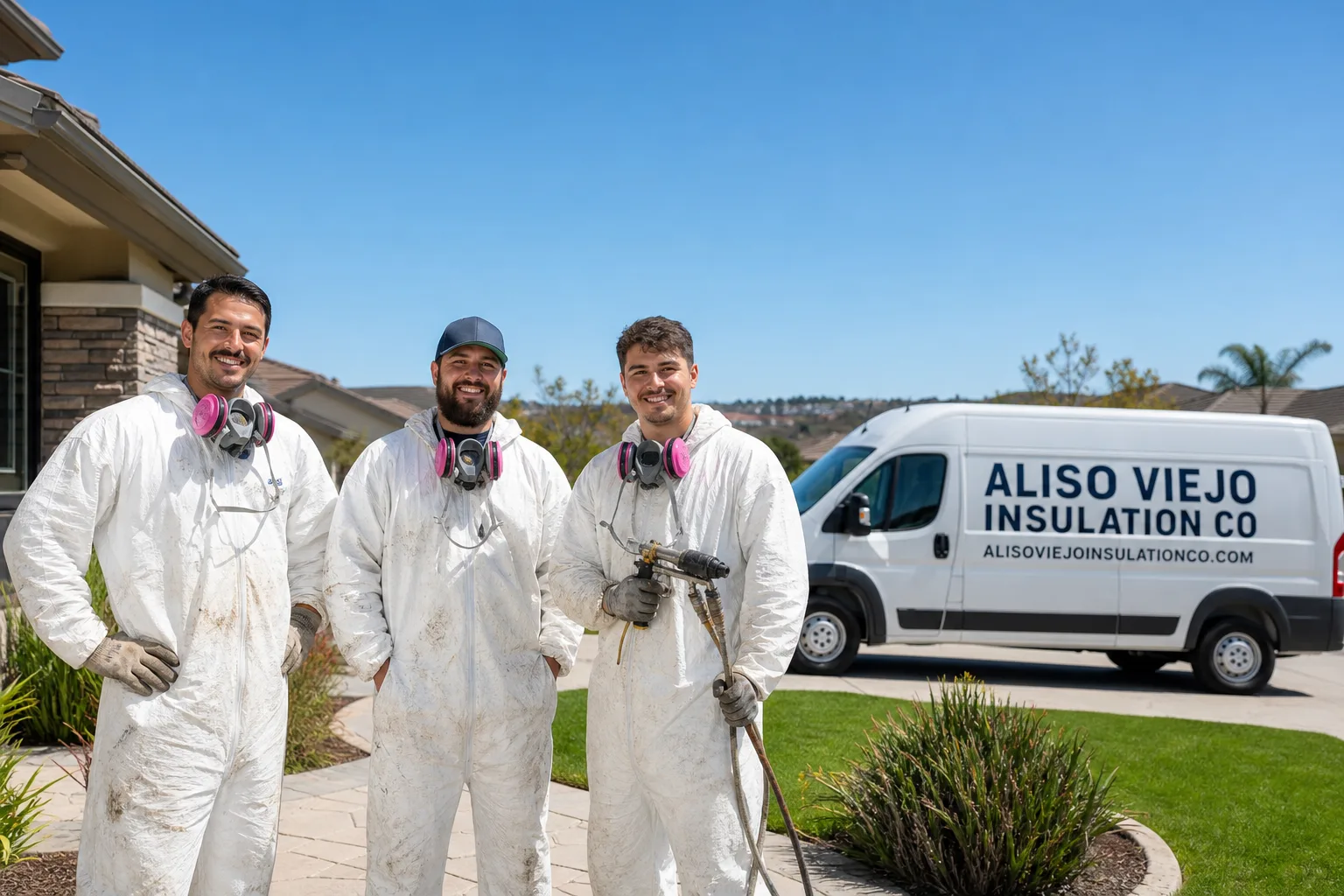
Fast, Reliable Spray Foam Insulation Across Lakewood
Spray foam insulation in Lakewood typically runs $2.50 – $6.50 per board foot installed, with most whole-attic jobs on 1950s ranch homes landing between $3,800 and $9,200 depending on foam type and attic condition. We’re in Lakewood weekly, and we know these Boyar tract homes well enough to quote accurately over the phone. If your cooling bills spike every summer afternoon or your bedroom walls feel warm to the touch by 4 p.m., the problem is almost always the original rock-wool batts and unsealed wall cavities those 1950s builders left behind. Call (877) 352-4780 for a free estimate, and we’ll tell you straight whether spray foam is the right fix or if a cheaper method does the job.
Why Aliso Viejo Insulation Co Is Lakewood’s Preferred Spray Foam Insulation Company
We’ve worked on enough Lakewood homes to spot the pattern before we climb the ladder. The 90712, 90713, and 90714 tracts are remarkably consistent, and that repetition means our crews know exactly what they’ll find in an original Boyar attic before the scuttle hole even opens. Homeowners across Lakewood Park, Mayfair, and the Carson Street corridor call us because we diagnose the actual problem rather than defaulting to whatever product makes us the most margin.
Nate Calloway built this company around material-agnostic advising. We carry Icynene and Demilec spray foam systems, plus Owens Corning, Johns Manville, Knauf, Rockwool, CertainTeed, and GreenFiber products across fiberglass, mineral wool, and cellulose. That breadth matters in Lakewood specifically, because some of these tract homes need closed-cell for structural rigidity and moisture control, while others do just fine with open-cell or even dense-packed cellulose. We’ll tell you which one fits your house and your budget, and we’ll install it right the first time. Same-week scheduling is typical for Lakewood jobs, and estimates are always free.
Closed Cell Spray Foam Insulation in Lakewood
Closed Cell Spray Foam Insulation is our most common recommendation for Lakewood’s original 1950s homes when the attic is vented and humidity from the marine layer is a concern. Closed-cell foam cures dense and rigid, adding structural strength to older framing while creating a vapor barrier that keeps morning dampness from soaking into insulation. It’s also the right call for rim joists and garage ceilings where air leakage is the primary problem.
For a typical 1,100 – 1,400 square foot Lakewood ranch, closed-cell attic work runs $5,200 – $8,800. The higher end applies when we’re vacuuming out rock-wool batts first, which most original Boyar homes need.
Rim Joist Sealing in Slab-Foundation Homes
Lakewood’s slab foundations mean the rim joist, where framing meets concrete, is a major air-leak point. We spray closed-cell along the entire perimeter to stop outside air from pushing into wall cavities. On a 1954 ranch near Mayfair Park, sealing the rim joists cut hallway drafts that had persisted for decades.
Garage Ceiling and Roof Deck Applications
Many Lakewood garages have living space above them or share a wall with the kitchen. Closed-cell on the garage ceiling blocks radiant heat and car exhaust from migrating into conditioned rooms. For unvented roof decks, we calculate foam thickness based on LA Basin climate data, not guesswork.
Open Cell Spray Foam in Lakewood
Open Cell Spray Foam is the better value for interior walls and vented attics where moisture control isn’t the primary goal. It expands to fill irregular 1950s framing cavities thoroughly, and it costs about 40% less than closed-cell per board foot. For Lakewood homeowners upgrading wall insulation during a remodel, open-cell is often the smart choice.
Expect open-cell work in Lakewood to run $3,200 – $5,800 for a full attic or $1,800 – $3,200 for a single wall assembly or room addition. The range reflects foam depth, prep work, and how much old insulation has to come out first.
Sound Control for Busy Streets
Homes along Lakewood Boulevard, South Street, and Del Amo get constant road noise. Open-cell foam absorbs sound measurably better than closed-cell, which is why we recommend it for street-facing walls. It’s also easier to trim and re-spray if you’re adding a second-story addition later.
Wall Cavity Retrofit
Original Lakewood wall cavities are mostly empty or minimally insulated. When we open walls during remodel projects, open-cell lets us fill the entire cavity without the pressure risks that rigid foams create in old framing. The result is a quieter, cooler house without compromising the structure.
Trusted Brands We Service in Lakewood
We’re authorized installers for Icynene and Demilec spray foam, two of the most rigorously tested systems in the industry. Depending on the job, we also draw on Owens Corning and Johns Manville fiberglass when a hybrid attic approach makes more sense, and GreenFiber or Knauf products for walls and dense-pack applications. Because we stock materials across these brands, Lakewood customers don’t wait on backordered foam or get pushed toward whatever one-brand contractor can sell that week. Your recommendation comes from building science, not inventory. Spray Foam Insulation is one of our three core specialties, and having the full brand lineup means your Lakewood home gets the right chemistry, not just the chemistry we happen to carry.
Common Spray Foam Insulation Problems We See in Lakewood Homes
- Foam sprayed directly over original rock-wool batts. Some crews try to save time by leaving the old batts in place. In Lakewood’s shallow attics, that traps moisture between the old batt and the new foam, causing uneven curing and eventual odor problems. We remove the rock wool first, every time.
- Unsealed scuttle holes and wall top plates. The original 1950s scuttle holes in Lakewood’s hallways are rarely weatherstripped. If those gaps and the wall top plates aren’t sealed before or during spray foam installation, convective air loops keep pulling attic heat into the living space, undoing the foam’s air-sealing benefit.
- Incorrect foam thickness on unvented roof decks. Lakewood’s summer heat and Santa Ana winds put real stress on unvented assemblies. Too thin a foam layer causes condensation at the roof deck, which damages shingles and sheathing over time. We size foam depth to manufacturer specs for the LA Basin climate.
- Crews not familiar with low-pitch 1950s geometry. A crew used to newer subdivisions will struggle in a Lakewood attic with 18 inches of clearance under a low-pitch roof. The best installers work flat on the joists, but that’s slow, careful work. Inexperienced teams rush it, leaving thin spots you can’t see until summer.
Pricing for Spray Foam Insulation in Lakewood, CA
Closed-cell spray foam in Lakewood runs $5,200 – $8,800 for a typical original ranch attic, including removal of old rock-wool batts. Open-cell runs $3,200 – $5,800 for the same footprint. Rim joist sealing alone is $900 – $1,800 depending on perimeter length, and garage ceiling applications are $1,100 – $2,400. What moves the number is prep work, attic access, foam depth, and whether your 1950s attic still has the original batts in place. We give you a written line-item estimate before work starts, and it’s free. Call (877) 352-4780 and we’ll have a number to you within a day.
We Also Serve Cities Near Lakewood
Our crews work regularly in Lakewood and the surrounding communities. If you’re in Signal Hill, Bellflower, Long Beach, or Paramount, we cover those areas too. The housing stock changes block by block out here, and we’ve done enough work in each city to know what those attics hold before we open them.
Serving Lakewood, CA — Our Local Coverage Area
We’re based in the Lakewood area and know this community well. Use the map below to see our service coverage — if you’re nearby, we can almost certainly help.
FAQs About Spray Foam Insulation in Lakewood
No, and we won’t do it. The original rock-wool batts in 1950s Boyar homes are almost always compressed, dusty, and sitting directly against the ceiling drywall. Spraying foam over them traps moisture and creates uneven curing. We vacuum out the old material first, then spray directly onto the ceiling plane and joists. Call (877) 352-4780 for a free inspection, and we’ll tell you exactly what’s up there.
Closed-cell and open-cell foam both create an air seal that stops the two things causing Lakewood’s afternoon cooling spikes: radiant heat gain through the attic and convective air movement through unsealed wall top plates and scuttle holes. During Santa Ana events, that air seal also prevents hot, dry wind from pushing into wall cavities and pressurizing the house. Most Lakewood customers notice the difference in room temperature within the first hot week after installation.
Yes, but it requires a crew that knows how to work flat on the joists. Lakewood’s original low-pitch roofs leave very little headroom, and many attics are accessible only through small hallway scuttle holes. We’ve done hundreds of these shallow attics, and the foam application itself is straightforward once the old batts are out. What matters is that the installer can reach the eaves and top plates without leaving thin spots.
For vented attics where the main goal is cooling-load reduction, closed-cell is usually the better choice because it adds structural strength and blocks moisture from the marine layer. For interior wall cavities and sound control along busy streets like Lakewood Boulevard or Carson Street, open-cell does the job at lower cost. We’ll walk through your home’s specific conditions and give you an honest recommendation based on building science, not margin.
Most spray foam insulation work in Lakewood does not require a building permit when it’s a retrofit on an existing home. The exception is when the work is part of a larger remodel that already has permits pulled, or when roof deck foam changes the attic from vented to unvented. We’ll let you know if your specific job triggers a permit requirement before we schedule. Call (877) 352-4780 and we’ll answer it for your exact address.
On a 1952 Boyar-built ranch in the Lakewood Park neighborhood, we found the original rock-wool batts compressed to R-7 and unsealed wall cavities that let attic heat radiate into the living room every afternoon. After vacuuming out the old batts, our tech sprayed closed-cell foam between the joists and sealed the wall top plates. Attic temperature dropped 20°F, and the family’s afternoon cooling spike disappeared. That’s the pattern on block after block in 90712, 90713, and 90714, and fixing it is what we do.
If your Lakewood home still has its original insulation, you’re paying for it every month. Call (877) 352-4780 for a free estimate. Nate Calloway and our crew will give you a straight answer on what your attic needs and what it’ll cost.
Written by Nate Calloway, Owner at Aliso Viejo Insulation Co, serving Lakewood since our first tract-home retrofit in the area.