
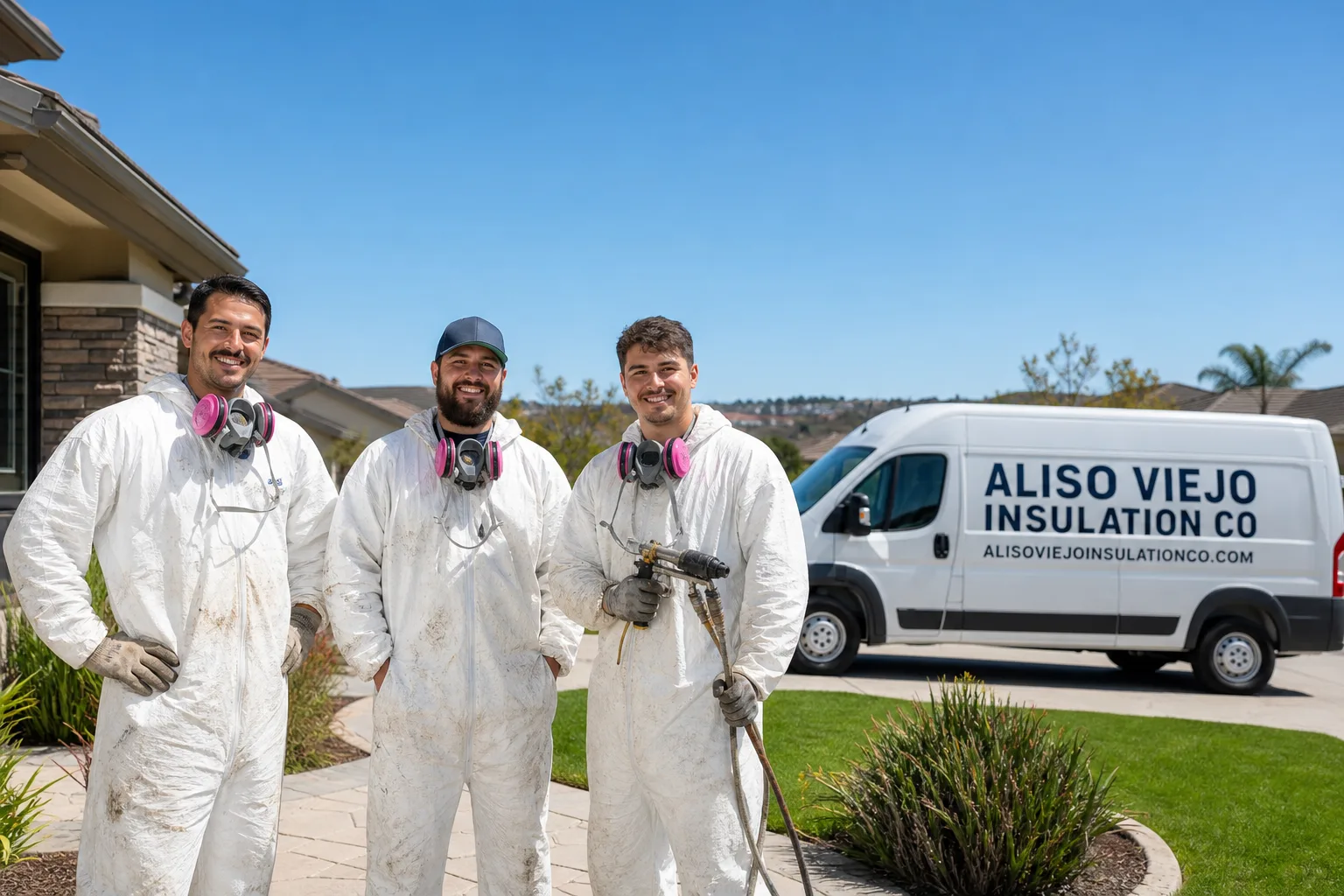
Fast, Reliable Spray Foam Insulation Across Mead Valley
Spray foam insulation in Mead Valley runs between $1,200 and $4,800 for most residential jobs, depending on whether you’re sealing a rim joist, a crawl space, or an entire attic. We serve every corner of the 92570 zip code, from the acreage parcels off Hwy 74 to the newer tract streets south of Cajalco Road. If your cooling bills keep climbing through July and August, the problem usually isn’t your AC unit. It’s your thermal envelope. Call Nate Calloway and our crew at (877) 352-4780 for a straight answer on what your home actually needs.
Why Aliso Viejo Insulation Co Is Mead Valley’s Preferred Spray Foam Insulation Company
Mead Valley homes don’t all need the same fix. A 1970s self-built ranch on a half-acre lot has different problems than a 2015 tract home in a subdivision off Rider Street. We’ve worked both. That’s the whole reason we source from eight manufacturers instead of pushing one product – Spray Foam Insulation is only the right answer when the building science says it is. Nate Calloway built this company around material-agnostic advising. We don’t have a single brand to move, so we don’t bend recommendations to fit inventory.
Our technicians have spent enough time in Mead Valley attics to know what they’ll find before the ladder goes up. Older uninsulated or under-insulated structures on rural parcels. Newer builds with builder-grade batts already settled. Manufactured homes with skirting that breathes wrong. When you call, we schedule fast – typically within a couple of business days for estimates, same-week for urgent sealing jobs. Residents across Mead Valley know we show up on time and leave the site cleaner than we found it.
Crawl Space Spray Foam Insulation in Mead Valley
Crawl Space Spray Foam Insulation in Mead Valley homes is one of the highest-value upgrades we do, especially under the older manufactured and self-built houses that sit on raised foundations throughout the 92570 corridor. The job involves sealing the subfloor from below, rim joist cavities, and foundation vents if we’re converting the space, using closed-cell foam that blocks air movement and keeps dry heat from baking your floors. In Mead Valley’s low humidity, closed-cell Icynene or Demilec holds up better than open-cell in vented crawl spaces. Expect to pay $1,400 to $3,200 for a typical single-story crawl space, with larger or tighter-access jobs running higher.
Sealing the Rim Joist and Subfloor
The rim joist is where your floor framing meets the foundation wall. In older Mead Valley homes, this gap often has nothing but a strip of fiberglass stuffed in – if that. We remove any mouse-chewed remnants, then apply closed-cell foam to the full band. The subfloor itself gets a continuous layer to stop the stack effect pulling hot air up through the rooms.
Crawl Space Ventilation and Dry Heat
Mead Valley’s dry heat means a vented crawl space isn’t the moisture disaster it would be in coastal climates. Venting helps keep things dry. What it doesn’t do is stop heat from radiating upward through your floors. Closed-cell foam on the subfloor cuts that heat transfer, which is why homeowners notice cooler rooms the same week installation wraps.
Garage Spray Foam Insulation in Mead Valley
Garage Spray Foam Insulation in Mead Valley is the fastest way to reclaim a garage that hits 110°F by noon in August. Most garages in both the older rural parcels and the newer tract homes have zero insulation in the walls and garage ceiling. Soffit vents above the garage are rare. That means the space directly above or beside your living area is acting as a heat reservoir. We apply open-cell or closed-cell foam to the garage ceiling and shared walls, depending on whether the garage is attached and whether you park vehicles with hot exhaust inside. A standard two-car garage ceiling runs $900 to $2,200, with full wall insulation adding $1,000 to $2,500.
Garage Ceiling and Shared Wall Sealing
If a bedroom sits over or next to the garage, the shared wall and ceiling are the leakiest thermal boundaries in the house. We spray foam directly against the exterior sheathing and the band joist, then add batts or dense-packed cellulose where cost matters more than air sealing. The result is a garage that finally stops driving heat into your living space.
Attached Garages in Newer Tract Homes
The tract homes built in Mead Valley over the last two decades often have the garage ceiling left uninsulated because code enforcement has been inconsistent on unfinished spaces. We correct that. Closed-cell foam on the garage ceiling also quiets the room above, a side benefit homeowners don’t anticipate until they notice it.
Trusted Brands We Service in Mead Valley
We’re authorized to install products from Owens Corning, Johns Manville, Knauf, Rockwool, CertainTeed, Icynene, Demilec, and GreenFiber. That roster matters in Mead Valley because the right material shifts from house to house. A tract home with an attached garage might get Johns Manville fiberglass in the wall cavities and Icynene closed-cell on the roof deck. An older manufactured home might do better with Rockwool for fire resistance in the crawl space. Because we stock supplies locally for Mead Valley jobs, we don’t need to run back to a warehouse in Aliso Viejo mid-install. We bring what the job needs the first day.
Common Spray Foam Insulation Problems We See in Mead Valley Homes
- Foam applied over settled or rodent-contaminated fiberglass. In older self-built and manufactured homes across the 92570 corridor, prior insulation is often compacted to half its original R-value and full of nesting debris. Foam sprayed directly over it won’t bond and won’t air-seal. We remove or top it correctly first.
- No attic ventilation before foam goes in. Mead Valley’s older rural homes frequently lack soffit and ridge vents entirely. Sealing the attic floor without adding venting can trap heat and condensation, causing the roof deck to bake and delaminate.
- Open-cell foam used in the wrong place. In vented crawl spaces or garages exposed to dry heat, open-cell foam picks up dust and degrades faster than closed-cell. We match the chemistry to the application, using Demilec closed-cell in crawl spaces and Icynene open-cell for interior wall cavities.
- Warranty-era failures in newer tract homes. Some homes built in Mead Valley’s 2005-2015 subdivision boom have insulation that’s already settled or was installed with gaps around top plates and can lights. Spray foam retrofit on those gaps fixes what fiberglass batts never sealed.
Pricing for Spray Foam Insulation in Mead Valley, CA
A typical attic floor spray foam retrofit in Mead Valley runs $1,800 to $3,800, including removal of settled insulation where needed. Crawl space work sits between $1,400 and $3,200. Garage ceilings cost $900 to $2,200. Rim joist sealing alone runs $600 to $1,400. What moves the number: access, square footage, whether we’re removing old material, and which foam chemistry fits the job. Open-cell is cheaper per board foot, usually $0.45 to $0.80 installed. Closed-cell runs $1.10 to $1.95 per board foot. We quote fixed prices after a walkthrough. Estimates are free. Call (877) 352-4780 and we’ll come measure.
We Also Serve Cities Near Mead Valley
Beyond Mead Valley, our crews work regularly in Mead Valley and the surrounding Perris Valley communities. We cover Perris, Good Hope, Canyon Lake, and Meadowbrook on the same schedule. If you’re anywhere in the western Riverside corridor and dealing with a hot attic or leaky crawl space, call us and we’ll route a tech your way.
Key Takeaways for Mead Valley Homeowners:
- Spray foam alone won’t fix an older Mead Valley home if attic ventilation is missing or blocked
- Closed-cell foam handles the dry heat and occasional monsoon humidity better in crawl spaces
- Most garage ceilings in Mead Valley are uninsulated, even in newer tract homes
- We quote from eight manufacturer lines, so the recommendation fits your structure, not our inventory
The Ventilation Problem Most Spray Foam Guys Skip in Mead Valley
Here’s what makes Mead Valley different from Temecula or Murrieta. In the older rural and manufactured homes on acreage along the Hwy 74 corridor and the dirt roads branching off Cajalco, attic ventilation is often nonexistent. No soffit vents. No ridge vents. Maybe a single gable vent that’s been blocked by storage or nesting. If you spray foam into an attic like that without adding ventilation first, you’re sealing heat in, not out. The foam does its job – it stops air leakage – but the attic becomes a heat trap. Roof deck temperatures spike. Shingles age faster. In the worst cases, moisture from occasional monsoon humidity gets trapped and condensation forms on the underside of the sheathing.
So in Mead Valley specifically, spray foam work on older homes starts with ventilation. We check the soffit and ridge first. If vents are missing or clogged, we correct that before the foam goes in. It’s a step suburban tract homes rarely need because they were built with code-required venting. Around here, it’s the difference between a retrofit that solves the problem and one that hides it for two years until the deck sheathing starts to rot. Nate Calloway made this a standard part of our Mead Valley walkthroughs because skipping it costs homeowners thousands down the line.
On a 1970s self-built ranch house off Hwy 74 near Mead Valley, we found settled fiberglass batts stuffed between ceiling joists and no soffit vents at all. After clearing out the rodent debris, our tech installed closed-cell Icynene on the attic floor and sealed the top plates, then added four new soffit vents and a ridge vent. The homeowner reported a 25°F drop in attic temperature on 105°F afternoons and a noticeable cut in cooling run time within the first week. That’s the standard we aim for here.
Serving Mead Valley, CA — Our Local Coverage Area
We’re based in the Mead Valley area and know this community well. Use the map below to see our service coverage — if you’re nearby, we can almost certainly help.
FAQs About Spray Foam Insulation in Mead Valley
Spray foam alone fails in older Mead Valley homes when the attic has no working ventilation because the foam seals air in, trapping heat that has nowhere to escape. The roof deck bakes, shingles curl, and condensation builds during any humid stretch. We fix ventilation first, then apply foam. Call (877) 352-4780 to have your attic vents checked before any foam work begins.
Yes, and it works well when you use the right chemistry. Under a manufactured home in Mead Valley’s dry heat, we use closed-cell foam because it doesn’t absorb moisture or break down in the hot, dusty environment. Open-cell would degrade faster and collect dirt. The foam goes on the subfloor from below, sealing air movement and cutting the heat that rises through your floors.
In a newer Mead Valley tract home, the garage retrofit usually means spraying closed-cell foam on the garage ceiling and the shared wall, often with no existing insulation to remove. In an older rural property, the job often starts with removing whatever’s there – settled fiberglass, rodent debris, or plywood nailed over open cavities – then air-sealing gaps before foam goes in. The older home costs more because of the prep work, usually $1,500 to $4,000 versus $900 to $2,200 for a tract home garage.
We remove the settled fiberglass first, then inspect the ceiling plane for gaps around top plates, electrical boxes, and plumbing stacks. Spray foam needs direct contact with the surface to bond and air-seal. If we sprayed over compacted fiberglass, you’d get a false sense of sealing with leaks still running through the old material. Removal adds $400 to $900 to an attic job, depending on square footage and access.
In Mead Valley and unincorporated Riverside County, spray foam insulation retrofits typically do not require a standalone building permit for existing single-family homes, but large structural changes like converting a vented attic to a conditioned space may. We’ll tell you during the walkthrough if your project crosses that line. For brands, we install Icynene and Demilec spray foam systems, along with Owens Corning, Johns Manville, Knauf, Rockwool, CertainTeed, and GreenFiber products for complementary insulation work.
Call Aliso Viejo Insulation Co for Spray Foam in Mead Valley
If your Mead Valley home is overheating, your bills are climbing, or you suspect the last insulation job was done wrong, call us. Nate Calloway and our crew will come out, get in the attic or crawl space, and tell you exactly what’s going on. No brand loyalty. No upsell. Just building science and the right material for your structure. Call (877) 352-4780 for a free estimate. We serve all of the 92570 zip code and the surrounding Perris Valley area.
Written by Nate Calloway, Owner at Aliso Viejo Insulation Co, serving Mead Valley and Greater Inland Southern California. Material-agnostic insulation specializing in spray foam, attic, and blown-in systems since the company’s founding.