
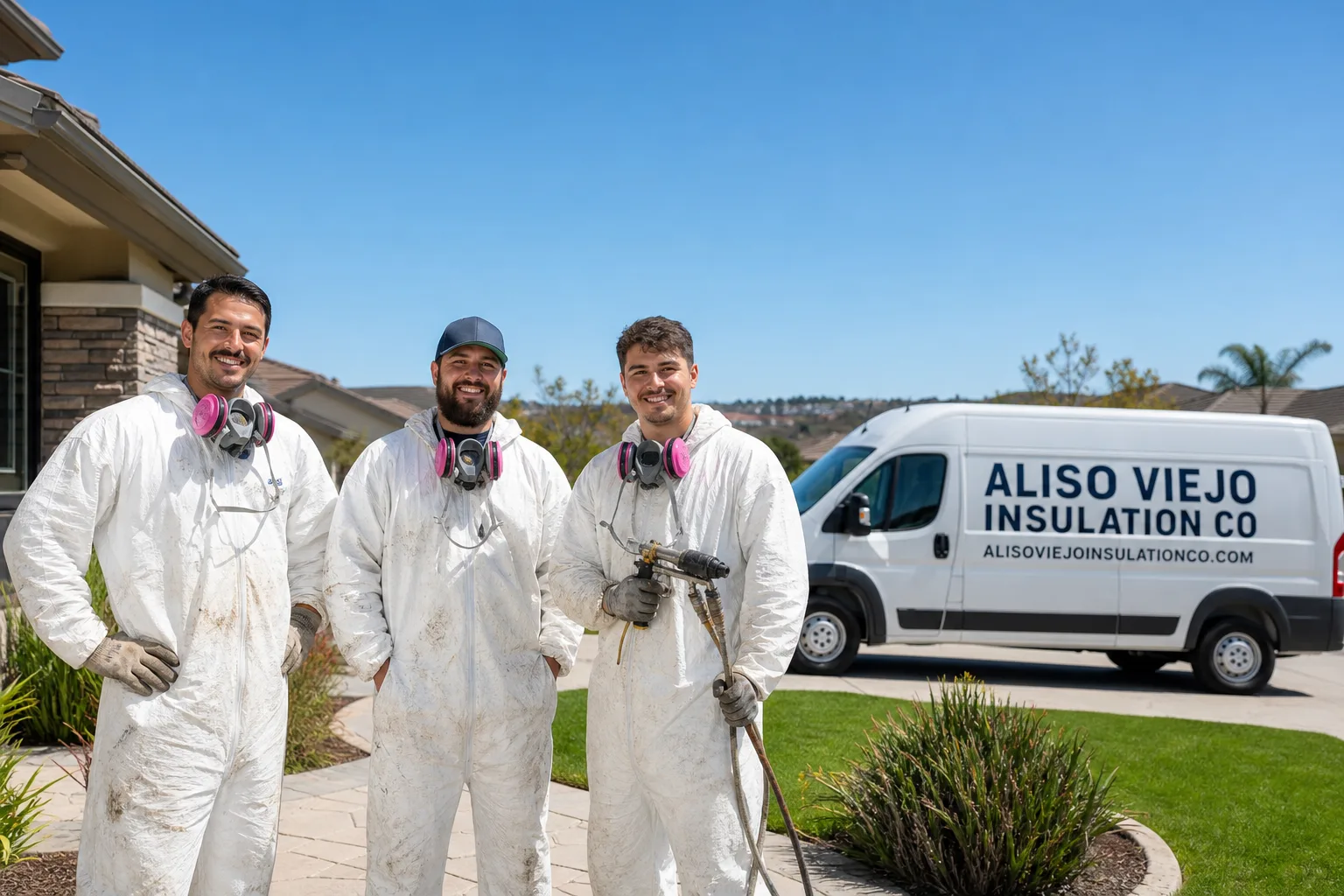
Fast, Reliable Spray Foam Insulation Across San Bernardino
Spray foam insulation in San Bernardino runs $2.50 to $4.75 per board foot for open-cell and $3.75 to $6.50 for closed-cell, with most attic jobs landing between $3,800 and $8,400 depending on square footage and prep work. We get crews to San Bernardino homes within 24 to 48 hours on most calls, because we know what a 150°F attic does to a family’s cooling bill when insulation isn’t doing its job. If you’re in 92404, 92405, 92410, or 92411 and your upstairs rooms won’t hold temperature, call (877) 352-4780 and we’ll walk you through what’s actually happening in your attic before we ever quote a number.
Why Aliso Viejo Insulation Co Is San Bernardino’s Preferred Spray Foam Insulation Company
San Bernardino isn’t a drive-by market for us. Our crews work the westside and central neighborhoods off Highland Avenue, Baseline Street, and Del Rosa Avenue regularly, and we’ve spent enough time in the attics of 92404 and 92405 to know what’s waiting up there before we even lift the access panel. Homeowners keep calling us back because we diagnose the thermal problem first, then match the foam chemistry to the house. That’s why someone with a 1950s stucco ranch in San Bernardino doesn’t get the same recommendation as someone with a newer build in Loma Linda.
Nate Calloway built this company around a simple rule: carry access to eight manufacturer brands, install all three major insulation methods, and never push a product because it’s what’s on the truck. For Spray Foam Insulation work, that means we’re authorized to install Icynene and Demilec systems, two of the industry’s better open-cell and closed-cell chemistries, so the recommendation comes down to what your roof assembly and budget actually need.
Our San Bernardino customers consistently mention two things in reviews: we show up when we say we will, and we explain the “why” behind the recommendation. When you’re spending $5,000 on something you can’t see, that matters.
Closed Cell Spray Foam Insulation in San Bernardino
Closed Cell Spray Foam Insulation in San Bernardino is the workhorse for our pre-1970s stucco homes because it adds structural rigidity to older roof sheathing while delivering roughly R-6.5 to R-7 per inch, which matters when your attic hits 150°F by noon in July. We commonly recommend closed-cell for low-slope roofs and for homes where the attic floor is the thermal boundary, especially in 92404 and 92405 where original framing can’t always carry the weight of multiple insulation layers. Expect to pay $3.75 to $6.50 per board foot installed, with a typical 1,200-square-foot attic floor running $5,500 to $8,400 including air-sealing prep.
Attic Floor Sealing and Foam Application
In San Bernardino’s older homes, closed-cell on the attic floor does two jobs at once: it insulates and it eliminates the convective air loops that pull conditioned air out of the living space. We air-seal top plates, can lights, and plumbing penetrations before we spray, because foam over a leaky ceiling is just an expensive lid on a drafty box.
Low-Slope Roof Deck Encapsulation
A lot of 1950s and 60s San Bernardino tract homes have low-slope or nearly flat roof sections where traditional vented attic design doesn’t work well. Closed-cell applied to the underside of the roof deck converts those spaces into conditioned, unvented assemblies, which stops the radiant heat gain from cooking the ceiling drywall below. Moisture control matters here too; we follow manufacturer specs on thickness to prevent the condensation problems that sloppy installs create.
Open Cell Spray Foam in San Bernardino
Open Cell Spray Foam in San Bernardino costs less than closed-cell, typically $2.50 to $4.75 per board foot, and it’s a better fit for homes with steep gable roofs or attic spaces that already have reasonable ventilation. The material expands aggressively to fill odd cavities in older San Bernardino bungalows, sealing air movement while letting the roof assembly breathe. Where closed-cell blocks moisture, open-cell allows vapor to pass, which on certain 92410 and 92411 homes built with older sheathing prevents the trapped-moisture problems that can blister exterior stucco.
Vented Attic Air Sealing
In a vented San Bernardino attic, open-cell works best as a continuous barrier against air exchange rather than a radiant heat blocker. We spray it into the joist bays and against the top plates, and the result is an attic that stops bleeding cooled air into a 150°F space. For homes where the budget can’t stretch to closed-cell but air leakage is the real problem, this is the honest recommendation.
Wall Cavity Retrofit
Many 92405 and 92410 homes have empty or nearly empty wall cavities, and open-cell is the only foam product that can realistically fill those voids in a retrofit scenario. We inject it through small access holes, and the expansion seals the stud bay while adding R-value without tearing out drywall. It’s invasive enough to require planning, but far less disruptive than a full gut-and-rebuild wall assembly.
Trusted Brands We Service in San Bernardino
We’re authorized to install Icynene and Demilec spray foam systems, and we carry access to Owens Corning, Johns Manville, Knauf, and Rockwool for homes where spray foam isn’t the whole answer. That matters in San Bernardino because older homes often need a hybrid approach: spray foam for the air-sealing and thermal core, with mineral wool or fiberglass for specific cavities or fire-rated assemblies. Because we’re not locked into one manufacturer, we stock the right substrate, tape, and compatible components for each system, which keeps turnaround fast. Call (877) 352-4780 and we’ll tell you exactly which product fits your house, not which one we’re trying to move.
Common Spray Foam Insulation Problems We See in San Bernardino Homes
- Foam applied over settled rock-wool without air-sealing first. In 92404 and 92405, we regularly find original 1950s rock-wool compressed to two inches or less, topped with a desert dust layer that spells years of unfiltered attic air movement. Spraying foam over that without sealing the leaks just traps the dust and leaves the convective loops running beneath the new insulation.
- Closed-cell sprayed too thick on older low-slope roof sheathing. San Bernardino’s pre-1970s homes often have roof decks that can’t handle the vapor profile of an over-built closed-cell layer. The result is moisture wicking into the wood and stucco blistering on the exterior wall below the eave line, a failure we’ve had to correct on more than one 92404 ranch.
- Open-cell foam in vented attics during Santa Ana events. When the winds kick up dust and drive fine particulates into the attic, open-cell’s structure catches that material. Over time, the foam’s surface loads with dust and its effective R-value drops, something most installers never mention.
- Ignoring the radiant gain problem entirely. Adding foam without addressing the radiant heat coming through the roof deck in a 150°F attic leaves the living space fighting a losing battle. Foam slows conduction, but it doesn’t stop the roof from radiating; the right assembly does both.
Pricing for Spray Foam Insulation in San Bernardino, CA
A typical open-cell attic job in San Bernardino runs from $3,800 to $6,200, while closed-cell work usually lands between $5,500 and $8,400 after prep. Wall cavity retrofits are priced by the stud bay and generally fall between $2,800 and $5,000 for a standard 1,000-square-foot home section. What moves the number is air-sealing prep time, access difficulty in low-slope attics, and whether we’re encapsulating a roof deck or just sealing the floor plane. We give every San Bernardino customer a written, line-item quote before work starts, and the estimate is free. Call (877) 352-4780 for exact numbers on your specific house.
We Also Serve Cities Near San Bernardino
Our crews run daily routes from San Bernardino north to Muscoy and Highland, west to Rialto, and south through Loma Linda. Same response windows apply across the whole corridor, and we stock parts and foam systems for the housing styles common to all of them. Wherever you are in the IE, the diagnostic first, sell-second approach doesn’t change.
Serving San Bernardino, CA — Our Local Coverage Area
We’re based in the San Bernardino area and know this community well. Use the map below to see our service coverage — if you’re nearby, we can almost certainly help.
FAQs About Spray Foam Insulation in San Bernardino
Yes, spray foam cuts attic temperature spikes by stopping both conductive heat transfer and air movement, but the heat source matters. In San Bernardino’s older homes, the biggest win comes from air-sealing first, then adding foam: without closing the leaks, cooled air keeps bleeding into a hot attic no matter how much foam you spray. Closed-cell on the attic floor or roof deck drops the ceiling surface temperature noticeably, and open-cell in a vented attic cuts the convective loop. Call (877) 352-4780 and we’ll measure your attic’s actual conditions before recommending anything.
No, and we won’t do it. The original rock-wool in San Bernardino’s 1950s homes has usually settled to R-7 or less, and it’s loaded with dust from years of air leaks. Spraying foam over it seals that dust in place and leaves the air leaks underneath running full strength. We remove or push aside the old material, air-seal the top plates and penetrations, then apply foam to the clean deck. It’s more labor, but skipping that step is why some San Bernardino homeowners spend $6,000 and see no bill change.
Open-cell costs less, expands more, and lets vapor pass through, which works in vented attics and wall cavities. Closed-cell costs more, adds structural strength, blocks moisture, and delivers higher R-value per inch. In San Bernardino’s older low-slope roof homes, closed-cell is typically the right call; on steeper gable roofs with good ventilation, open-cell often gets the job done without the moisture risk. We carry both because the house decides, not the price point. Call (877) 352-4780 for a straight answer on which one your roof needs.
In most San Bernardino attics, no. Spray foam slows conductive and convective heat gain enough that a radiant barrier adds little. Where a radiant barrier does earn its keep is on uninsulated roof decks or exposed ductwork in vented attics, which are rare in the housing stock we see across 92404 and 92405. If your foam was installed correctly and the air-sealing is done, you’re getting the bulk of the thermal benefit already.
We treat them as unvented assemblies, which means closed-cell foam on the underside of the roof deck at a thickness the manufacturer specifies for our climate zone. The key variable is vapor control: too much closed-cell traps moisture against the older sheathing, too little allows condensation. We also check the exterior stucco condition before we spray, because a home that’s already blistering tells us there’s a pre-existing moisture problem we need to address in the assembly design first.
If your San Bernardino home’s attic still has that original rock-wool and a dust layer telling you the air leaks were never fixed, don’t wait for the next heat wave. Call Aliso Viejo Insulation Co at (877) 352-4780 and Nate Calloway’s team will come out, diagnose what’s happening, and give you a written quote on the right spray foam solution for your specific house.
Written by Nate Calloway, Owner at Aliso Viejo Insulation Co, serving San Bernardino and the greater Inland Empire.