
Fast, Reliable Spray Foam Insulation Across Spring Valley Lake
Spray foam insulation in Spring Valley Lake runs most homeowners between $2,200 and $6,800 depending on whether we’re sealing a garage ceiling, a west-facing cathedral ceiling, or a full attic retrofit, and our crews reach most Spring Valley Lake jobs within one business day. The lakefront homes here face a combination no other Victor Valley community does: wind-driven heat off the water and intense afternoon sun hitting west- and south-facing walls, which means insulation decisions have to account for radiant gain, not just winter R-value. We know the HOA review process here, we know which of these 1970s and 80s homes have original batts failing in the attic, and we match the foam chemistry to the actual house, not to what’s on the truck. Call (877) 352-4780 for a free estimate specific to your Spring Valley Lake home.
Why Aliso Viejo Insulation Co Is Spring Valley Lake’s Preferred Spray Foam Insulation Company
Spring Valley Lake homes are not Aliso Viejo homes. The 92395 housing stock skews older, the wind loads are constant, and the HOA’s architectural review adds a layer most insulation contractors never think about until the job gets flagged. We’ve worked on enough lakefront and lake-view properties here to know that visible foam at the eaves or changed roofline venting can send a perfectly good insulation job back to the board. So we plan for it from the first walkthrough.
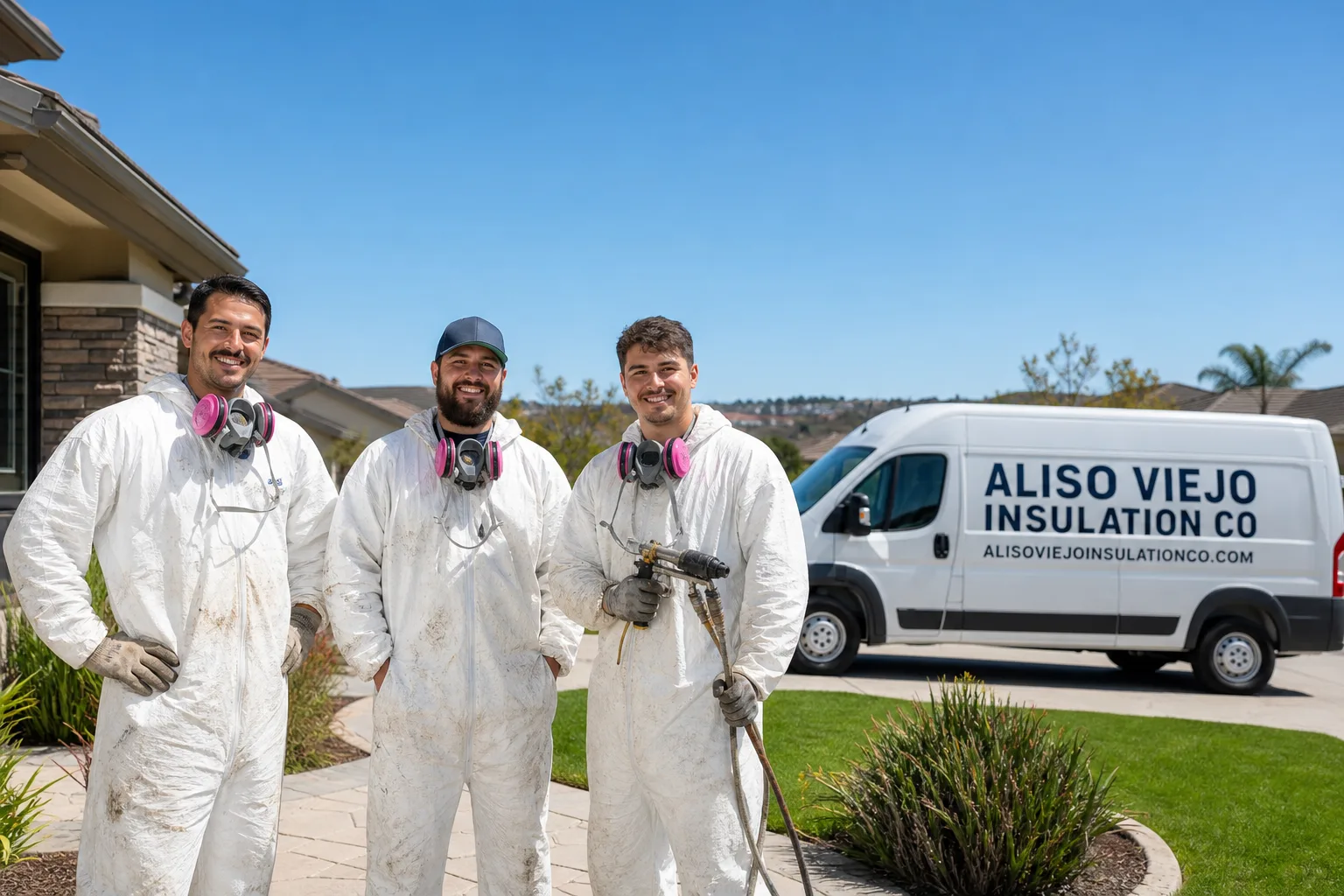
Our crews come from Aliso Viejo with experience across the high desert and mountain-adjacent communities, and the difference shows in how we approach a Spring Valley Lake attic. We inspect the rafter bays, the existing venting, the condition of old batt insulation, and the west-facing exposure before recommending anything. Nate Calloway built this company around a simple rule: recommend the right material for the specific house, not the material that’s easiest to install. That’s why we carry both open-cell and closed-cell spray foam systems from Icynene and Demilec, and why we’re authorized to install products from Owens Corning, Johns Manville, Knauf, Rockwool, CertainTeed, and GreenFiber. When a Spring Valley Lake homeowner needs mineral wool for fire resistance near a lakefront deck or recycled cellulose for an eco-conscious retrofit, we can supply it. Most single-brand contractors can’t.
Response time matters when your west-facing living room climbs 15 degrees above the rest of the house by 2 p.m. We prioritize Spring Valley Lake calls and typically schedule an on-site assessment within 48 hours, with installation often completed the same week. Estimates are free, and every quote includes a written scope that specifies the foam type, the R-value target, and how we’ll handle venting so the HOA review doesn’t stall the project.
Garage Spray Foam Insulation in Spring Valley Lake
Garage Spray Foam Insulation in Spring Valley Lake is one of the most common requests we field, because so many homes here have attached garages on the west or south side of the lot that turn into heat boxes by early afternoon. When the garage shares a wall or ceiling with living space, that heat doesn’t stay in the garage; it bleeds into the house and forces the cooling system to work against a thermal load the original 1970s construction never anticipated. A typical garage ceiling spray foam job in Spring Valley Lake runs $1,400 to $2,800 for a standard two-car garage, depending on whether we’re foaming the ceiling only or carrying it down the shared wall.
Attached Garage Ceiling and Shared Wall
On a home off Spring Valley Parkway, we sprayed a closed-cell foam layer on the garage ceiling and the full shared wall between the garage and an adjacent bedroom. The foam sealed the air gaps around the old framing and added enough R-value to knock the bedroom temperature down noticeably within the first week. Closed-cell makes sense here because it doubles as an air barrier, which open-cell doesn’t do as effectively at lower thicknesses.
When the Garage Door Panel Radiates Heat
Metal garage doors facing west absorb solar heat all afternoon and radiate it into the space until midnight. Foaming the ceiling helps, but the bigger win usually comes from sealing the air leakage around the door’s perimeter and insulating the ceiling above. We’ve measured 20-degree differences between a foamed garage ceiling and an unfoamed one on two nearly identical Spring Valley Lake homes in the same week.
Closed Cell Spray Foam Insulation in Spring Valley Lake
Closed Cell Spray Foam Insulation in Spring Valley Lake is what we recommend for most lakefront and lake-view homes, because the wind and moisture exposure off the lake demand a material that holds its R-value when it gets damp and adds structural rigidity to aging roof decks. Closed-cell foam runs roughly $1.10 to $1.80 per board foot installed in the 92395 market, with a typical rafter-bay application on a sloping lake-oriented roof landing between $3,500 and $6,800. It’s hydrophobic, which matters when wind-driven rain finds its way under older tile or composition shingles near the waterline.
Cathedral Ceilings on Lake-View Homes
West-facing cathedral ceilings over living rooms are where Spring Valley Lake insulation failures show up first. The original 1978-era batts compress under their own weight after forty-plus years, and once they sag, the air gap between the insulation and the roof deck becomes a solar chimney. Closed-cell foam sprayed directly against the underside of the roof deck eliminates that gap and locks the temperature differential where it belongs.
Rim Joists and Air Sealing
Before we ever foam an attic, we check the rim joists. Spring Valley Lake’s persistent wind drives air through every unsealed penetration in the building envelope, and rim joists in 1970s and 80s construction are rarely sealed at all. A closed-cell rim joist application on a typical Spring Valley Lake home costs $800 to $1,600 and usually pays for itself within two cooling seasons on the reduced air infiltration alone.
Trusted Brands We Service in Spring Valley Lake
We’re authorized to install spray foam systems from Icynene and Demilec, two of the most widely specified foam chemistries in North American residential construction, and we stock the supporting materials Spring Valley Lake jobs require without waiting on special orders. For homes where spray foam isn’t the right call – and there are some – we also supply Owens Corning fiberglass batts, Johns Manville products, Knauf insulation, and Rockwool mineral wool. Access to eight manufacturer lines means the recommendation you get in Spring Valley Lake is based on your home’s orientation, existing venting, and HOA constraints, not on whichever brand we happen to have in the warehouse. Nate Calloway set up the supply relationships this way on purpose.
Common Spray Foam Insulation Problems We See in Spring Valley Lake Homes
- Collapsed original batts in west-facing attic spaces. Homes built between the late 1960s and mid-1980s were insulated to far lower standards than Title 24 requires today, and forty-plus years of wind vibration and radiant heat have compressed those batts to a fraction of their original R-value. The cathedral ceilings over lake-view living rooms are always the first hot spot.
- Deteriorating duct insulation in near-water homes. UV exposure and constant wind break down the outer jacket on older duct insulation, especially in crawlspaces and attics facing the lake. We often spray foam the air handler and main trunk lines before adding attic R-value, because sealing the ducts first keeps the conditioned air from leaking into the attic.
- HOA flagging visible foam at the eaves. Spring Valley Lake’s architectural review treats exposed spray foam and changed roofline venting as exterior modifications. We plan attic-side applications and vent-chute placement so the foam never shows from the street or the lake side of the house.
- Open-cell foam traps heat under composition shingles. Open-cell applied too thick on the underside of a composition-shingle roof deck can hold heat against the shingles and shorten their service life. On Spring Valley Lake homes with dark shingles and full western exposure, we recommend a radiant-barrier or vent-chute strategy alongside the foam, and we’ll put that in the written scope.
Pricing for Spray Foam Insulation in Spring Valley Lake, CA
A garage ceiling spray foam application in Spring Valley Lake typically lands between $1,400 and $2,800. A closed-cell rafter-bay retrofit on a lake-view cathedral ceiling runs $3,500 to $6,800 depending on the square footage and how much old material needs removal first. Rim joist air sealing on a standard single-story home usually falls between $800 and $1,600. What moves the number: foam thickness, whether we’re removing failed batts first, how much venting has to be preserved or hidden for HOA compliance, and whether ducts need sealing before the attic work begins. Every Spring Valley Lake estimate includes a free on-site assessment, a written scope, and a line-item price so you can see exactly where the money goes. Call (877) 352-4780 and we’ll schedule the walkthrough.
We Also Serve Cities Near Spring Valley Lake
Our crews cover the surrounding high-desert communities, including Mountain View Acres, Victorville, Apple Valley, and Hesperia. Whether you’re in a lakefront home in Spring Valley Lake or a 1980s rancher in Hesperia, our Spray Foam Insulation team brings the same material-agnostic approach and HOA-aware planning to every job. One call schedules service anywhere in the Victor Valley.
Serving Spring Valley Lake, CA — Our Local Coverage Area
We’re based in the Spring Valley Lake area and know this community well. Use the map below to see our service coverage — if you’re nearby, we can almost certainly help.
FAQs About Spray Foam Insulation in Spring Valley Lake
Yes, visible exterior changes trigger Spring Valley Lake HOA architectural review, so any spray foam application that would be visible from the street or lake side needs approval. Most of the foam work we do in Spring Valley Lake is applied from the attic side or behind existing vent chutes, which means no exterior change at all. We plan every job so the foam never shows, and we can provide documentation for the architectural review board if your project does involve a visible change. Call (877) 352-4780 and we’ll walk you through what the HOA will and won’t flag.
West-facing cathedral ceilings overheat because the original 1970s and 80s batt insulation has compressed and sagged away from the roof deck, leaving an air gap that acts as a solar chimney. The wind and radiant heat off the lake accelerate this deterioration, so the ceiling reads 10 to 15 degrees hotter than the rest of the house by mid-afternoon. Closed-cell spray foam applied directly to the underside of the roof deck eliminates the gap and holds the heat where it belongs. Call (877) 352-4780 for an assessment of your specific ceiling.
Yes, and on many Spring Valley Lake homes the ducts need attention before the attic does. UV exposure and constant wind break down the outer jacket on older duct insulation, especially in attics and crawlspaces facing the lake, and that leakage wastes cooled air before it ever reaches the living space. We spray foam the air handler and main trunk lines first, then evaluate what the attic needs. Call (877) 352-4780 and we’ll check both during the free assessment.
Yes, and it’s one of the fastest paybacks in the Victor Valley because west-facing garages in Spring Valley Lake collect solar heat from noon until sunset and radiate it into attached living spaces all evening. A standard two-car garage ceiling application runs $1,400 to $2,800 and typically drops the adjacent room’s temperature within a week. We’ve measured 20-degree reductions in the garage itself on comparable homes. Call (877) 352-4780 for a quote specific to your garage.
If the home still has its original 1970s or 80s batt insulation, retrofit almost always makes more sense than trying to patch what’s there. The old material is compressed, the air sealing was never adequate, and the house was built to standards that are well below current Title 24 requirements. If a previous spray foam application failed – usually because open-cell was applied too thick under a composition-shingle roof without a vent strategy – we evaluate whether the foam can be remediated or needs removal before reapplication. We’ll tell you which way to go after a free on-site assessment. Call (877) 352-4780 to schedule one.
For spray foam insulation in Spring Valley Lake, CA, call Aliso Viejo Insulation Co at (877) 352-4780. Free estimates, written scopes, and HOA-aware planning on every project.
Written by Nate Calloway, Owner at Aliso Viejo Insulation Co, serving Spring Valley Lake and the surrounding Victor Valley.