
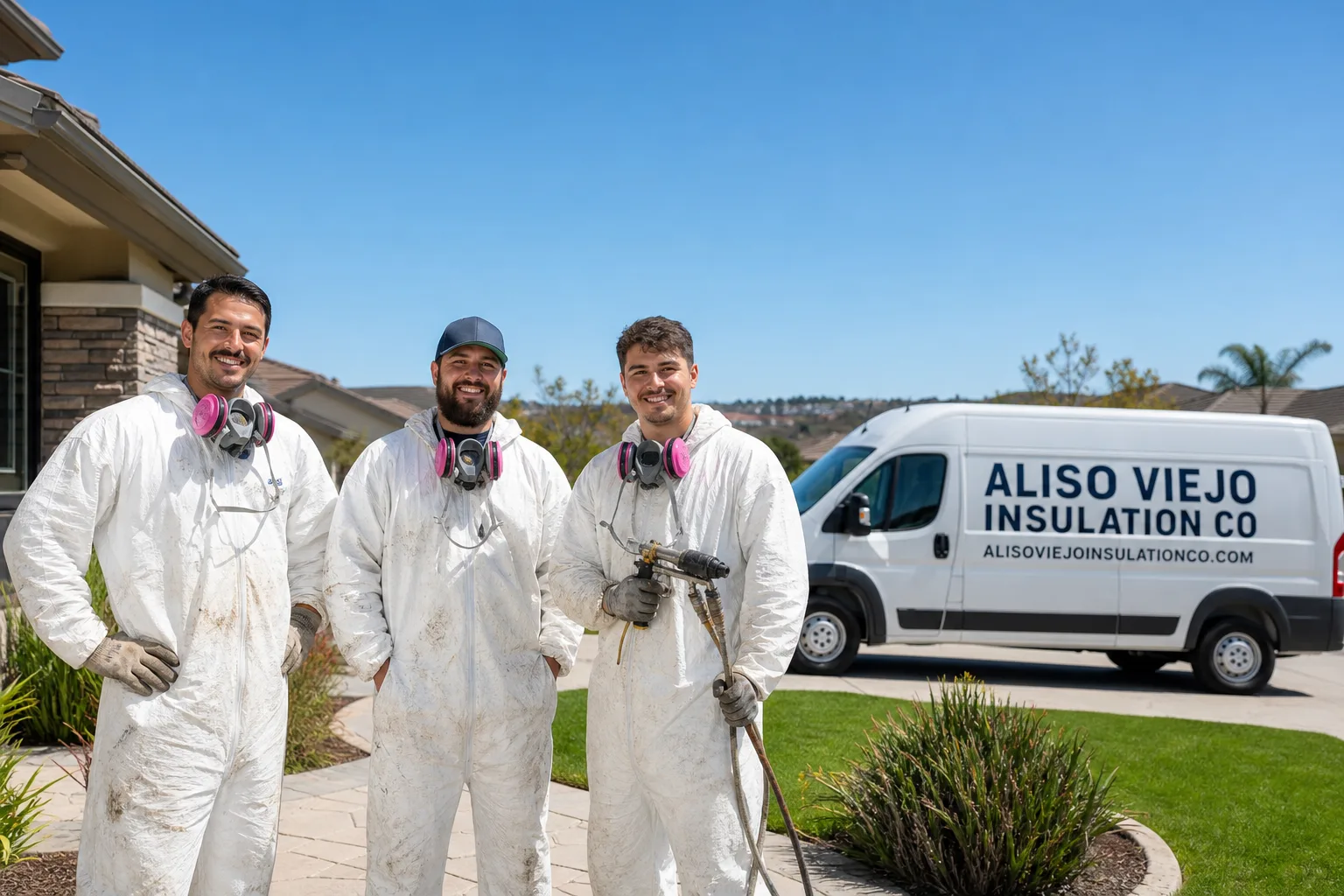
Fast, Reliable Attic Insulation Across Hawthorne
Attic insulation in Hawthorne usually runs $1,500 to $4,200 for a full removal and re-insulation on a typical 1940s-50s bungalow, and most jobs are done in one day. That’s the range we quote most often for the 90250 and 90251 zip codes, where the postwar tract homes need more work than people expect. We know Hawthorne’s houses because we’ve been inside hundreds of them, from the bungalow rows off Hawthorne Boulevard to the converted-garage ranches near Prairie Avenue, and we can usually tell you what’s in your attic before we climb the ladder. If you’re tired of hearing every LAX departure through your ceiling or watching your upstairs rooms swing ten degrees every afternoon, call us at (877) 352-4780 and we’ll schedule an attic inspection this week.
Why Aliso Viejo Insulation Co Is Hawthorne’s Preferred Attic Insulation Company
Homeowners in Hawthorne keep calling us back because we actually diagnose the problem instead of just quoting a re-insulation by square footage. Nate Calloway built this company around one principle: the right insulation for your home’s specific conditions. In Hawthorne, those conditions are coastal humidity, aircraft noise, and 70-year-old framing. That combination demands a different approach than we’d use inland, and we’ve learned exactly what works here.
We’re not a franchise sending whoever’s available. The team that shows up in Hawthorne knows the difference between a 1948 stucco bungalow on a tight lot and a 1960s apartment conversion near the 105. We’ve removed more moisture-blackened batts from Hawthorne attics than we can count, and we’ve re-insulated enough of them to know which materials hold up against marine-layer condensation and which don’t. Feedback from Hawthorne customers has been consistent: we’re thorough, we show up on time, and we don’t push a product just because it’s on the truck.
Attic Insulation Removal in Hawthorne
Attic insulation removal in Hawthorne is the service we recommend more than any other, because most of the attics here were insulated once in the 1950s and never touched again. The first sentence of every inspection report we write for a Hawthorne home says some version of the same thing: old batts, wet from condensation, sagging between the joists, doing almost nothing. Removal means vacuuming out the old fiberglass or mineral wool, bagging it, and disposing of it before any new insulation goes in. You need removal when the existing material is wet, moldy, pest-damaged, or compressed to the point where its R-value is a fraction of what it was rated for. In Hawthorne, that’s most homes built before 1960. Full removal for a 1,200-square-foot attic typically runs $800 to $1,600 on its own, or $1,500 to $3,200 when bundled with new insulation installation.
What We Remove
Fiberglass batts from the 1950s and 60s are the most common find in Hawthorne attics, followed by loose mineral wool that’s drifted and compacted over decades. Cedar or foil-backed batts show up too, usually in homes where a previous owner did a partial fix. We also remove mouse and rat nesting material, which is unfortunately common in the older tracts around Lawndale and the 90250 core.
What Removal Involves Here
Hawthorne attics tend to be tight, low-pitch spaces with limited access hatches, often through a hallway ceiling or a bedroom closet. We work carefully around existing wiring, recessed light housings, and the odd converted-garage framing that’s everywhere in this city. After removal, we can treat framing for surface mold and let the space dry before new material goes in, which matters more in Hawthorne than almost anywhere else in LA County because of the marine layer.
Insulation Contractors in Hawthorne
Insulation contractors in Hawthorne come in two flavors: the ones who only install one product and the ones who’ll actually evaluate your house. We’re the second kind. We install fiberglass, mineral wool, blown cellulose, and both open- and closed-cell spray foam, because we source from eight manufacturers including Owens Corning, Johns Manville, Knauf, Rockwool, CertainTeed, Icynene, Demilec, and GreenFiber. Eight manufacturer brands, one objective recommendation. That’s the whole point when you hire us.
For Hawthorne’s postwar bungalows and ranches, the job usually involves removing failed batts, air-sealing the attic floor and top plates, and installing new material matched to the home’s specific noise and moisture exposure. Houses directly under the LAX approach paths need different treatment than ones south of Rosecrans with tree cover and more distance from the flight corridors. Expect to pay $2,000 to $4,200 for a complete attic re-insulation in Hawthorne, including old material removal, air sealing, and new R-38 to R-49 insulation. It’s the best money you’ll spend on a house built before 1960.
Single-Source Specialist
Because we handle removal, air sealing, and installation under one contract, you’re not coordinating three companies or wondering whose fault it is when something doesn’t line up. Our crews do the full job start to finish, and the same installers who pull your old batts are the ones who’ll lay the new ones.
Building Science, Not Brand Loyalty
We don’t have a quota on spray foam or a warehouse full of one brand we need to move. We recommend Rockwool when sound damping and fire resistance matter, Owens Corning or Johns Manville fiberglass when budget is the priority, and cellulose from GreenFiber when you want a recycled, eco-forward option. Spray foam from Icynene or Demilec gets specified when air sealing demands it, but it’s not the right answer for every Hawthorne attic, and we’ll tell you when it isn’t.
Trusted Brands We Service in Hawthorne
Hawthorne homeowners get access to a full manufacturer roster without having to call around. We’re authorized to install products from Owens Corning, Johns Manville, Knauf, Rockwool, CertainTeed, Icynene, Demilec, and GreenFiber, which means your recommendation comes from building science, not from whatever’s in the warehouse. We stock materials for the common Hawthorne jobs locally, so most re-insulation projects can kick off within a week of the estimate. For homes under the flight path, we keep Rockwool batts on hand specifically because they cut airborne noise better than standard fiberglass. If a specific product is backordered, we’ll tell you up front and offer a comparable alternative from another brand rather than stalling the job.
Common Attic Insulation Problems We See in Hawthorne Homes
- Marine-layer condensation soaking batts. The humidity that rolls in off the ocean south of LAX gets into vented attics and condenses on the underside of the roof deck. Over years, this wets the batts below, and wet insulation is dead insulation – it compresses, loses R-value, and often goes moldy before you ever see it.
- LAX and traffic noise through thin ceilings. Homes built in the 1940s and 1950s often have little more than a layer of rock lath and plaster between the attic and the living space, with maybe an inch or two of original insulation. Every departure, every landing, every truck on Hawthorne Boulevard comes straight through. New high-density insulation makes a real, measurable difference, and it’s the first thing homeowners mention after we finish.
- Original batts sagging between joists. Kraft-faced fiberglass from the 1950s is usually stapled to the joist sides, and after 70 years of humidity cycles the staples fail and the batts drop. The result is a big air gap between the insulation and the ceiling below, which is almost the same as having no insulation over half the attic.
- Uninsulated stucco wall cavities. Most Hawthorne tract homes have no wall insulation at all, just stucco, wire, and open stud bays. That’s a whole-wall issue we can address with blown-in methods, and it’s one of the reasons indoor temperatures swing so much even when the attic is in decent shape. Our Attic Insulation team will let you know if your wall cavities are contributing to the problem.
Pricing for Attic Insulation in Hawthorne, CA
Here’s what we actually quote for Attic Insulation in Hawthorne, not a national average. Attic insulation removal alone runs $800 to $1,600 for a standard postwar bungalow attic around 1,000 to 1,400 square feet. A complete removal plus re-insulation with R-38 fiberglass or mineral wool runs $2,000 to $3,800. Adding air sealing typically brings the total to $2,400 to $4,200. Spray foam runs higher, usually $4,500 to $7,500 for a full attic, but we only recommend it when the conditions justify it. Homes directly under the LAX approach or with converted garages and add-on rooms tend to land at the upper end. Estimates are free, and the quote we give you is the price – no add-on surprises after we start. Call (877) 352-4780 for an exact number on your house.
We Also Serve Cities Near Hawthorne
Our territory reaches well beyond the 90250 and 90251 zip codes. We handle attic insulation and removal across Del Aire, Inglewood, Lennox, and Lawndale regularly, and we’re familiar with how those neighborhoods’ housing stock differs from Hawthorne’s. If you’re a few blocks over the city line on Rosecrans or Prairie, the same crew that knows Hawthorne’s postwar attics can be at your place just as fast.
Serving Hawthorne, CA — Our Local Coverage Area
We’re based in the Hawthorne area and know this community well. Use the map below to see our service coverage — if you’re nearby, we can almost certainly help.
FAQs About Attic Insulation in Hawthorne
Because Hawthorne sits under the marine layer south of LAX, and that humidity migrates into vented attics and condenses on cool surfaces almost year-round. Inland attics mostly deal with dry heat, which degrades insulation slowly. Hawthorne attics deal with persistent moisture, which soaks batts, collapses their loft, and causes them to sag and mold within 15 to 20 years. Add LAX overflight vibrations and the material breaks down even faster. If you’re in a 1940s or 1950s home and have never looked in the attic, it’s probably time. Call (877) 352-4780 and we’ll inspect it for free.
Every two years is smart for a Hawthorne home under the flight path, and annually if you’re in one of the older tracts near Lawndale or the 105 corridor where condensation is heaviest. Look for sagging batts, water stains on the ceiling below, or any musty smell after a damp stretch. If you’re seeing drywall nail pops or your upstairs runs noticeably warmer than downstairs by mid-afternoon, that’s another sign the attic insulation has checked out. We inspect Hawthorne attics regularly as part of our free estimate process.
Yes, and it’s one of the most common reasons Hawthorne homeowners call us. High-density materials like Rockwool batts and dense-packed cellulose absorb airborne sound noticeably better than standard low-density fiberglass. We typically recommend Rockwool or GreenFiber cellulose for homes in the 90250 core where aircraft noise is constant, and homeowners consistently report fewer flyover disturbances after installation. It won’t make a plane silent, but it takes the edge off enough that conversations and sleep stop getting interrupted. Call (877) 352-4780 and we’ll talk through which material fits your home’s noise exposure.
The answer depends on whether you’re under the flight path and how much moisture your attic traps. Most 1950s Hawthorne bungalows do well with R-38 to R-49 fiberglass or mineral wool batts after the old material is removed and the attic floor is air-sealed. Rockwool batts are our default recommendation along the LAX corridor because they add real sound damping along with thermal performance. If your attic is tight and the roof deck shows signs of condensation, we’ll talk about whether air sealing upgrades or a vapor-management strategy should come first before you spend money on insulation. There’s no single right answer for every house, and that’s exactly the point of working with a material-agnostic contractor.
In most Hawthorne homes built before 1960, yes. The existing batts are usually wet, compressed, moldy, or all three, and blowing new insulation over the top just hides the problem while the old material keeps rotting underneath. Removing the failed material first also lets us air-seal the top plates, wiring penetrations, and recessed light housings, which is where most of the air leakage actually happens. In some clean, dry attics we can do a top-up without full removal, but that’s the exception in Hawthorne, not the rule. We’ll tell you honestly after we see the space, and the inspection is free.
Written by Nate Calloway, Owner at Aliso Viejo Insulation Co, serving Hawthorne and the South Bay since our founding.