
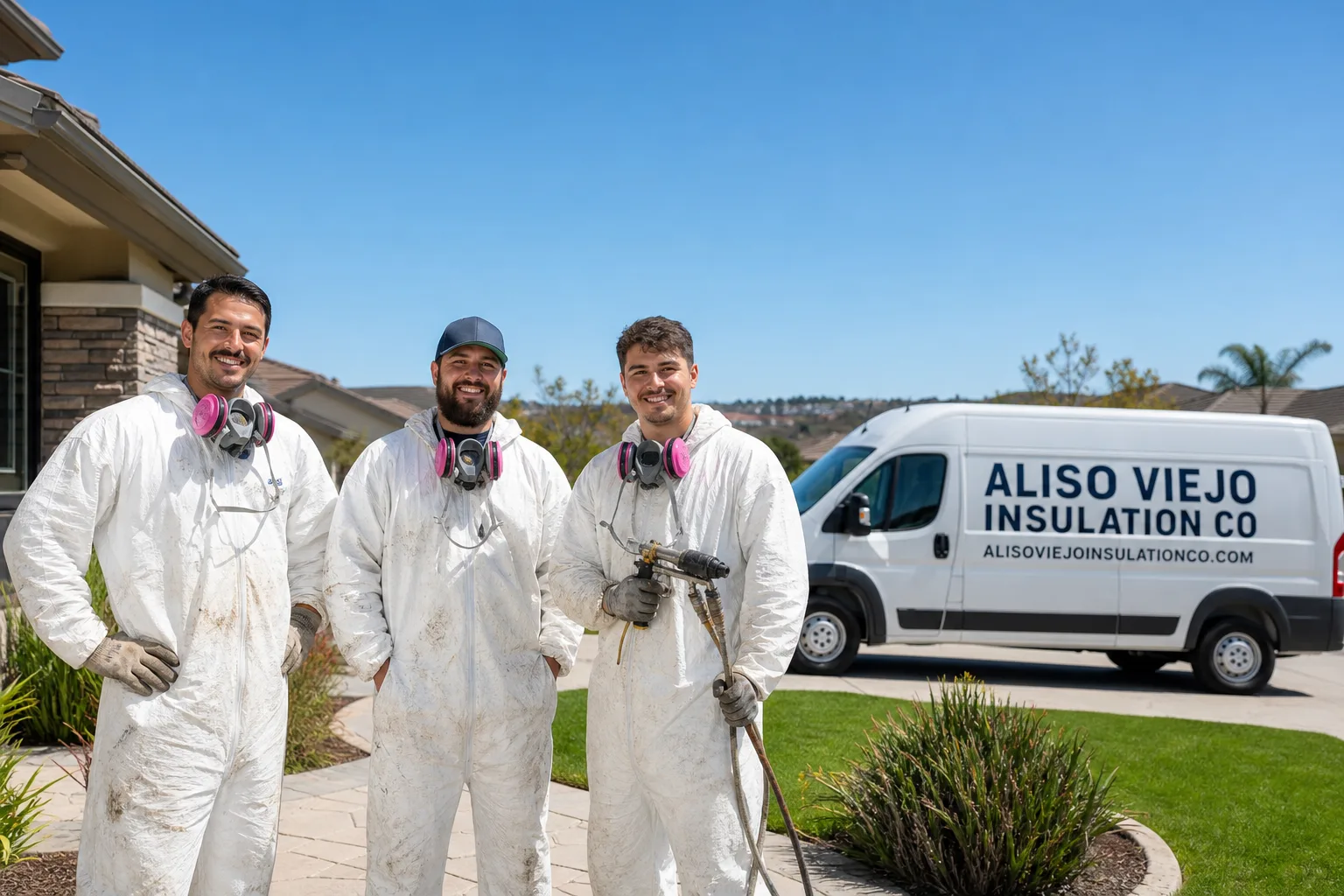
Fast, Reliable Spray Foam Insulation Across Cabazon
Spray foam insulation in Cabazon typically costs $2.50 to $6.50 per square foot installed, with most whole-attic jobs landing between $4,200 and $9,800 depending on foam type and depth. We get crews out to Cabazon within 24 to 48 hours for most jobs because we know a 110°F attic waits for no one. Call (877) 352-4780 for a free estimate with real numbers, not ballpark ranges pulled from a national chart.
Why Aliso Viejo Insulation Co Is Cabazon’s Preferred Spray Foam Insulation Company
Cabazon homes face a problem most insulation contractors never see: the San Gorgonio Pass wind physically moves loose insulation. We’ve crawled through enough Cabazon attics off Main Street and along the 10 corridor to know what wind-scoured fiberglass looks like, and more importantly, what stops it. Spray foam stays put because it bonds to the surface. That simple difference matters more here than almost anywhere else in Riverside County.
Nate Calloway built this company around one principle: match the material to the job, not to what’s sitting on the truck. We’re authorized installers for eight manufacturers including Icynene and Demilec, so when we recommend closed-cell foam for a Cabazon attic, it’s because the wind and heat demand it, not because it’s all we carry. Homeowners across Cabazon have called us after other quotes told them fiberglass was “good enough.” It isn’t here. Our Spray Foam Insulation team has seen the difference a properly spec’d foam makes in high-wind, high-heat conditions.
We serve all of Cabazon’s 92230 zip code, from the older streets near the outlets to the newer tracts east of the pass. Response time to Cabazon runs 24 to 48 hours for standard estimates. Emergency jobs where an attic is fully exposed or a retrofit has failed mid-summer get prioritized same-week whenever possible.
Closed Cell Spray Foam Insulation in Cabazon
Closed Cell Spray Foam Insulation is the most common spray foam spec we install in Cabazon because it handles both of the area’s extreme conditions: intense radiant heat and wind-driven air infiltration. Closed-cell foam cures into a rigid, dense layer that adds structural strength, blocks air movement, and holds an R-value around R-6.5 to R-7 per inch even when temperatures swing 40 degrees between night and noon. In a Cabazon attic, that dense air seal is what keeps 110°F outdoor air from pushing into the living space through every crack the wind finds.
Wind Sealing and Dust Control
The wind through the pass doesn’t just cool the air; it forces dust and fine debris into any gap in the building envelope. Closed-cell foam’s continuous air barrier seals those gaps at the attic floor, rim joists, and wall-to-ceiling transitions. Once cured, the foam blocks the dust that otherwise sifts through perforations in older drywall and framing.
Roof Deck and Attic Floor Applications
Applying closed-cell foam directly to the underside of a roof deck converts an attic into a semi-conditioned space, which helps when HVAC ductwork runs through the attic, something common in Cabazon’s older single-story homes. Expect closed-cell spray foam in Cabazon to run $3.50 to $6.50 per square foot depending on depth and surface prep.
Open Cell Spray Foam in Cabazon
Open Cell Spray Foam runs $2.50 to $4.50 per square foot in Cabazon and is the quieter, more forgiving option for interior walls, sound dampening, and attics where air sealing matters more than maximum R-value per inch. Open-cell foam expands aggressively, fills irregular cavities well, and breathes slightly, which works well in vented attic assemblies. In Cabazon’s dry climate, open-cell foam’s moisture permeability is rarely a problem, though it should not be used in contact with the ground or where standing water is possible.
Interior Sound Control
Cabazon sits close to the 10 freeway and the constant hum of pass traffic. Open-cell foam’s soft, porous structure absorbs sound better than closed-cell, making it a practical choice for shared walls, bedrooms facing the freeway, and home offices. It doesn’t replace drywall, but it measurably cuts the din.
Budget-Sensitive Attic Sealing
For Cabazon homeowners who need air sealing but can’t justify the full closed-cell cost, open-cell foam at thicker depths still delivers solid performance. At 6 inches, it approaches R-21 to R-22 while sealing gaps nearly as effectively. The trade-off is that open-cell won’t stop driving rain or hold up to sustained moisture, which matters less in Cabazon’s arid climate than it would on the coast.
Trusted Brands We Service in Cabazon
We install both Icynene and Demilec spray foam systems in Cabazon, and we carry Owens Corning and Johns Manville products for hybrid jobs where foam pairs with batt or blown-in fiberglass. Having access to multiple manufacturers means we’re not locked into one chemistry when a Cabazon home calls for something specific. Stock for Cabazon jobs is staged at our Aliso Viejo facility, so most materials arrive on-site the morning of the install without supply-chain delays. Spray Foam Insulation in Cabazon shouldn’t mean waiting two weeks for a truck from Texas.
Common Spray Foam Insulation Problems We See in Cabazon Homes
- Wind-scoured loose-fill under spray foam retrofits. In many Cabazon attics, the existing fiberglass or cellulose has drifted to one side, leaving half the attic floor bare. Spray foam applied over these gaps bonds directly to the drywall, but the old material has to be redistributed or removed first or you’re sealing in a thermal void.
- Delaminated foam on aging roof decks. Cabazon’s UV exposure and 100°F-plus attic temperatures stress the bond between spray foam and older plywood or OSB. We see this most often with DIY kits or rushed installs where the deck wasn’t cleaned or primed. Proper surface prep on 1960s and 1970s Cabazon bungalows adds time but prevents peeling within five years.
- Insufficient foam depth at the eaves. The wind pushes air hard through the soffit-to-wall transition, and thin foam at the perimeter lets heat bleed into the living space exactly where the afternoon sun hits. We spec minimum 2 inches of closed-cell at all Cabazon eave lines, even when the field of the attic gets less.
- Manufactured home belly boards with failing factory insulation. Cabazon has a significant stock of manufactured homes where the undercarriage insulation has compacted, been torn out by wind-driven rodents, or simply degraded. Spray foam on the underside helps only if the belly board and perimeter rim are properly prepped; otherwise the foam bonds to dust and fabric that’s about to fail.
Pricing for Spray Foam Insulation in Cabazon, CA
| Service | Typical Cabazon Range |
|---|---|
| Open-cell spray foam, attic floor | $2.50 – $4.50 / sq ft |
| Closed-cell spray foam, attic floor | $3.50 – $5.50 / sq ft |
| Closed-cell spray foam, roof deck | $4.50 – $6.50 / sq ft |
| Rim joist spray foam (per linear foot) | $14 – $22 / linear ft |
| Garage ceiling spray foam | $2.75 – $5.00 / sq ft |
Whole-attic closed-cell jobs in Cabazon typically land between $5,000 and $9,800. Open-cell runs $3,500 to $7,200. The variables are attic size, access difficulty, existing insulation removal, and whether the roof deck needs prep work. Call (877) 352-4780 for a written quote based on your attic’s actual square footage. Estimates are free and the number we give you is the number you pay.
We Also Serve Cities Near Cabazon
Our crews regularly work in Cabazon and the surrounding pass communities. We serve Banning for homeowners dealing with similar wind and heat conditions, plus Idyllwild and Idyllwild-Pine Cove where the elevation changes the insulation calculus entirely. Garnet is also in our regular service area for both new construction retrofits and older home upgrades.
Serving Cabazon, CA — Our Local Coverage Area
We’re based in the Cabazon area and know this community well. Use the map below to see our service coverage — if you’re nearby, we can almost certainly help.
FAQs About Spray Foam Insulation in Cabazon
Cabazon’s San Gorgonio Pass wind actually improves the case for spray foam because the foam’s adhesive bond prevents the displacement that plagues loose-fill insulation here. Wind pushes airborne dust through any gap in the envelope, but closed-cell foam seals those gaps permanently, so the air and dust never enter the building assembly. Loose-fill fiberglass in Cabazon attics routinely gets scoured into piles at the downwind eaves, leaving bare drywall elsewhere; spray foam doesn’t move once cured. Call (877) 352-4780 to have us assess your attic’s wind exposure.
Yes, spray foam works in Cabazon manufactured homes, but the undercarriage must be properly prepped first. The belly board, rim joists, and factory-installed insulation need inspection before foam goes on. In many Cabazon manufactured homes, the original fiberglass has compacted or been displaced, and spraying foam over failing material just seals in the problem. We spec closed-cell foam on the underside after addressing the existing condition, which gives both air sealing and structural reinforcement. Estimates for manufactured home undercarriage work in Cabazon are free: (877) 352-4780.
For Cabazon’s climate, we recommend at least R-38 in the attic, which means about 6 inches of open-cell foam or 5.5 inches of closed-cell foam on the attic floor. If you’re foaming the roof deck to create a conditioned attic, R-20 to R-26 is typically adequate because the conditioned space shifts. Cabazon’s extreme heat makes air sealing more important than raw R-value; a continuous foam layer that stops air infiltration outperforms fluffy fiberglass with double the nominal R-value once the wind starts pushing hot air through gaps.
No, spray foam cannot be sprayed directly over existing fiberglass in a Cabazon attic. The foam needs a clean, solid substrate to bond to, and spraying over batts or loose-fill creates an unbonded layer that eventually delaminates and fails. In Cabazon, where wind has typically pushed existing fiberglass into uneven drifts anyway, the old material should be removed or redistributed first. We handle the removal and disposal as part of the job, and pricing includes that prep work. For a quote on your attic’s specific condition, call (877) 352-4780.
For Cabazon homes specifically, closed-cell foam is the stronger default because it resists wind-driven dust intrusion better, holds its R-value under extreme temperature swings, and adds structural rigidity to older single-story homes. Open-cell foam costs less and excels at sound control, which matters along the 10 freeway corridor, but it’s vapor-permeable and softer. In most Cabazon attics we recommend closed-cell at the eaves and rim joists where wind drives air hardest, with open-cell as a cost-saving option in the field of the attic floor. Call (877) 352-4780 and we’ll walk you through which chemistry fits your specific house.
We recently sprayed closed-cell foam in a 1960s desert bungalow off Bonita Avenue in Cabazon, where decades of wind had pushed loose-fill into a six-inch pile at the east eave, leaving the west half of the attic bare. Our tech applied two inches of Icynene closed-cell foam directly to the drywall, sealing the attic floor and locking out the dust that had been sifting through the wind-scoured gaps. The homeowner immediately noticed fewer dust intrusions and a more stable indoor temperature during 110°F afternoons.
If your Cabazon attic is baking your house or the wind is winning, call (877) 352-4780. We’ll measure, spec the right foam for your roof and your budget, and give you a written quote before any work starts.
Written by Nate Calloway, Owner at Aliso Viejo Insulation Co, serving Cabazon and the San Gorgonio Pass communities.