
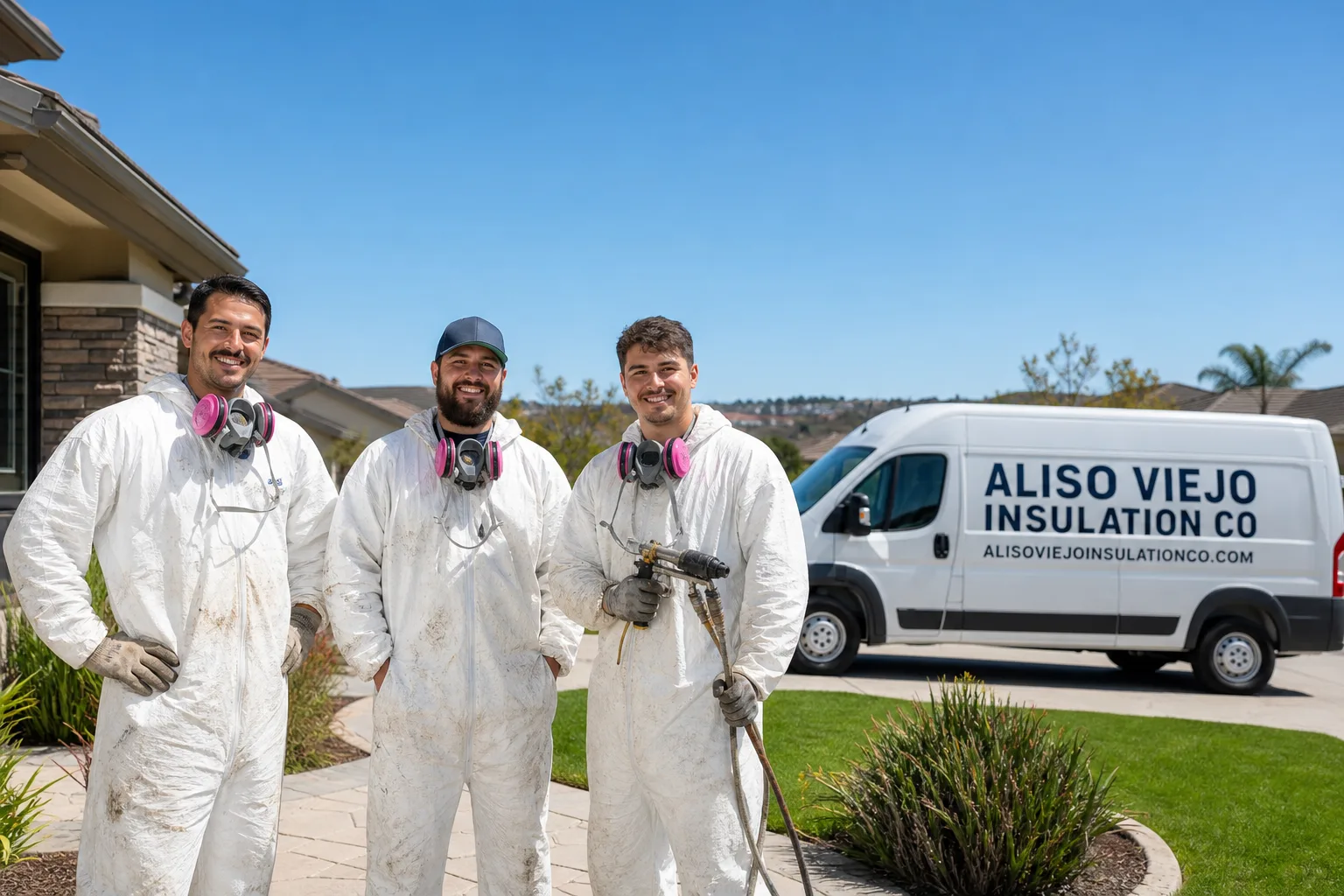
Fast, Reliable Spray Foam Insulation Across Covina
Spray foam insulation in Covina typically runs $2.50 – $6.00 per board foot depending on open-cell versus closed-cell chemistry, and most attic jobs fall between $3,200 and $7,800 for a typical 1,200 – 1,800 square foot ranch home. We respond to Covina service calls from our Aliso Viejo base, covering every neighborhood across 91722, 91723, and 91724, usually within one to two business days for estimates. If your attic hits 140°F in August and your air conditioner can’t keep up, the problem isn’t your HVAC – it’s the thermal envelope. Call (877) 352-4780 and we’ll diagnose it properly.
Why Aliso Viejo Insulation Co Is Covina’s Preferred Spray Foam Insulation Company
Covina homeowners call us because we don’t show up pushing one product. We install spray foam from Icynene and Demilec, but we also work with Owens Corning fiberglass, Rockwool mineral wool, and GreenFiber cellulose. That means when we recommend spray foam for your Covina attic, it’s because your specific house – its roof pitch, its framing, its existing insulation – actually warrants it, not because it’s the only thing on the truck.
Our crews know Covina’s housing stock. We’ve foamed attics off Badillo Street, worked crawlspaces in the tract homes north of the 10, and air-sealed ranch houses near Covina High. Nate Calloway runs every project with the same standard: the foam goes in right, the air-sealing gets done, and you get an honest assessment of what your home actually needs. We’re material-agnostic by design. Eight manufacturer brands, one objective recommendation.
Homeowners in Covina regularly tell us the same thing: other contractors quoted them a product, not a solution. That’s the difference. Our Spray Foam Insulation team shows up, measures your attic’s actual R-value, checks for air leaks, then tells you what’s worth doing and what isn’t.
Spray Foam Insulation Contractors in Covina
Spray foam insulation contractors in Covina work on homes that most contractors in newer cities never see. The post-war ranch and tract homes across 91722, 91723, and 91724 were built when energy was cheap and insulation was an afterthought. Many attics still hold the original fiberglass batts, now settled to functional R-values of 7 or less. A proper spray foam job here involves air-sealing top plates and penetrations, addressing any existing moisture issues, then applying foam at the right depth and density for the application.
When a Covina homeowner needs this work, it’s usually because they’ve noticed upstairs rooms running 10 – 15 degrees warmer than the rest of the house in summer, or their energy bills have crept up despite a newer HVAC system. The fix is rarely just adding more insulation. It’s fixing the air movement first.
Open-Cell vs. Closed-Cell
Open-cell foam runs about $2.50 – $3.50 per board foot in Covina and works well for interior wall cavities and sound control. Closed-cell runs $3.50 – $6.00 per board foot, adds structural strength, and acts as its own vapor barrier. For Covina attics, we often recommend closed-cell on the roof deck in homes with ductwork in the attic, because it keeps the entire attic space inside the conditioned envelope.
Rim Joist and Garage Ceiling Work
Rim joist spray foam in Covina runs roughly $900 – $2,200 depending on linear footage and access. It’s one of the highest-payback jobs we do, sealing the gap where foundation meets framing. Garage ceiling foam – especially under finished bonus rooms – typically runs $1,400 – $3,600 and makes a measurable difference in rooms above garages.
Spray Foam Attic Insulation in Covina
Spray foam attic insulation in Covina is the single most effective upgrade for the city’s shallow attics and intense summer heat. Most of the attics we see over 1950s – 1970s ranch homes don’t have enough clearance for deep blown-in insulation to hit modern R-values without blocking soffit vents. Closed-cell foam solves that by delivering R-6.5 to R-7 per inch – meaning just 5 to 6 inches gets you to R-38 in a space where fiberglass would need 12 inches or more.
A typical spray foam attic retrofit in Covina costs $4,100 – $9,200 for a standard single-story home. That includes prep, air-sealing, and foam application. The payback comes fast: attic temperatures that used to hit 140°F drop dramatically when the foam seals the thermal boundary at the roof deck, and your air conditioner stops fighting a losing battle.
Radiant Barrier Pairing
On older Covina homes with original roof decks, we pair spray foam with a radiant barrier. The radiant barrier reflects heat before it penetrates the roof structure, and the foam seals the air leaks. Skipping the radiant barrier on a 1962 ranch with original decking misses the biggest payback for Covina’s attic heat, especially on south-facing roof slopes.
Code-Compatible R-Value Strategies
California Title 24 requires R-38 for attic insulation in new construction, and retrofits are expected to get as close as practical. The covina-specific challenge: shallow attics with settled fiberglass that’s compacted to R-7 or less. Spray foam must be paired with air-sealing and often a radiant barrier to hit code-required R-values without trapping heat against the roof deck, which voids shingle warranties.
Trusted Brands We Service in Covina
We’re authorized to install Icynene and Demilec spray foam systems, plus insulation products from Owens Corning, Johns Manville, Knauf, Rockwool, CertainTeed, and GreenFiber. For Covina customers, that means we stock the right material for the right job – Demilec closed-cell for roof decks and rim joists, Icynene open-cell for interior walls and sound attenuation, GreenFiber cellulose for eco-conscious homeowners who prefer recycled material. We don’t force-fit a brand to a job. The house dictates the material, and we carry the full spectrum so you don’t have to compromise.
Common Spray Foam Insulation Problems We See in Covina Homes
- Foam applied over collapsed fiberglass without air-sealing. We routinely find Covina attics where a previous contractor sprayed foam directly over settled, decades-old fiberglass and skipped the air-sealing. The result: convective loops move hot air around the foam, and the homeowner paid for an upgrade that isn’t performing. Our crew recently foamed a 1962 ranch off Cypress Street near downtown Covina where the original fiberglass batts had collapsed to R-4. We air-sealed the top plates, applied 2 inches of closed-cell foam to the roof deck, and the homeowner reported a 12°F drop in upstairs bedroom temperature the first week.
- Closed-cell foam used without a thermal barrier in shallow attics. Closed-cell foam against an unventilated roof deck in Covina’s summer heat can cause heat buildup that degrades the foam compound over time and, critically, can void shingle warranties when roof temperatures climb too high. The fix: proper ventilation planning or open-cell where appropriate, which is a judgment call based on the specific roof assembly.
- No radiant barrier on 1950s – 1970s homes with original decking. Covina’s inland San Gabriel Valley location means radiant heat loads are extreme. Homes with original wood decking absorb that heat directly through the roof. A radiant barrier – foil-faced sheathing or a reflective coating – reflects a large portion of that heat before it ever reaches the insulation layer.
- Insulation replaced without checking the existing ductwork location. Many Covina attics have HVAC ducts running through unconditioned attic space. If spray foam seals the attic floor but leaves the ducts above in 140°F heat, the system still loses efficiency. We check where ducts sit and recommend deck-level foam when ductwork stays in the attic.
Pricing for Spray Foam Insulation in Covina, CA
Here’s what Covina homeowners should expect to pay. Open-cell spray foam runs $2.50 – $3.50 per board foot. Closed-cell runs $3.50 – $6.00 per board foot. A full attic retrofit on a typical 1,400 square foot ranch home in 91723 lands between $4,100 and $9,200. Rim joist sealing runs $900 – $2,200. Garage ceiling foam runs $1,400 – $3,600. What moves the number: attic size, roof pitch, access difficulty, whether we’re removing old insulation first, and whether a radiant barrier is included. Call (877) 352-4780 for a free estimate. We give you the number before we start, and it doesn’t change unless the scope changes.
We Also Serve Cities Near Covina
Our coverage from Aliso Viejo reaches beyond Covina into the surrounding San Gabriel Valley. We regularly work in Irwindale, Azusa, Citrus, and West Covina, handling the same retrofit-heavy insulation challenges those cities share with Covina’s older housing stock. If you’re in one of those areas and want the same material-agnostic assessment, call us at (877) 352-4780.
Serving Covina, CA — Our Local Coverage Area
We’re based in the Covina area and know this community well. Use the map below to see our service coverage — if you’re nearby, we can almost certainly help.
FAQs About Spray Foam Insulation in Covina
Yes, and it’s the single most effective fix for the problem. When closed-cell foam is applied to the roof deck and air-sealing is done properly, attic temperatures in Covina homes typically drop from 140°F+ down to within 5 – 10 degrees of the conditioned living space. The foam stops the heat from entering in the first place, which is far more effective than trying to ventilate it out. Call (877) 352-4780 for an attic assessment and we’ll tell you what your specific roof assembly can realistically achieve.
No, and you shouldn’t let anyone do that. Old fiberglass in Covina’s post-war ranches has often compacted to R-4 or R-7 and is full of dust and rodent debris. Foam applied over it creates voids and cannot form a proper air seal. The right approach is removing the old material, air-sealing the attic floor or roof deck, then applying foam at the correct depth. It costs more upfront but actually performs – the alternative is paying for foam that doesn’t work.
Properly installed spray foam lasts the life of the home. The hot, dry conditions in the San Gabriel Valley don’t degrade cured polyurethane, and closed-cell foam actually acts as a secondary moisture barrier. What shortens foam’s life is installation error – applying it without air-sealing, using the wrong foam against an unventilated deck, or skimping on depth. That’s why we’re careful about the prep work; failures we see in Covina are always prep failures, not material failures.
California Title 24 requires R-38 for attic insulation in most residential applications. Closed-cell spray foam delivers R-6.5 to R-7 per inch, so about 5.5 to 6 inches hits the target – which fits in Covina’s shallow attics where fiberglass would need 12+ inches. Open-cell delivers about R-3.5 per inch, so it needs roughly 11 inches. The right choice depends on your attic’s clearance, existing ventilation, and whether ducts live in the attic.
Yes, that’s the majority of what we do in Covina. Shallow attics over 1950s – 1970s ranches and tract homes are our bread and butter. We use closed-cell foam specifically because it packs more R-value into less space, and we pair it with air-sealing and often a radiant barrier to get the full benefit. Call (877) 352-4780 with your address and we’ll tell you what your attic can accommodate before we schedule anything.
Written by Nate Calloway, Owner at Aliso Viejo Insulation Co, serving Covina and the San Gabriel Valley with material-agnostic insulation expertise.