
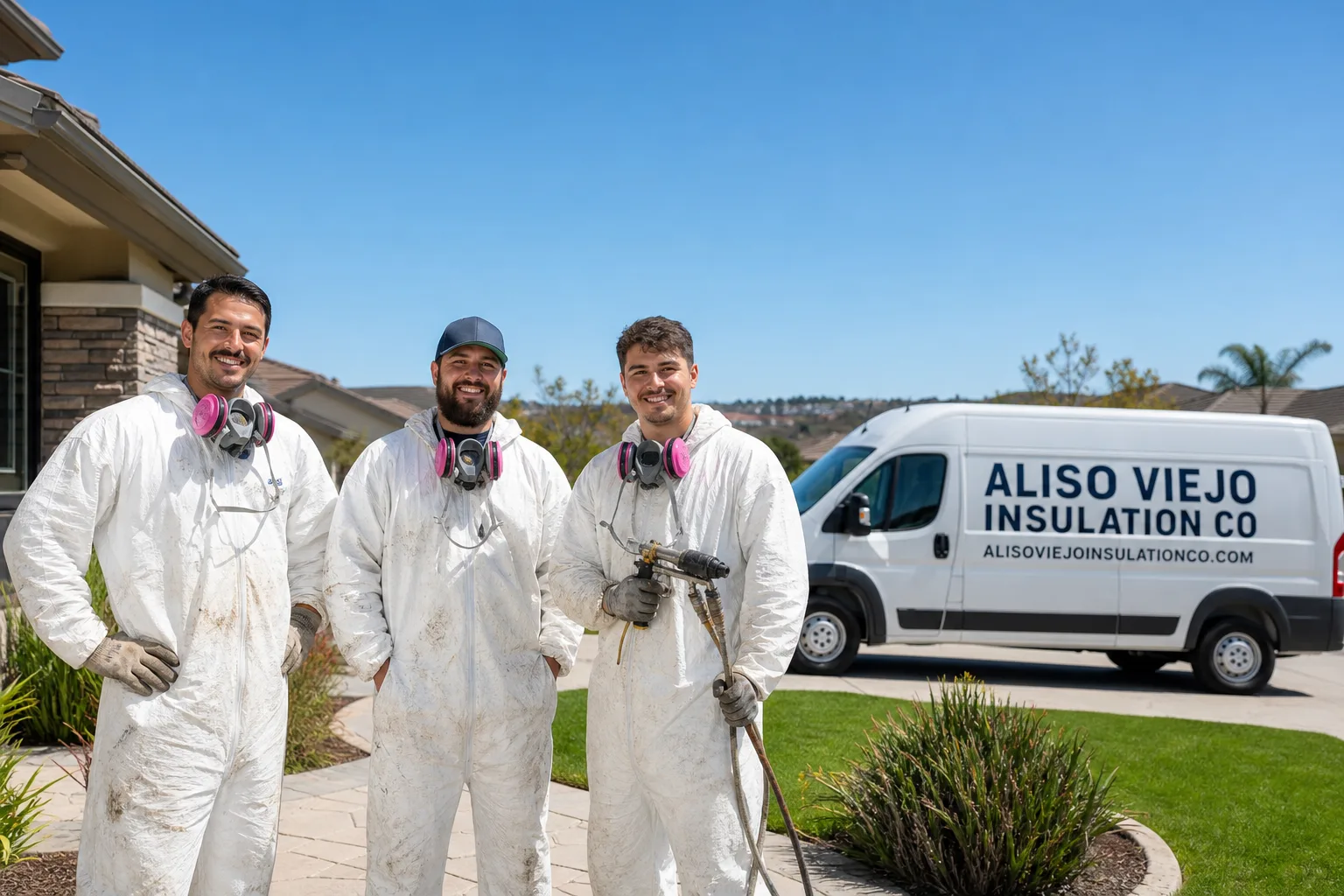
Fast, Reliable Spray Foam Insulation Across Desert Edge
Spray foam insulation in Desert Edge typically runs $2.40 – $5.60 per board foot installed, depending on whether the job calls for open-cell or closed-cell chemistry. Most homes here need closed-cell on west-facing attic slopes and gable ends, where the San Gorgonio Pass winds push sand and grit into every gap that foam is supposed to seal. If your energy bills climb every summer while your AC runs nonstop, the problem usually isn’t the unit itself. It’s the thermal envelope failing under conditions most insulation was never specified to handle. Call (877) 352-4780 and we’ll tell you exactly what’s happening in your attic, crawl space, or garage.
Why Aliso Viejo Insulation Co Is Desert Edge’s Preferred Spray Foam Insulation Company
We work in Desert Edge regularly, and we’ve learned what this specific stretch of the Coachella Valley does to insulation. The westerly winds through San Gorgonio Pass don’t just cool things down at sunset. They carry fine sand that works its way into attics, scours exposed foam surfaces, and piles up in west-facing corners where it degrades whatever insulation was there first. Most contractors from down-valley don’t see this failure mode because they don’t work in it often enough to recognize it. We do.
Nate Calloway built Aliso Viejo Insulation Co around a simple idea: the right material for the job is the one the building science points to, not the one sitting on the truck. That’s why we’re authorized installers for eight manufacturers, including Icynene and Demilec for spray foam, Owens Corning and Johns Manville for fiberglass, and Rockwool for mineral wool. When we recommend closed-cell foam for a Desert Edge attic, it’s because closed-cell handles wind abrasion and radiant heat better than anything else. When we recommend open-cell for an interior wall, it’s because that’s where open-cell makes sense. We’re not married to one product line, and that’s the whole point.
Response time matters in a place where a failed insulation job shows up as a $600 August electric bill. We schedule Desert Edge jobs within days, not weeks, and we show up knowing the housing stock: mid-century stucco-on-slab ranches, manufactured homes, original fiberglass batts that were barely adequate in 1965 and are useless now. We know the unsealed can lights, the uninsulated top plates, the gable vents that let in more sand than air. That local knowledge means we diagnose faster and specify correctly the first time, because we’ve already seen your house a hundred times.
Crawl Space Spray Foam Insulation in Desert Edge
Crawl Space Spray Foam Insulation in Desert Edge addresses a specific problem most homeowners here don’t know they have. Stucco-on-slab construction is common in this part of 92240, but plenty of older homes and manufactured units sit on raised foundations with vented crawl spaces. Those crawl spaces pull in outside air all year, and in Desert Edge, outside air means 110°F dust-laden wind in summer and 40°F desert cold in winter. Sealing the crawl space with closed-cell foam stops that exchange and keeps the floor above from radiating heat into the living space all afternoon.
A crawl space encapsulation with 2 inches of closed-cell foam on the perimeter walls and rim joists typically runs $3,800 – $6,500 in Desert Edge, depending on square footage and access. It’s not a cosmetic upgrade. It’s the difference between a floor you can feel the heat through at 4 PM and one that stays the same temperature as the room. For homes where ductwork runs through the crawl space, the payoff compounds fast: the ducts aren’t sitting in 120°F air anymore.
Rim joist sealing against wind-driven dust
The rim joist is the wood band around the perimeter of your floor framing. In Desert Edge it’s the single biggest entry point for blowing sand. We spray closed-cell foam directly onto the rim joist from inside the crawl space, creating an air seal that stops dust intrusion and eliminates a major source of air leakage. For older Desert Edge homes where the rim joist was never insulated at all, this one fix can cut floor-level drafts by a noticeable margin.
What slab-on-grade homes need instead
If your home sits on a concrete slab with no crawl space at all, the problem moves upward. Slab-on-grade ranches in Desert Edge lose most of their conditioned air through the attic, not the floor. In that scenario we’d point you toward attic air sealing and roof deck foam rather than crawl space work. The point of material-agnostic advising is recommending the right fix for the house you actually have, not the one we’re most set up to sell.
Garage Spray Foam Insulation in Desert Edge
Garage Spray Foam Insulation in Desert Edge matters because attached garages on afternoon-facing elevations become heat sinks. When your garage shares a wall or ceiling with living space, a 130°F garage at 5 PM is actively heating your home. We see this constantly in Desert Edge tract homes where the garage faces west and absorbs the full brunt of the late-day sun with zero thermal barrier. Spray foam applied to the shared wall and garage ceiling breaks that heat bridge and returns the garage to something closer to ambient outdoor temperature.
Garage ceiling and wall spray foam in Desert Edge typically runs $1,900 – $4,200 depending on square footage and whether we’re doing open-cell or closed-cell. For west-facing garages that get pounded by San Gorgonio Pass wind, we lean toward closed-cell on the exterior-facing surfaces. It holds up better against wind-driven sand and gives you a higher R-value per inch in a space where headroom matters. For interior shared walls where sound transmission matters too, open-cell does a better job damping noise from outside and from adjacent living space.
Closed-cell on west-facing garage walls
The west wall of your garage takes direct wind and sand load every afternoon. Open-cell foam exposed to that kind of abrasion will degrade faster than its rated lifespan. Closed-cell Icynene or Demilec, applied to the interior of the wall sheathing, locks out grit and adds structural rigidity at the same time. It’s the same principle we use in wind-scoured attics, applied to the largest uninsulated room in most Desert Edge homes.
Trusted Brands We Service in Desert Edge
We install Spray Foam Insulation using Icynene and Demilec systems, two of the most thoroughly engineered foam chemistries in the industry. That dual capability matters in Desert Edge because open-cell and closed-cell have genuinely different jobs. We also carry Owens Corning and Johns Manville fiberglass for homes where spray foam isn’t the right call, and Rockwool mineral wool for fire-prone areas where an added margin of safety makes sense. Because we maintain relationships with eight manufacturers rather than one, the recommendation we give you is based on your attic, your walls, and your crawl space, not on our inventory. That’s the difference between an installer and an insulation specialist.
We keep materials staged for Desert Edge jobs so we’re not running back down-valley mid-project. When we quote a Desert Edge attic, we’re quoting materials we already know will handle wind-driven sand, extreme diurnal swings, and sustained triple-digit heat. Same brands, same chemistry, but specified for what this specific place does to a house.
Common Spray Foam Insulation Problems We See in Desert Edge Homes
- Wind-scoured foam on west-facing roof decks. San Gorgonio Pass gusts abrade the cured foam surface over time, embedding sand and degrading the air seal. This is a Desert Edge-specific failure mode that installers from down-valley rarely anticipate, and it’s why we specify closed-cell with a protective topcoat on exposed west-facing slopes.
- Dust accumulation on open-cell foam in vented attics. Open-cell foam acts as a filter; in Desert Edge, it filters a lot of sand. Once dust builds up on the foam surface, it masks the air-sealing benefits and forces the foam to breathe through a layer of grit. We recommend closed-cell in vented attics here specifically to avoid this.
- Foam applied over unsealed can lights and top plates. This is the classic mid-century tract home problem. The foam covers the visible gaps but leaves a hidden path through fixture penetrations, pushing hot attic air and dust straight past the insulation into the living space. Air sealing has to happen before foam goes on, not after.
- Open-cell foam specified for a desert climate. Open-cell has its place, but Desert Edge attics that hit 140°F need closed-cell’s higher R-value per inch and its moisture and vapor resistance. When a generic installer quotes open-cell because it’s $1.50 cheaper per board foot, homeowners pay for it every August when the thermal load overwhelms the lower-density material.
Pricing for Spray Foam Insulation in Desert Edge, CA
Spray foam pricing in Desert Edge runs about 8 – 12% higher than down-valley averages, driven by the specialized closed-cell specification most homes here require and the logistics of working at the far western edge of the Coachella Valley. Open-cell foam typically runs $2.40 – $3.60 per board foot installed. Closed-cell runs $3.80 – $5.60 per board foot installed, with the highest end reserved for wind-exposed roof decks and gable ends where we apply extra thickness. A full attic retrofit on a 1,400-square-foot Desert Edge ranch typically falls in the $5,500 – $9,000 range. Crawl space work runs $3,800 – $6,500. Garage jobs run $1,900 – $4,200. Call (877) 352-4780 for an exact quote. Estimates are free, and we’ll tell you honestly if spray foam isn’t the right material for your specific house.
We Also Serve Cities Near Desert Edge
Our crews work throughout the western Coachella Valley and the high desert corridor. We regularly service Garnet, Desert Hot Springs, Morongo Valley, and Palm Springs, which means we understand how conditions shift from the wind-scoured pass area to the calmer valley floor. If you’re in Desert Edge or any of the surrounding communities, call (877) 352-4780 and we’ll get you scheduled. Same crews, same standards, same attention to what each specific location throws at a house.
Serving Desert Edge, CA — Our Local Coverage Area
We’re based in the Desert Edge area and know this community well. Use the map below to see our service coverage — if you’re nearby, we can almost certainly help.
FAQs About Spray Foam Insulation in Desert Edge
Because Desert Edge sits at the mouth of San Gorgonio Pass, where prevailing westerly winds carry fine sand that abrades exposed foam surfaces and works its way into any gap the foam doesn’t seal completely. The same closed-cell foam that performs fine in Palm Desert can be scoured and degraded on a west-facing attic slope here within a few years. That’s why we specify closed-cell with a topcoat on wind-exposed surfaces and why air sealing before foam application matters more in Desert Edge than almost anywhere else in the valley. Call (877) 352-4780 and we’ll assess your specific exposure.
No, and we’ll tell you that directly because it’s true. Old fiberglass batts in Desert Edge homes are typically matted down, dust-loaded, and wind-scoured in the corners; spraying foam over them just creates an uneven surface with built-in air gaps and locks the contamination in place. The batts come out first, then we air-seal the can lights, top plates, and any other penetrations, then the foam goes onto the clean roof deck. The removal is part of the job cost, and it’s the difference between a retrofit that works and one that just looks good for a year.
Yes, it’s one of the highest-impact insulation upgrades for Desert Edge homes, especially if your garage shares a wall with living space or sits on the west side of the house. A west-facing garage in 92240 can hit 125 – 130°F by late afternoon, and that heat bleeds straight through an uninsulated shared wall. Closed-cell foam on the garage ceiling and the shared wall drops that temperature meaningfully and stops the heat transfer. Most homeowners notice the difference within a day or two of the job finishing.
If your home is true slab-on-grade construction, there’s no crawl space to insulate, and we’ll point you toward the attic instead. But many older Desert Edge homes and manufactured units are pier-and-beam with a vented crawl space, and those absolutely benefit from closed-cell foam on the perimeter walls and rim joists. The payoff is most dramatic when ductwork runs through the crawl space, since those ducts sit in 120°F air otherwise. You’ll spend less and your floors will feel stable, not heat-radiating. We’ll tell you which foundation type you have and what that means for your insulation strategy.
The short answer is closed-cell chemistry and proper specification. Closed-cell foam handles the thermal cycling and diurnal swing far better than open-cell does, and when it’s specified for wind exposure with the right topcoat, it holds up to San Gorgonio Pass conditions. The longer answer involves doing the air sealing first, using the right foam for each surface, and not cutting corners on west-facing exposures. That’s the difference between an installer who’s worked in Desert Edge and one who’s applying a Palm Desert spec to a harder environment. Call (877) 352-4780 and we’ll walk you through what your house specifically needs.
Written by Nate Calloway, Owner at Aliso Viejo Insulation Co, serving Desert Edge and the western Coachella Valley with eight-brand insulation expertise and no brand loyalty. Call (877) 352-4780 for a free estimate.