
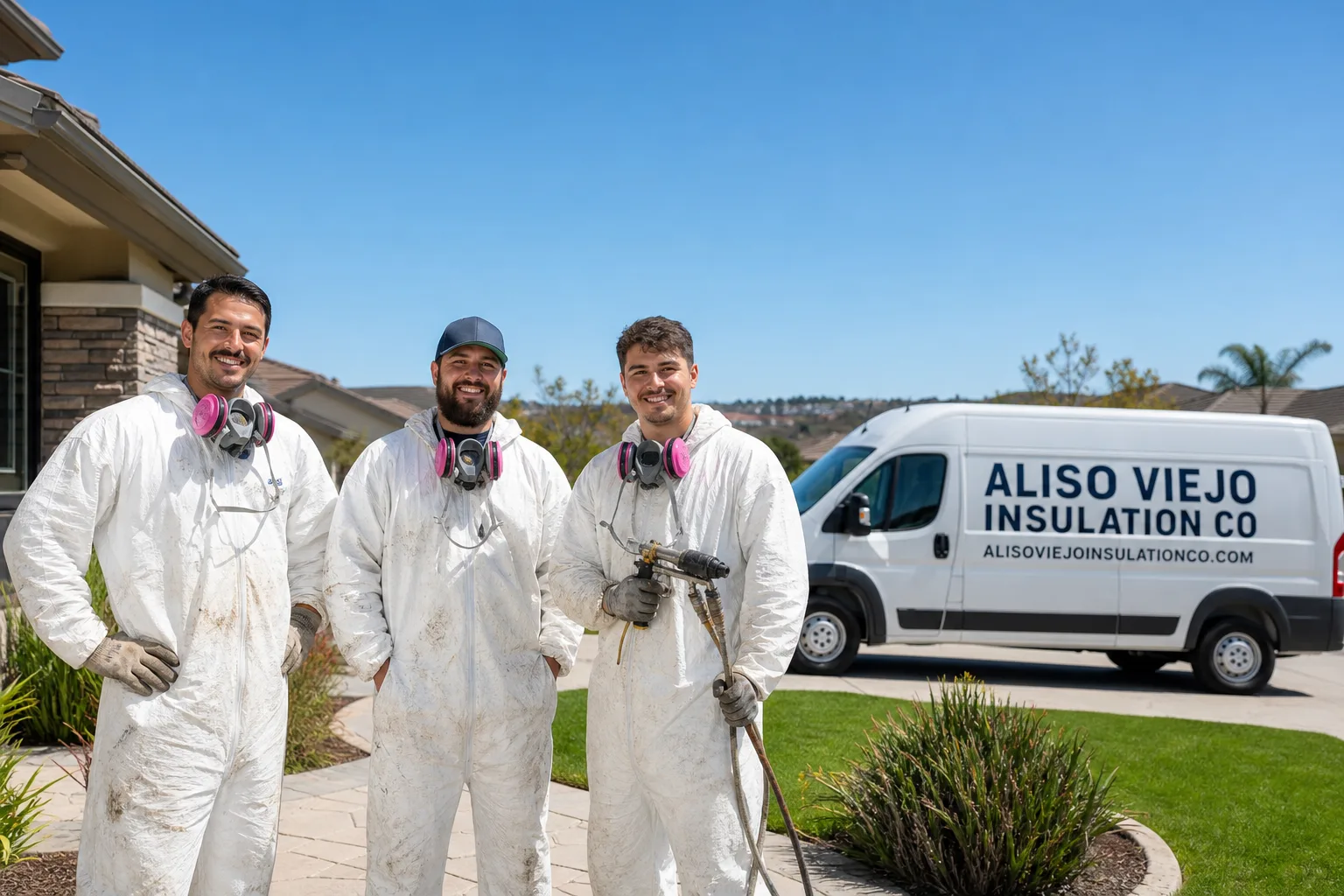
Fast, Reliable Spray Foam Insulation Across Hawaiian Gardens
Most Hawaiian Gardens homes we inspect share the same two complaints: freeway noise that never lets up and attics that turn into ovens by 2 p.m. The fix is usually the same one we’ve applied across hundreds of post-war tract homes in the 90716 zip code: spray foam insulation, installed by a crew that knows these tight lots and attached-wall floor plans inside out. We’re the insulation contractor that backs your home onto the 605 or 91 and deals with what that actually means for your walls, attic, and yes, your garage-door hardware. If you’re tired of paying to cool air that leaks straight through your top plates, call (877) 352-4780 and we’ll schedule an attic inspection this week.
Why Aliso Viejo Insulation Co Is Hawaiian Gardens’s Preferred Spray Foam Insulation Company
We didn’t parachute into Hawaiian Gardens with a marketing budget. We’ve worked enough of these one-square-mile blocks to know that no two lots are the same, even when the floor plans look identical from the street. We’ve sprayed homes off Carson Street, worked zero-lot-line stucco boxes near the 605, and crawled through attics in the apartment rows south of the 91. That mileage matters because spray foam is unforgiving when details get missed.
Homeowners here tell us the same thing after we finish: the crew arrived when they said they would, walked the house inch by inch, and explained the material choice in plain terms. We’re led by Nate Calloway, who built this company on an unpopular idea in the trades: recommend the material that fits the job, not the one that fits the truck. That’s why we carry Spray Foam Insulation systems from Icynene and Demilec alongside fiberglass and mineral wool options. You get the right foam chemistry for your specific walls and attic, not a canned pitch.
Closed Cell Spray Foam Insulation in Hawaiian Gardens
Closed Cell Spray Foam Insulation is the material we reach for most often on Hawaiian Gardens lots where homes back directly onto the 605 or 91 corridors. It cures into a rigid, vapor-impermeable layer at about R-6.5 to R-7 per inch, which means it insulates and air-seals in a single pass. For a 2×4 wall cavity, you’re getting roughly R-21 to R-24 in the same space that fiberglass batts would deliver R-13. On those lot-line properties, that density is the difference between hearing Jake brakes at 5 a.m. and not hearing them.
Cost-wise, closed-cell spray foam in Hawaiian Gardens typically runs $2.10 to $3.10 per board foot installed, depending on cavity depth and access. A full 1,200-square-foot attic roof deck project generally lands between $5,500 and $8,800. We see the highest demand for closed-cell on rim joists, garage ceiling applications, and any wall shared with a neighbor’s structure where moisture transfer is a constant fight.
Rim Joist and Band Board Sealing
On slab-on-grade Hawaiian Gardens homes, the rim joist is the single biggest leak point in the whole thermal envelope. Closed-cell foam locks that band board tight, stopping the air wash that pulls hot attic air down through wall cavities all summer. We’ve measured the temperature difference before and after on dozens of these small-lot homes, and the band board is almost always the first place Nate points to when a homeowner asks where the heat is really getting in.
Lot-Line Wall Treatment
Attached stucco construction means one or both side walls are essentially impossible to access from outside. Closed-cell foam applied from the interior stops not just heat transfer but also the moisture migration from your neighbor’s irrigation or a shared rain gutter. On homes with zero-lot-line setbacks, this is often the only insulation upgrade that doesn’t require opening a wall from the exterior.
Open Cell Spray Foam in Hawaiian Gardens
Open Cell Spray Foam is the smarter choice for the vented attics that dominate Hawaiian Gardens’ 1950s and 60s housing stock. It’s softer, expands more, and does a better job of filling the irregular cavities and settling gaps in older rafters where closed-cell would require a surgical, time-heavy pass. At around R-3.7 per inch, you need more of it to hit the same R-value as closed-cell, but you pay less per board foot: typically $1.10 to $1.80 installed in this market. A standard attic ceiling application in a Hawaiian Gardens tract home runs $2,800 to $4,600.
The big advantage open-cell brings to these old vented attics is that it doesn’t trap moisture the way a vapor-impermeable product can. That matters in a city where marine humidity off Long Beach meets hot afternoon sun, and your old fiberglass batts have been quietly absorbing that cycle for sixty years. Open-cell breathes enough to let the attic dry out while still cutting the radiant heat gain that turns your ceiling into a radiator by late afternoon.
Freeway Nose Reduction in Attic Ceilings
Homeowners who back onto the 605 or 91 corridors ask us about sound deadening more than any other single topic. Open-cell foam is the better answer on the attic ceiling, because its softer cell structure absorbs and disrupts sound transmission rather than reflecting it. We sprayed open-cell foam in a 1960s tract home near the 605 lot line off Carson Street, where the homeowner wanted freeway noise and afternoon attic heat handled in one pass. Before foaming we found the garage-door track fasteners and opener chain already rust-flecked from years of marine air, so we switched the homeowner to galvanized-coated springs, stainless hinge screws and nylon rollers while sealing the shared wall with closed-cell foam. The result was a quieter garage and a top plate that stopped sweating into the old fiberglass batts.
Top Plate and Wall-Top Sealing
The top plate, where wall framing meets attic floor, is the other leak we find on nearly every Hawaiian Gardens home we inspect. Builders in the 1950s stuffed whatever scrap fiberglass they had on hand into that junction, and six decades of marine humidity have compressed it into almost nothing. Open-cell foam applied along the top plate seals that four-line leak from the outside wall to the attic, which is where most of your conditioned air escapes in the summer.
Trusted Brands We Service in Hawaiian Gardens
We don’t believe in choosing your foam before we’ve looked at your attic. That’s why we’re authorized installers for both Icynene and Demilec spray foam systems, and why we keep GreenFiber blown-in cellulose and Owens Corning fiberglass batts in our rotation when the job calls for something else. The Hawaiian Gardens homes we work on are rarely identical, and the material decision should follow the structure, not the other way around. If you’re not sure whether you need open-cell, closed-cell, or a hybrid approach, call (877) 352-4780 and we’ll tell you what we’d put in our own attic.
Common Spray Foam Insulation Problems We See in Hawaiian Gardens Homes
- Salt-air corrosion on garage-door hardware surrounding foam anchor points. Homes on lots facing the 605 and 91 corridors get salt-laden marine air pushing in from the Long Beach coastal belt. The track fasteners, torsion springs, and opener chains rust years before inland homes in Cerritos or Lakewood see the same wear. When foam is applied around those rusting anchors, it can hide the issue until a spring snaps or a roller seizes.
- Compressed, moisture-laden fiberglass batts in vented attics. Original 1950s-60s batts in Hawaiian Gardens tract homes get compacted by decades of marine humidity and dense lot-line construction. We see attic insulation that tests at half its rated R-value. If open- or closed-cell foam is applied directly over that damp, collapsed material without removal, you trap moisture pockets inside the envelope, and that’s how you get mold on the underside of your roof deck.
- Zero-lot-line and attached stucco construction leaving no exterior access. Many Hawaiian Gardens homes share a wall with the neighbor’s structure, leaving no side yard to work from. Poorly planned closed-cell passes on these cramped lots can trap off-gassing and block attic ventilation if the installer doesn’t account for the building’s airflow. Our crews map the ventilation path before we spray a single board foot.
- Foam sealed around rusting anchors without a hardware assessment first. We’ve had Hawaiian Gardens homeowners ask us to foam a garage ceiling, only for us to find the opener chain red-brown and the spring coils pitted. Foam that seals those anchors in place makes a future spring replacement far more expensive and dangerous. We check the hardware before we spray, and if it needs replacement, we say so before the foam goes on.
Pricing for Spray Foam Insulation in Hawaiian Gardens, CA
Spray foam insulation pricing in Hawaiian Gardens breaks down like this: open-cell runs $1.10 to $1.80 per board foot, closed-cell runs $2.10 to $3.10 per board foot, and a full attic ceiling application on a typical 1,200-square-foot tract home lands between $2,800 and $8,800 depending on foam type and cavity depth. Rim joist sealing on a slab-on-grade home usually runs $900 to $1,800. Garage ceiling applications run $1,400 to $3,200. What moves the price most is access, existing insulation removal, and whether we’re sealing a lot-line wall that requires interior-only work. We give a fixed written estimate before any job starts, and the estimate is always free. Call (877) 352-4780 and we’ll have Nate walk your attic personally.
We Also Serve Cities Near Hawaiian Gardens
Our crews run spray foam jobs throughout southeast LA County, including Los Alamitos, Cypress, La Palma, and Rossmoor. If you live in any of those neighboring cities, the same eight-brand material roster and the same attention to salt-air and freeway-lot-line details apply. This is what we do across the whole Hawaiian Gardens area and the communities that wrap around it.
Serving Hawaiian Gardens, CA — Our Local Coverage Area
We’re based in the Hawaiian Gardens area and know this community well. Use the map below to see our service coverage — if you’re nearby, we can almost certainly help.
FAQs About Spray Foam Insulation in Hawaiian Gardens
Homes backing onto those two freeways in Hawaiian Gardens get hit with a double load: constant road noise and salt-laden marine air pushing in from the Long Beach coastal belt. The sound and the corrosion work together. Spray foam seals the top plates, wall cavities, and attic junctions where wheel noise infiltrates, while the foam’s air-sealing properties keep that humid, salt-heavy air from circulating through your old fiberglass batts. Homes a few miles inland in Cerritos or Lakewood don’t see anywhere near the same hardware corrosion or acoustic load. Call (877) 352-4780 and we’ll tell you what your specific lot line is dealing with.
No, but it can hide it. If we spray foam around anchors, tracks, or opener mounts that are already corroding, the foam seals moisture in and speeds the failure. That’s why we inspect garage-door hardware before any Hawaiian Gardens spray foam job. If the springs, hinge screws, or chain show rust, we recommend galvanized-coated springs, stainless hardware, and nylon rollers before we spray. You get the thermal benefit of the foam without sealing a mechanical problem into your wall. Call (877) 352-4780 and ask us to check the garage hardware on your lot-line wall.
Open-cell is almost always the right answer for a 1950s vented attic in Hawaiian Gardens, because it fills the irregular rafters and gaps in older framing far better than closed-cell, and it doesn’t trap the marine moisture that accumulates from the Long Beach coastal air. The attic stays breathable enough to dry out while the foam cuts the radiant heat gain. Closed-cell makes more sense on rim joists, lot-line walls, and garage ceilings where you need structural strength and vapor impermeability. Call (877) 352-4780 and we’ll tell you which one your attic actually needs.
Yes, and this is one of the most common jobs we take in Hawaiian Gardens. On a zero-lot-line or attached stucco home, we work from the interior, mapping the wall cavities and applying closed-cell foam from inside the living space or garage. The constraint is real: we have to preserve attic ventilation and account for the shared wall’s moisture profile before we spray. But we’ve done this on enough of the dense post-war lots here to know exactly where the vents are and how to keep them clear. Call (877) 352-4780 for a walkthrough.
Hawaiian Gardens is one of the smallest, most densely packed cities in LA County, barely one square mile of mostly 1950s-60s tract housing hemmed in by the 605 and 91 freeways. That means almost every insulation job is retrofit-on-tight-lots rather than new build. The housing mix of small-lot single-family homes and low-rise stucco apartments means we see a lot of vented attics, original fiberglass batts, and attached walls with zero exterior access. Spray foam works, but only if the installer knows how those post-war buildings breathe. We know these buildings. Call (877) 352-4780 and we’ll put that knowledge to work on your attic.
Written by Nate Calloway, Owner at Aliso Viejo Insulation Co, serving Hawaiian Gardens and southeast LA County.
Contact Aliso Viejo Insulation Co for Spray Foam Insulation in Hawaiian Gardens
If you live in Hawaiian Gardens and you’re ready to stop losing conditioned air through a sixty-year-old attic, call (877) 352-4780. We’ll schedule a free attic inspection, walk you through the open-cell and closed-cell options for your specific walls, and give you a fixed written estimate. Whether your home backs onto the 605, the 91, or a neighbor’s stucco wall, we know what it takes to seal it right. That’s the job we do every day in Hawaiian Gardens and the communities around it.