
Spray Foam Insulation in Irvine: What It Costs and How It Works in Coastal Air
Closed-cell spray foam for a standard Irvine garage runs $1,800 to $3,600 depending on square footage and access. Open-cell jobs in attics and wall cavities typically land between $0.90 and $1.80 per board foot installed. In Irvine’s marine-layer climate, closed-cell is often the right call even when open-cell would cost less, because vapor control matters as much as R-value here. Call us at (877) 352-4780 for a fixed quote based on your specific village and wall assembly.
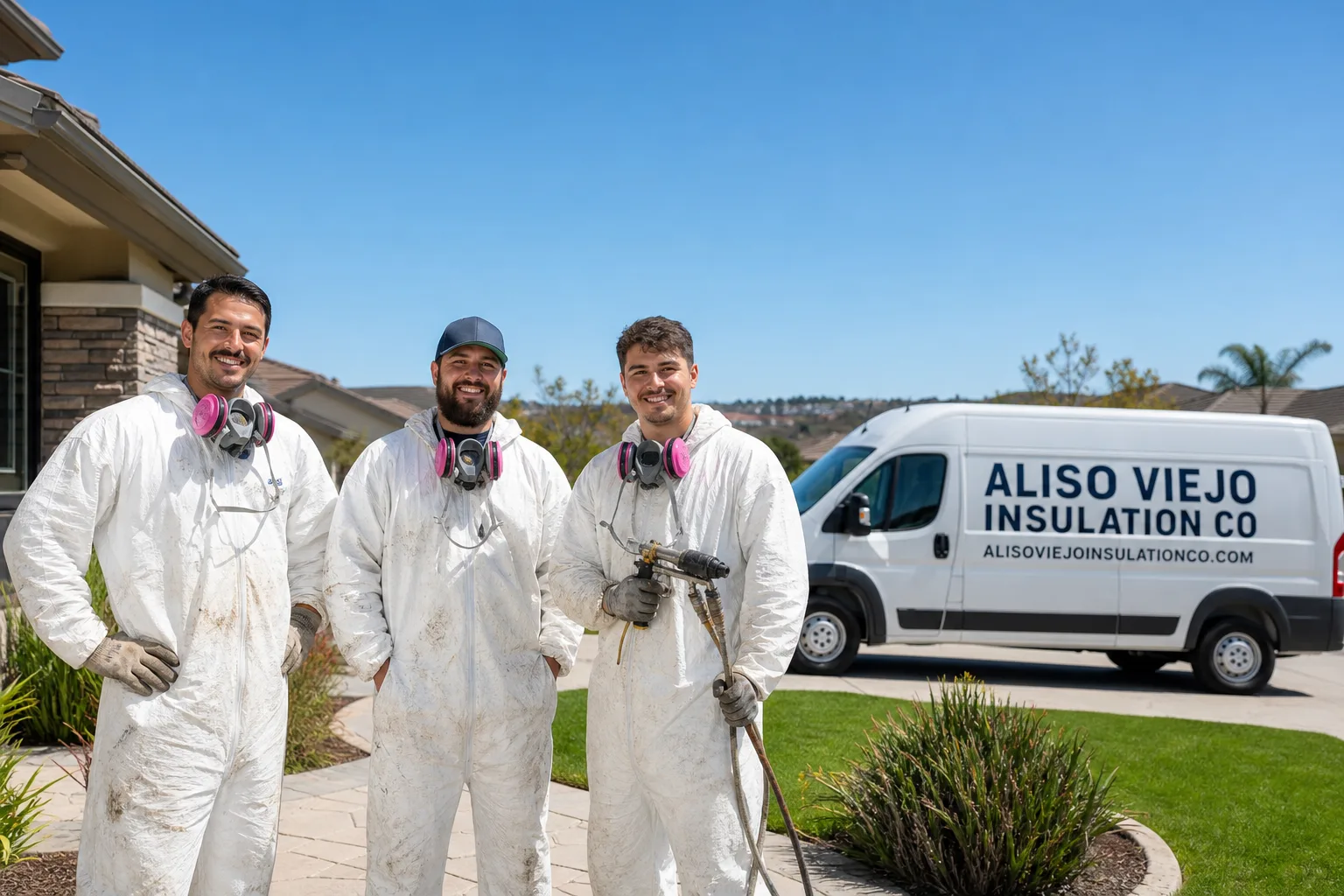
We work in Irvine every week. The drive from our shop in Aliso Viejo puts us in most Irvine neighborhoods within 30 to 45 minutes, from Turtle Rock to Portola Springs. That means when a garage ceiling shows condensate staining or an attic inspection reveals compressed 1970s batts, we can get there fast, diagnose the actual failure mode, and fix it before the next marine-layer cycle makes things worse.
Why Irvine Garages Need a Moisture-First Spray Foam Spec
Most insulation contractors sell R-value first and ask questions later. In Irvine, that approach fails. The marine layer that rolls in most mornings from June through September pushes dew points into garage wall and ceiling cavities. When warm daytime air hits those cooled surfaces, condensation forms inside the assembly. Fiberglass batts absorb the moisture, sag, and start smelling like a damp basement. Closed-cell spray foam changes the physics: it acts as both an air barrier and a vapor retarder, stopping moist coastal air from reaching the cold side of the wall in the first place.
This is a moisture-first spec, not a generic insulation upgrade. Inland cities like Riverside or even Mission Viejo rarely demand it, because their air is drier. Irvine is different. The humidity here is subtle, you barely feel it, but it drives dew points into enclosed garage-wall cavities with surprising consistency. If you insulate a garage here the same way you would insulate one in Rancho Cucamonga, you get condensation, paint blistering, and musty odors within a season or two. We spec closed-cell foam behind garage drywall in Irvine for exactly this reason.
One job in a 1970s Woodbridge tract off Westpark illustrated the point. Our tech found the original fiberglass batts in a garage ceiling compressed and rodent-displaced, with an Owens Corning-faced batt sagging off the joists and condensate staining the drywall below. We pulled the failing batts, air-sealed the top plates and penetrations, and sprayed closed-cell foam against the garage-side wall and ceiling to lock out marine-layer moisture, then reset the R-value. The homeowner’s uneven garage temperature and musty smell both resolved after the foam cured. That’s the pattern we see block by block in Irvine’s older villages.
Our Spray Foam Insulation team carries both Icynene and Demilec systems, so we can match open-cell or closed-cell chemistry to the wall assembly, not to whatever product we happen to stock that week. For Spray Foam Insulation in Irvine, that latitude matters, because the right answer in University Park is not always the right answer in Great Park.
How Much Does Spray Foam Insulation Cost in Irvine?
You pay for three things: the foam chemistry, the prep work, and the access. Here’s what that looks like in Irvine’s market right now.
- Closed-cell spray foam (garage ceiling or wall): $2.80 to $4.20 per board foot, $1,800 to $3,600 for a typical one-car to two-car garage.
- Open-cell spray foam (attic or interior wall): $0.90 to $1.80 per board foot, $1,200 to $2,800 for most Irvine attics depending on square footage and depth.
- Prep and air-sealing: $300 to $650 when we need to remove failed fiberglass, air-seal top plates, or address rodent damage before spraying. Most older Woodbridge and Turtle Rock jobs include this.
- Full garage conversion (wall plus ceiling, closed-cell): $3,200 to $5,600 based on exposed studs versus finished drywall.
What moves your number in Irvine: whether the garage is attached or detached, whether we’re spraying against exposed studs or behind existing drywall, and whether old insulation has to come out first. A straight open-cell attic spray in a 2010s Portola Springs home runs lower than a closed-cell garage job in a 1970s Woodbridge tract with failed batts and rodent damage. That’s not margin padding, that’s the reality of working on very different housing stock.
The estimate is free. We’ll walk your garage or attic, check the existing assembly, and quote the actual job. Call (877) 352-4780 and we’ll schedule it around your availability, including evenings and Saturdays.
Garage Spray Foam Insulation in Irvine
Garage Spray Foam Insulation in Irvine is about condensation control first, comfort second, and R-value third. Most Irvine garages are unconditioned, meaning the wall cavities share the same moisture dynamics as the outside marine air. When you park two cars that warmed up in the sun, then close the door as the evening marine layer rolls in, the temperature differential inside the wall cavity spikes. That’s when closed-cell foam earns its cost.
What The Job Actually Involves
We start by checking what’s in the wall or ceiling now. In older villages like Woodbridge and University Park, that often means compressed fiberglass batts that have slipped, rodent-displaced, or absorbed enough moisture to lose their loft. We remove failed material, air-seal the top plates and any penetrations, then spray the foam directly against the sheathing or drywall back. On an attached garage with a shared wall to living space, we also check the band joist and any electrical or plumbing penetrations. Skipping the air-seal step is the most common cause of post-spray musty smells in Irvine garages, and we won’t skip it.
Fiberglass Removal Before Spraying
You can’t spray foam over failed fiberglass and expect it to work. The old batt material is already holding moisture against the sheathing and that moisture stays trapped once foam is sprayed over it. In Irvine’s marine-layer climate, this is a recipe for drywall staining and odor within one season. We remove and dispose of old batts, inspect the cavity for rodent damage or leaks, then spray clean. It adds cost but avoids the most common failure we see in older Irvine garages.
Closed Cell Spray Foam Insulation in Irvine
Closed Cell Spray Foam Insulation in Irvine is our default recommendation for any garage wall or ceiling shared with living space, because it handles both the thermal and the moisture layer in one pass. At roughly R-6.5 per inch, it builds R-value fast. But the more important number in Irvine is its perm rating. Closed-cell foam at 2 inches acts as a Class II vapor retarder, which means it stops the marine-layer moisture from condensing inside the wall cavity in the first place.
Attached Garages and Shared Walls
If your garage shares a wall with a bedroom or kitchen, closed-cell is the answer. Open-cell foam is air-permeable and allows moist air to pass. In Irvine’s daily coastal humidity cycle, that moisture will find the cold side of the wall and condense. Closed-cell won’t allow that air movement at all. We spec it at 2 to 3 inches on the shared wall, then add a thermal layer if the room above needs additional separation from garage heat.
Garage Ceilings in Older Villages
In original Woodbridge and Turtle Rock homes, the garage ceiling is often just exposed joists with a few sagging fiberglass batts. Closed-cell foam sprayed against the underside of the floor above does two jobs: it seals the stack effect that pulls garage air into the living space, and it blocks the condensation that otherwise forms when the air-conditioned floor above meets the humid garage air below. We’ve pulled failed batts from dozens of these ceilings and seen the drywall staining underneath. Closed-cell stops that cycle permanently.
Trusted Brands We Service in Irvine
We’re authorized to install spray foam from Icynene and Demilec, two of the industry’s leading closed- and open-cell systems. For homes where spray foam isn’t the right call, or where the budget points toward a hybrid approach, we also install Johns Manville and Knauf fiberglass batts, Rockwool mineral wool for sound and fire performance, and CertainTeed products when the job needs a specific batt spec. We don’t stock every product from every brand, and we don’t need to. We carry what Irvine’s housing stock actually demands: closed-cell chemistry for garages and shared walls, open-cell for attics where vapor control isn’t the limiting factor, and mineral wool for homeowners who prioritize acoustic separation or fire resistance. Nate Calloway built the company around this idea: match the material to the job, not the job to the material.
Common Spray Foam Insulation Problems We See in Irvine Homes
- Musty garage smell after a spray foam job. This usually means someone sprayed open-cell foam over a vapor-retarding wall or skipped the air-sealing step. The moisture is trapped behind or inside the foam layer, and it will keep coming back. In Irvine’s marine-layer climate, this is the single most common post-install complaint we hear.
- Compressed fiberglass in 1970s Woodbridge and Turtle Rock garages. Decades of HVAC work and rodent traffic have pushed the batts down or aside, leaving uninsulated voids. The mild climate masked the energy loss for years. Then a heat wave or a Santa Ana event pushes uneven room temperatures and the homeowner notices the garage is 15 degrees hotter than the living room.
- Paint blistering in newer Great Park and Portola Springs garages. These tight-envelope homes already have vapor-retarding exterior sheathing. Adding open-cell foam to the inside of that wall traps moisture between the sheathing and the foam. The result is bubbling paint and a damp smell that shows up months after the install. Closed-cell or a proper vapor strategy is needed here.
- Condensation staining on garage ceilings under the living space. When the air-conditioned floor above meets humid garage air below, the underside of the subfloor collects condensation. If the ceiling is insulated with old fiberglass, that moisture stays against the wood. Closed-cell foam sprayed against the ceiling eliminates the temperature differential and the moisture path.
Serving Irvine, CA — Our Local Coverage Area
We’re based in the Irvine area and know this community well. Use the map below to see our service coverage — if you’re nearby, we can almost certainly help.
FAQs About Spray Foam Insulation in Irvine
Because moist marine-layer air is getting trapped behind or inside the foam. The most common cause is open-cell foam sprayed over a vapor-retarding wall, or a job that skipped air-sealing the top plates and penetrations before spraying. In Irvine’s daily condensation cycle, that trapped moisture turns into musty odor within weeks. The fix is removing the failed foam, air-sealing the cavity correctly, and re-spraying with closed-cell chemistry. Call (877) 352-4780 and we’ll diagnose what happened.
Closed-cell, almost always. Irvine’s marine layer drives dew points into garage wall cavities often enough that vapor control matters more than R-value. Closed-cell foam at 2 inches acts as a vapor retarder and stops the moisture path. Open-cell is air-permeable and lets moist air through. There are open-cell applications in Irvine, like vented attics, but a garage exposed to daily Marine-layer humidity should get closed-cell.
No. The old fiberglass is likely compressed, rodent-displaced, and holding moisture against the sheathing. Spraying foam over it seals that moisture in place and causes drywall staining and odor. We remove the failed batts, inspect for rodent damage, air-seal the top plates and penetrations, then spray closed-cell foam directly against the ceiling. It’s the only way the job lasts in Irvine’s climate.
They may still need it, but the reason is different. Great Park homes meet current Title 24 insulation requirements, but their tight envelopes create a new problem: over-spraying open-cell foam on an interior garage wall can trap moisture and blister paint. If you’re finishing a garage in Great Park as a workshop or living space, closed-cell foam with a proper vapor strategy is the right spec. It’s not about code compliance, it’s about condensation physics.
It stops moist air from reaching the cold surfaces inside the wall cavity. During the marine-layer months, the outside air is humid and the inside of your wall or ceiling is cooler. When warm, moist air touches that cool surface, water condenses. Closed-cell foam blocks the air movement entirely, so the condensation can’t form in the first place. In Irvine, that’s the primary reason we recommend it over fiberglass or open-cell in garage and shared-wall applications.
We Also Serve Cities Near Irvine
We serve Irvine plus the surrounding communities: Tustin, Aliso Viejo, Santa Ana, and North Tustin. If you’re in one of those areas and need spray foam, blown-in, or attic insulation, the same crew and the same eight-brand material expertise applies. Call (877) 352-4780 and tell us where you are.
Get a Free, Honest Estimate for Your Irvine Home
If your garage smells musty, your attic batts are 40 years old, or you’re converting a Great Park garage into living space, we can tell you exactly what the job needs and what it costs. No brand-pushing, no pressure. We’ll walk the space, check the existing assembly, and give you a fixed quote. Call (877) 352-4780 and ask for an Irvine inspection. Nate and the crew handle most Irvine calls within 24 to 48 hours.
Written by Nate Calloway, Owner at Aliso Viejo Insulation Co, serving Irvine and surrounding South Orange County communities.