
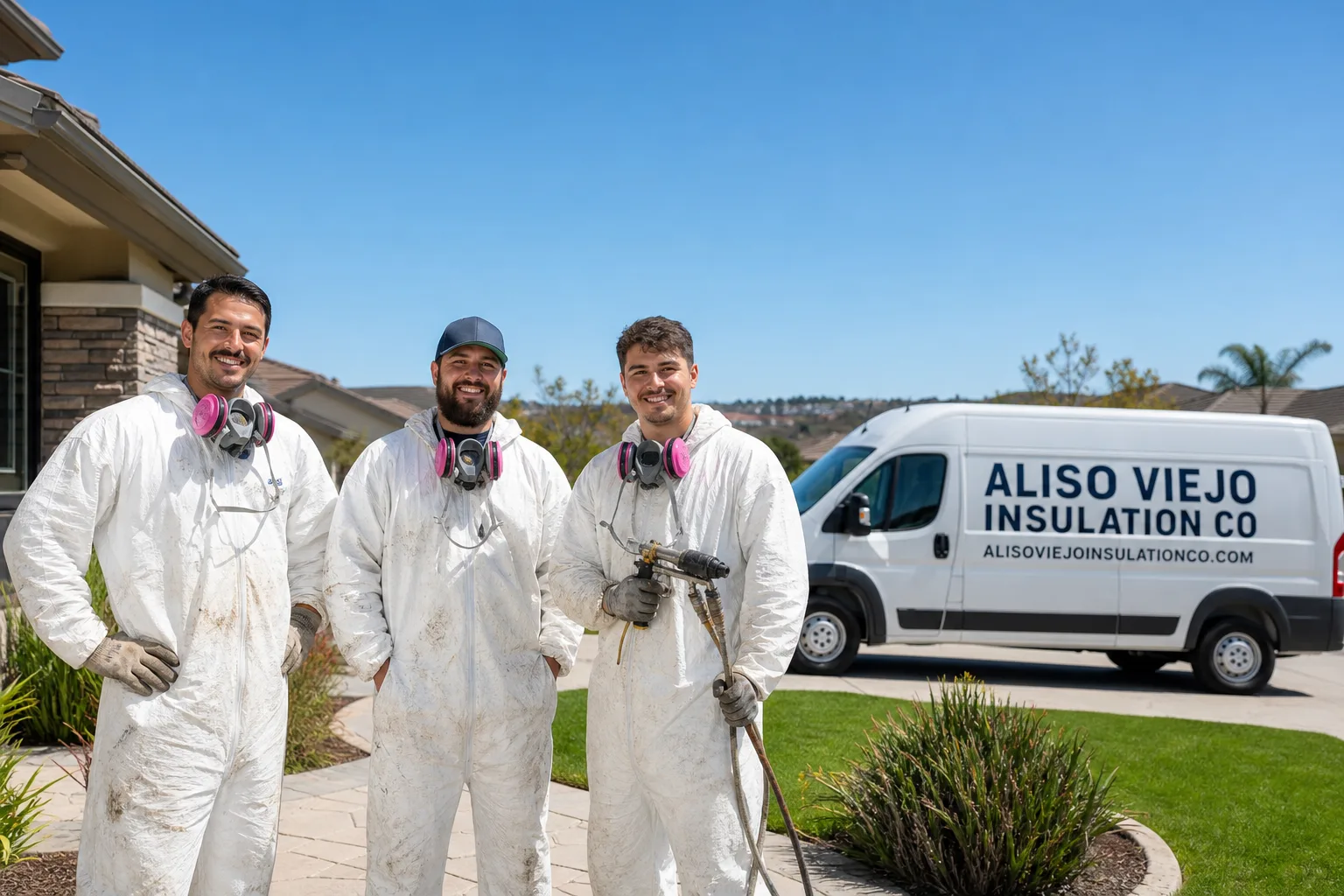
Fast, Reliable Spray Foam Insulation Across Lynwood
Spray foam insulation in Lynwood typically runs $2.50 to $6.80 per square foot installed, depending on whether the job calls for open-cell or closed-cell chemistry, and most retrofit attics here fall between $3,800 and $9,200 for a full roof-deck or attic-floor application. The real variable in this city is rarely the foam itself. It’s the condition of the attic before we spray: decades of settled blown-in material, rodent contamination, and 1950s-era wiring that has to be identified and shielded first. Our crews work throughout the 90262 zip code and know these post-war stucco bungalows well enough to flag the wiring and contamination issues before they become your problem. Call (877) 352-4780 for a free estimate and we’ll tell you exactly what your attic needs, foam or otherwise.
Why Aliso Viejo Insulation Co Is Lynwood’s Preferred Spray Foam Insulation Company
We’re not the contractor that shows up with one product and a script. We install open-cell and closed-cell spray foam, blown-in insulation, and attic batts, pulling from eight manufacturer lines so the recommendation you get is built on your home’s actual conditions. If you need Reflectix repair in Lynwood, we can assess whether it fits your situation or if spray foam is the better option. Homeowners off Long Beach Boulevard, around Lynwood Park, and through the streets south of the 105 have called us for the same reason: we diagnose before we quote.
Nate Calloway runs our insulation work, and the approach is straightforward. We look at what’s in your attic now, what’s been living in it, what your wiring looks like, and whether your ceiling plane can actually hold the foam we’d want to install. That’s not a sales pitch. It’s building science, applied to houses that were framed when Eisenhower was in office. The result is fewer callbacks and an air seal that holds through the long, hot summers this part of the LA basin gets every year.
We respond to Lynwood service calls quickly, and because we stock both Icynene and Demilec systems along with Johns Manville, Knauf, and Rockwool product lines, we’re not waiting on a distributor when your attic is already stripped and ready. Same-week scheduling is typical for most Lynwood jobs.
Crawl Space Spray Foam Insulation in Lynwood
Crawl Space Spray Foam Insulation in Lynwood is a retrofit job first and a foam job second, because most of these 1940s-1960s stucco bungalows were built with vented, unconditioned crawlspaces that were never insulated at all. What we’re doing is sealing the rim joist bays and the underside of the floor system with closed-cell foam to stop the stack effect, the slow pull of hot attic air down through wall cavities and up through the floor. A typical Lynwood crawl space runs $2,800 to $6,500 depending on square footage and how much prep the space needs.
When the ground under a house off Atlantic Avenue stays damp through the dry months, that moisture migrates upward into the floor framing. Closed-cell foam does double duty there: it insulates and it acts as a vapor retarder, which matters more than people expect in a semi-arid climate where crawlspace humidity still spikes after irrigation and occasional winter rain. We don’t recommend open-cell below a floor system. It can hold moisture against the framing in a vented crawl, and that’s a future rot problem.
Rim Joist Sealing and Rodent Entry
Rim joist bays in Lynwood crawlspaces are rarely air-sealed from the builder, and they’re the primary entry point for both outside air and rodents. We spray closed-cell foam into each bay after confirming the sill plate isn’t compromised, which tightens the thermal envelope and closes the gaps that let rats and mice into the walls. This is always the first step before any floor insulation goes in, because insulating above an open rim joist is wasted money.
Moisture Management in Vented Crawls
Some Lynwood crawlspaces are wet enough that foaming over the problem would trap moisture against the framing. If we see standing water or heavy efflorescence on the foundation, we’ll tell you to address drainage or install a vapor barrier before foam touches the joists. That’s the honest call, and it saves you from a sealed-in humidity problem five years down the road.
Garage Spray Foam Insulation in Lynwood
Garage Spray Foam Insulation in Lynwood addresses a problem nearly every homeowner here knows: attached garages with uninsulated walls and ceilings that turn into ovens by midmorning and radiate heat into adjacent bedrooms all afternoon. A standard two-car garage roof deck or ceiling in Lynwood runs $1,500 to $4,200 with open-cell foam, and that’s the application we recommend most often because it’s cost-effective and you’re not asking the foam to manage moisture. Closed-cell on garage walls is a premium upgrade that adds structural rigidity and a higher R-value per inch, useful when the garage shares a wall with living space.
The garages on these small lots are usually attached, south-facing or west-facing, and they hold heat like a kiln. Foaming the ceiling plane means the bedroom above or behind the garage stops absorbing that heat load, and the garage itself becomes usable for storage, a workshop, or just parking without the broiler effect. When the garage has living space above it, we typically step up to a full closed-cell roof deck application, because the thermal boundary moves to the roofline and you want the air seal there anyway.
Shared Walls and Living Comfort
Where a garage wall butts against a bedroom or hallway, open-cell spray foam in the stud bays cuts both heat transfer and noise. For freeway-adjacent homes near the 105 and 710 corridors, that sound-dampening matters just as much as the thermal gain. We’ve had customers off Martin Luther King Jr. Boulevard tell us the bedroom adjacent to the garage stopped feeling like a sauna within days of the install, and the traffic drone dropped noticeably.
West-Facing Garage Doors
An uninsulated metal garage door facing the afternoon sun is a radiant heat panel aimed at your house. We don’t foam the door itself, but we do recommend an insulated door or a radiant barrier panel as part of the package when the existing door is original to a 1950s build. Pair that with a foamed ceiling and the attached garage stops being the hottest room in the home.
Trusted Brands We Service in Lynwood
Our Spray Foam Insulation work in Lynwood is anchored by Icynene and Demilec systems, two of the more demanding spray foam chemistries in the industry. We carry both open-cell and closed-cell formulations and we’re authorized to install them to manufacturer spec. Beyond foam, we stock fiberglass from Johns Manville and Knauf, and mineral wool from Rockwool for Lynwood projects where fire resistance or sound attenuation matters more than R-value alone. Because we’re not locked to a single brand, the foam or batt that goes into your attic is the one that fits the ceiling plane, the wiring condition, and the budget. We keep a working inventory for common Lynwood retrofit applications, so most jobs are measured, quoted, and installed without waiting on shipped product.
Common Spray Foam Insulation Problems We See in Lynwood Homes
- Foam sprayed directly over cloth-wrapped wiring. On 1940s-1960s tract homes, the original attic wiring is often cloth-wrapped cable run across shallow joist bays. Closed-cell foam encapsulating that old conductor is a genuine fire-safety concern, and code requires the wiring be evaluated and shielded or relocated first. Any inspector will flag it, and any responsible crew addresses it before the gun comes out.
- Rodent-compromised blown-in left in place. We routinely pull attic hatches in Lynwood to find old cellulose or fiberglass matted down, tunneled through, and contaminated with droppings. Foaming over that traps odor, kills the air seal, and leaves a biological mess under your new insulation. It has to come out first, and that’s part of our prep on nearly every retrofit here.
- Shallow joist bays over-filled without depth control. These little stucco bungalows run 2×6 or 2×8 ceiling joists. Closed-cell foam installed to full cavity depth can crack ceiling drywall below when it expands. Depth control and lift timing matter more in Lynwood than in newer construction with deeper trusses.
- Open-cell foam used below a vented crawlspace. We see it in homes where a previous contractor cut a corner. Open-cell absorbs moisture in a vented Lynwood crawl, holds it against the floor framing, and invites rot. Closed-cell is the only foam we’ll put under a floor system here.
Pricing for Spray Foam Insulation in Lynwood, CA
You should know what the foam actually costs before you call anyone. Open-cell spray foam in a Lynwood attic floor or garage ceiling runs $0.55 to $1.10 per board foot installed. Closed-cell runs $1.15 to $2.40 per board foot installed, and it’s the product for rim joists, crawlspaces, and any application where moisture or structural strength is in play. A full attic retrofit on a 1,200-square-foot single-story bungalow, including removal of old blown-in material and shielding of legacy wiring, typically lands between $5,500 and $10,500. A garage ceiling alone is $1,500 to $4,200. A crawlspace is $2,800 to $6,500. We give you a written line-item quote so you see the prep, the foam, and the markup separately. Call (877) 352-4780 for a free estimate.
We Also Serve Cities Near Lynwood
Our crews cover the full Lynwood service area and the surrounding communities, including South Gate, East Rancho Dominguez, Willowbrook, and Paramount. If you’re in a neighboring city with a similar post-war home, the same retrofit approach applies. Give us a call at (877) 352-4780 and we’ll tell you whether it’s worth the trip or whether you can handle the diagnosis yourself over the phone.
Serving Lynwood, CA — Our Local Coverage Area
We’re based in the Lynwood area and know this community well. Use the map below to see our service coverage — if you’re nearby, we can almost certainly help.
FAQs About Spray Foam Insulation in Lynwood
Your attic needs a wiring inspection first because most Lynwood homes built between the 1940s and 1960s still have original cloth-wrapped or knob-and-tube-era conductors running across the shallow joist bays, and closed-cell foam encapsulating unshielded legacy wiring creates a recognized fire hazard and a code violation. We identify, shield, or relocate those conductors before any foam is applied. On a small stucco bungalow off Martin Luther King Jr. Boulevard, our crew opened the attic hatch to find decades of rodent-tunneled, settled blown-in material and a run of cloth-wrapped 1950s wiring stapled high in the shallow joists. We isolated and shielded the old conductors, vacuumed out the contaminated fill, then flashed the attic-floor penetrations with Icynene closed-cell foam before masking the open bays. The homeowner noticed the difference most on the long summer afternoons when the west-facing roof used to bake the back bedrooms. If we find wiring that needs an electrician’s sign-off, we’ll tell you before you’ve paid for foam you can’t install. Call (877) 352-4780 and we’ll walk through what’s likely in your attic based on the age of the house.
Yes, open-cell spray foam cuts airborne noise meaningfully, and it’s the most effective insulation material for damping the constant low-frequency drone that comes off the 105 and 710 corridors plus the LAX flight paths that pass directly over this part of South LA. In a sealed attic or shared garage wall, open-cell absorbs sound energy that fiberglass batts let right through. The effect is smaller in walls than in attic cavities, but the combination of an air-sealed attic and foamed shared walls takes the edge off the traffic and aircraft noise in a way that blown-in fiberglass alone doesn’t. If noise is your primary complaint, tell us on the call and we’ll prioritize open-cell in the right cavities.
No, we don’t foam over settled or rodent-damaged material because the contamination stays trapped under the foam, the dead insulation keeps off-gassing odor, and the air seal never forms properly against the ceiling plane. That legacy material has to be vacuumed out first, and it’s standard prep on nearly every Lynwood retrofit we do. We’ll pull it, sanitize the sheathing where needed, then flash the penetrations and install the new foam or blown-in product on a clean ceiling plane. The removal usually adds $800 to $1,800 depending on attic size and how much material is up there, and it’s never optional when we’re the crew doing the work.
Crawl space spray foam on a Lynwood bungalow seals the rim joist bays and underside of the floor system, which stops the stack effect that pulls hot attic air down through wall cavities and up through gaps around your floorboards, and it blocks the main rodent entry points into your walls. Closed-cell foam at the rim joist and floor system runs $2,800 to $6,500 for a typical home here, and it also acts as a vapor retarder against the ground moisture that rises through the soil even in a dry climate. If your floors are cold in the winter and your energy bills don’t match the size of the house, the crawlspace is usually the first place we look.
Yes, and in Lynwood specifically, it’s one of the highest-return insulation projects you can do because the attached garages on these small lots sit directly against living space and the west-facing or south-facing walls absorb heat from midmorning until sunset. A garage ceiling with open-cell foam runs $1,500 to $4,200 and drops the temperature in the garage and the adjacent bedrooms noticeably during the June through October stretch. If the garage shares a wall with a bedroom or living room, foaming those stud bays cuts both heat transfer and noise from the 105 and 710 corridors. We recommend open-cell for garage ceilings and closed-cell for shared walls and rim joists. Call (877) 352-4780 and we’ll give you an honest breakdown of what’s worth doing in your specific garage and what isn’t.
Written by Nate Calloway, Owner at Aliso Viejo Insulation Co, serving Lynwood and the surrounding South LA basin communities with Spray Foam Insulation since the company was founded.