
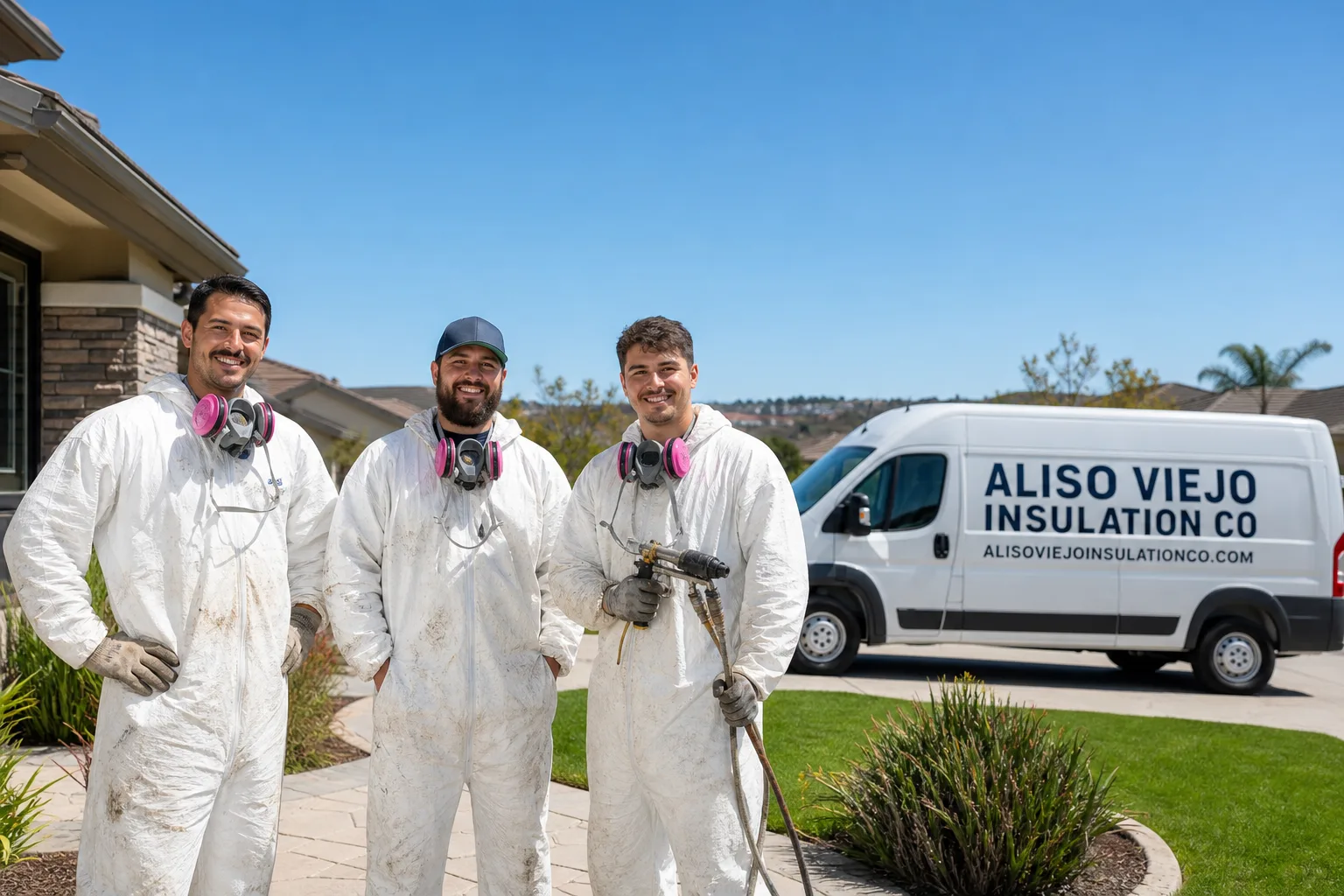
Fast, Reliable Spray Foam Insulation Across March Air Force Base
Spray foam insulation in March Air Force Base typically runs $1.80 – $4.50 per board foot installed, depending on whether the job calls for open-cell or closed-cell chemistry. Most attic and wall projects in the 92551 ZIP code can be scheduled within 3 to 5 business days, and we keep crews familiar with the base-adjacent housing stock so the work moves fast once we’re on site. If you’re fighting a hot house on a 100°F afternoon or dust blowing through your attic penetrations every time the Perris Valley wind picks up, call (877) 352-4780 for a straight answer and a free estimate.
We’ve worked the tract streets off the March ARB perimeter long enough to know what’s behind those ceilings: settled fiberglass batts, open top plates, and aging vapor barriers that were never meant to handle 60-degree day-night temperature swings. That’s the job. Not a product pitch.
Why Aliso Viejo Insulation Co Is March Air Force Base’s Preferred Spray Foam Insulation Company
Nate Calloway runs our insulation crew with one rule: match the material to the house, not the other way around. Because we’re authorized to install products from eight manufacturers, including Owens Corning, Johns Manville, and Knauf, we don’t have to talk a March Air Force Base homeowner into whatever’s sitting on the truck. We can tell you honestly whether your base-adjacent tract house needs open-cell foam in the attic or closed-cell at the rim joist, or whether blown-in cellulose would handle it for less.
Our Spray Foam Insulation team has spent enough afternoons in attics around the March ARB perimeter to know what quick-built military housing looks like from the inside. That matters. A contractor from the newer Inland Empire sprawl south of here might not recognize how Perris Valley winds exploit top-plate gaps in mid-century construction. We do, because we’ve sealed them.
Response time to March Air Force Base is straightforward: most estimates happen within two business days, and we can usually get a crew scheduled the same week. You’ll talk to someone who knows the difference between an attic in 92551 and one in a new subdivision off the 215. That’s the kind of local knowledge that comes from doing the work, not just mapping the ZIP code.
Spray Foam Attic Insulation in March Air Force Base
Spray Foam Attic Insulation in March Air Force Base is the most direct fix for the heat and dust problems we see in mid-century and late-20th-century base housing. The job involves air-sealing the top plate and attic penetrations, then applying foam across the attic deck or knee walls so radiant heat stops pouring through gaps on summer afternoons. If you’ve got a home off the March ARB perimeter with settled batts and daylight showing at the top plate, foam is the upgrade that actually changes your indoor temperature, not just your insulation depth.
For a typical 1,200 – 1,800 square foot single-story tract home in 92551, expect to pay $3,800 – $7,200 for a full attic spray foam job. Smaller attic deck-only applications run $2,200 – $4,000. The range hinges on square footage, access, and whether we’re doing open-cell or closed-cell.
Air-Sealing the Top Plate Before Foam
In March ARB housing, the top plate is where the wall meets the attic, and it’s almost never sealed in quick-built construction. Before we spray anything, we close those gaps. Otherwise the Perris Valley afternoon wind pushes dust and heat straight through your attic assembly no matter how many inches of foam we add above it.
Open-Cell vs. Closed-Cell for March ARB Attics
Open-cell foam costs less per board foot and works well for attic deck applications where the primary goal is blocking radiant heat. Closed-cell costs more but adds structural rigidity and a vapor barrier, which matters in homes with aging or failed original vapor barriers. We’ll tell you which one your attic actually needs after we look at the substrate and ventilation.
Spray Foam Wall Insulation in March Air Force Base
Spray Foam Wall Insulation in March Air Force Base addresses a different problem than attic work: the exterior walls of mid-century base housing are often under-insulated and leaky at the top plate and electrical penetrations. When afternoon winds sweep the Perris Valley floor, those wall cavities act like chimneys, pulling hot air up and out of the living space. Foam seals the assembly and insulates the cavity in one pass, which no batt can do.
Wall cavity injection or full wall spray foam typically runs $2,800 – $6,500 for a single-story March Air Force Base home, depending on how many exterior walls are involved and whether we’re opening drywall or injecting through drilled access holes. Closed-cell is the usual recommendation for wall work because of its vapor-management properties and higher R-value per inch in limited cavity depth.
Handling Aging Vapor Barriers in 92551 Walls
If your mid-century house still has the original thin vapor barrier, it’s likely brittle and failing under summer heat and winter night swings. We prep the substrate before spraying so foam adheres correctly. Spraying over a compromised barrier without addressing it is how you get adhesion failures six months later, and nobody in March Air Force Base should pay for that.
Rim Joist Sealing for Wind-Driven Infiltration
The rim joist, where the floor framing meets the foundation wall, is another wind-driven penetration point in tract homes around the base. Sealing and insulating rim joists with closed-cell foam stops the dust and conditioned-air loss that Perris Valley winds push through these gaps. It’s a smaller job, often $900 – $2,200, but it delivers outsized comfort and energy impact.
Trusted Brands We Service in March Air Force Base
We stock and install from a manufacturer roster that includes Owens Corning, Johns Manville, and Knauf, which means we’re not locked into one foam chemistry or one batt product when we work on March Air Force Base homes. If your project calls for open-cell or closed-cell spray foam, we have access to two of the industry’s premium systems: Icynene and Demilec. That gives us the flexibility to match the foam to the job, whether it’s an attic deck on a base-adjacent tract street or a retrofit wall cavity that needs closed-cell’s vapor properties. Fast turnaround on materials for 92551 jobs, no waiting on special orders that some single-brand contractors run into.
Common Spray Foam Insulation Problems We See in March Air Force Base Homes
- Settled legacy batts leave the top plate wide open. Quick-built military-family housing from the mid-century era often has fiberglass batts that have settled to a few inches deep, leaving a gap at the top plate. Perris Valley afternoon winds push dust and heat straight through that gap, and foam is the only material that seals and insulates it in a single pass.
- Thin original vapor barriers fail under extreme temperature swings. The day-night swing in 92551 can hit 50 to 60 degrees, which cracks and compromises the thin vapor barriers installed in original base housing. That affects how foam bonds, so the substrate has to be evaluated and prepped before any spray application.
- Unsealed attic penetrations pour radiant heat into living space on 100°F afternoons. Older wiring chases, vent pipes, and attic hatches in these tract homes were rarely sealed at construction. Even after batts are topped up, radiant heat floods through those openings, and homeowners still see 85°F indoors with the AC running hard.
- Wind-driven dust infiltration through wall and rim joist assembly gaps. The persistent afternoon winds on the Perris Valley floor don’t just push heat; they push fine dust into wall cavities and rim joist voids. We see dust trails around electrical boxes and along the top plate in attics near the March ARB perimeter, which tells us the entire assembly is leaking.
Pricing for Spray Foam Insulation in March Air Force Base, CA
Attic spray foam in March Air Force Base runs $3,800 – $7,200 for a full single-story application, with attic-deck-only jobs starting around $2,200. Wall insulation work typically lands between $2,800 and $6,500, and rim joist sealing runs $900 – $2,200 depending on perimeter linear footage. Closed-cell foam costs more per board foot than open-cell, but it delivers higher R-value per inch and adds a vapor-management layer that open-cell doesn’t. Access matters too: tight attics and low slope clearances add labor time, and homes with failed vapor barriers need substrate prep before we spray. Call (877) 352-4780 and we’ll give you a line-item estimate based on your actual attic and wall measurements, not a square-footage guess.
We Also Serve Cities Near March Air Force Base
Beyond March Air Force Base, our crews cover Moreno Valley, Woodcrest, Perris, and Good Hope. If you’re in one of those nearby communities and dealing with the same wind-driven attic issues or settled batts, the same team and the same manufacturer access apply. Call (877) 352-4780 to schedule an estimate anywhere in the area.
Serving March Air Force Base, CA — Our Local Coverage Area
We’re based in the March Air Force Base area and know this community well. Use the map below to see our service coverage — if you’re nearby, we can almost certainly help.
FAQs About Spray Foam Insulation in March Air Force Base
March ARB housing in ZIP 92551 was largely quick-built for base personnel, which means top plates and attic penetrations were rarely sealed at construction. Combined with Perris Valley afternoon winds driving dust and heat through those gaps, the air-sealing properties of spray foam address a failure mode that newer subdivisions south of here, built with tighter envelope standards, simply don’t have. That’s the difference foam makes on a base-adjacent tract street versus a new-build community off the 215. Call (877) 352-4780 and we’ll tell you if your home has this problem.
Yes. Closed-cell foam in particular creates an air seal that batt insulation cannot, which is exactly what’s needed when afternoon winds sweep the Perris Valley floor and push dust into wall cavities and attic assemblies. The foam’s adhesion to the substrate blocks the air movement that carries that dust, so the envelope actually stays sealed. For homes near the March ARB perimeter, this matters more than adding inches of fiberglass.
For most attic deck applications in March Air Force Base, open-cell foam handles the radiant-heat problem at a lower cost per board foot. But if your mid-century house has an aging or failed vapor barrier, or if you want added structural rigidity on the roof deck, closed-cell is the better call. We’ll inspect the attic and recommend based on what’s actually there, not on which product carries a higher margin. Give us a call at (877) 352-4780 and we’ll walk you through it.
Yes, but the vapor barrier has to be evaluated and the substrate prepped before any foam goes in. A brittle, compromised barrier will cause adhesion failures if foam is sprayed directly over it, especially with the 50 to 60 degree day-night temperature swings in 92551. We handle that prep as part of the job, so the foam bonds correctly and the assembly performs.
If your attic has settled batts, daylight visible at the top plate, or dust trails around penetrations, more insulation alone won’t fix the problem. The air movement through those gaps has to be sealed first, and spray foam is the only material that seals and insulates in one pass. We’ll do an attic inspection and show you exactly what we found before we quote anything. Call (877) 352-4780 for a free estimate.
Written by Nate Calloway, Owner at Aliso Viejo Insulation Co, serving March Air Force Base and the surrounding Inland Empire communities.