
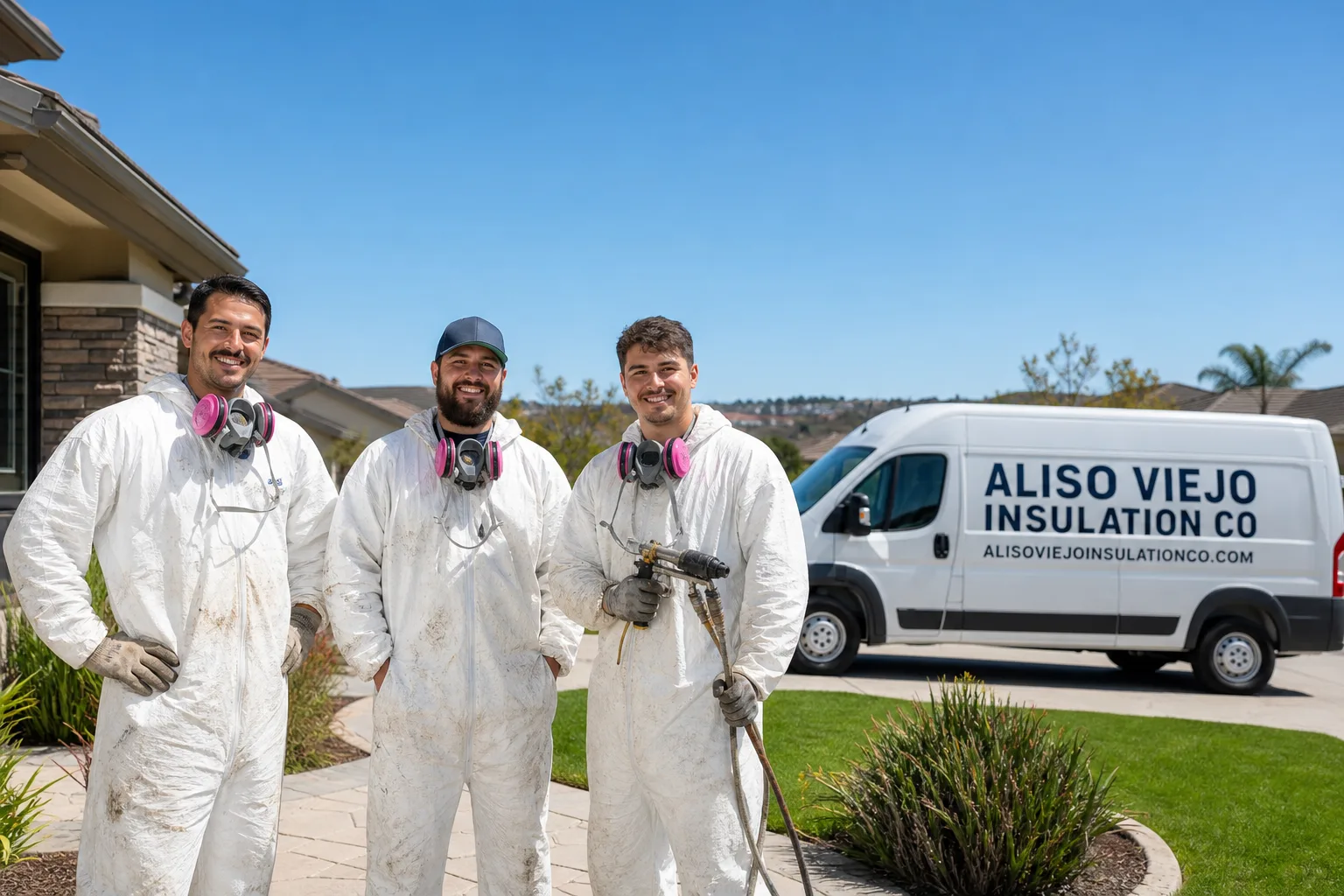
Fast, Reliable Spray Foam Insulation Across Mayflower Village
Spray foam insulation in Mayflower Village costs $2.75 – $6.50 per board foot for open-cell and $4.00 – $9.00 per board foot for closed-cell, with most whole-attic or wall-cavity jobs landing between $3,200 and $9,800 depending on square footage and existing insulation condition. We work the 91006 zip code constantly and know exactly what these mid-century ranches need. If your attic is baking the rest of the house or a back bedroom won’t hold its setpoint, call us at (877) 352-4780 for a free estimate. We’re here year-round, and we pull permits through Los Angeles County because that’s how unincorporated Mayflower Village works.
Mayflower Village sits in a hot inland valley where summer afternoons grind past 95°F before cooling into the low 60s at night. That swing punishes homes built in the 1940s through 1960s, especially the single-story ranches and bungalows that dominate the residential streets here. Most of them still carry original wall cavities, minimal attic insulation, and HVAC ducts running through raw attic space. The problem is rarely the air conditioner. It’s the thermal envelope leaking conditioned air into an attic that hits 120°F by 2 p.m. We’ve spent enough time in Mayflower Village attics to know the difference a properly sealed top plate and rim joist makes on a 98-degree afternoon.
Why Aliso Viejo Insulation Co Is Mayflower Village’s Preferred Spray Foam Insulation Company
We show up in Mayflower Village within 24 to 48 hours for estimates, and we schedule most spray foam jobs within two weeks of the signed quote. That matters when a bedroom is unusable by late afternoon or your cooling bill has doubled since May. Our crews know the low-pitch rooflines and shallow eaves along the residential streets here, and we plan for the confined access before we arrive, not after we’re in the attic.
Nate Calloway runs our field operations and has personally walked dozens of Mayflower Village attics. What sticks with him is the consistency of the housing stock. The ranches built off Lemon Avenue and the surrounding 91006 streets share an original construction DNA, open wall cavities, undersized attic ventilation, and no thought given to interior moisture management in 1955. That consistency means we know what a Mayflower Village job will take before we open the hatch. You’re not paying us to learn on your house.
Our reputation in Mayflower Village is built on material honesty. We carry two premium spray foam systems, Icynene and Demilec, and we’ll recommend open-cell or closed-cell based on your specific roof deck, wall assembly, and budget. We’re not tied to moving one manufacturer’s product. If a Mayflower Village home needs open-cell in the walls and closed-cell at the rim joist, that’s what we quote. If cellulose or mineral wool makes more sense in a particular attic, we’ll say so. That independence is why homeowners here choose us over single-brand contractors.
Spray Foam Wall Insulation in Mayflower Village
Spray Foam Wall Insulation in Mayflower Village typically involves injecting or applying open-cell foam into existing wall cavities to stop the air movement that makes back bedrooms useless by late afternoon. In these 1950s ranches, the original wall assembly is often just plaster over wood lath with nothing behind it but the raw attic. Air moves from the attic down into the wall cavity, picks up heat, and bleeds into the living space. Spray foam wall insulation closes those pathways. A typical wall-cavity job in Mayflower Village runs $2.75 – $4.50 per board foot for open-cell, with most single-room or whole-side retrofits landing between $1,800 and $5,600.
How We Access Mid-Century Wall Cavities
On a Mayflower Village ranch with original plaster, we usually go through the exterior, drilling access holes from the stucco side or working from the attic down. The goal is to hit the cavity without destroying the plaster you’re trying to keep. Most of these homes haven’t been remodeled since the Carter administration, so we’re careful with the existing surfaces.
When Wall Insulation Alone Won’t Solve It
If a back bedroom won’t hold its setpoint even after the walls are sealed, the rim joist and top plates are the likely culprits. Air doesn’t care about one sealed cavity if it can flow through the band joist and up the wall. We’ll tell you honestly whether wall foam alone does the job or whether the rim joist needs to be included. Sometimes the answer is both, and we’d rather tell you that before you spend money on a partial fix.
Rim Joist Spray Foam in Mayflower Village
Rim joist spray foam in Mayflower Village is the single highest-return air-sealing job in these low-slung ranches, because the rim joist is where the floor framing meets the foundation wall and it’s almost never sealed in 1950s construction. In the 91006 zip code, the band joist sits against a stucco exterior that heats all day and cools all night. That temperature differential pulls air through the rim joist like a slow leak, and closed-cell foam stops it. Rim joist sealing in Mayflower Village usually runs $3.50 – $6.00 per linear foot when done as part of a broader job, with standalone rim joist work typically landing between $1,500 and $3,200 depending on crawl space access and linear footage.
Open-Cell vs. Closed-Cell at the Rim Joist
We use closed-cell foam at the rim joist in Mayflower Village almost every time. It adds R-value, it acts as a vapor retarder, and it holds up against the moisture that collects where conditioned air meets the foundation wall. Open-cell is the wrong material here, and we won’t sell it to you just because it’s cheaper.
What the Job Actually Looks Like
The rim joist sits at the very edge of the floor system, so access depends on whether your home has a crawl space or a basement. Most Mayflower Village ranches have a crawl space, and we work from below to seal each joist bay with closed-cell foam. The work is messy, confined, and demands a respirator. It’s also one of the most effective things you can do for a home that’s losing conditioned air through the foundation line.
Trusted Brands We Service in Mayflower Village
We install and service spray foam systems from Icynene and Demilec, two of the most respected names in the insulation industry, and we stock the application materials our crews need for Mayflower Village jobs so we’re not running back to a supply house mid-project. Beyond spray foam, we’re authorized to install products from Owens Corning, Johns Manville, Knauf, Rockwool, CertainTeed, and GreenFiber. That’s eight manufacturers across every major category, fiberglass batts, mineral wool, blown cellulose, open-cell and closed-cell spray foam. For Mayflower Village homeowners, that breadth matters because it means our recommendation is based on what your specific home needs, not what we happened to buy at a discount last quarter. Nate Calloway built the company around that principle: the job dictates the material.
Common Spray Foam Insulation Problems We See in Mayflower Village Homes
- Closed-cell foam on the roof deck without an ignition barrier. On low-pitch mid-century roof decks, we regularly see foam sprayed to the underside of the sheathing with no code-compliant ignition barrier over it. Los Angeles County requires one, and a lot of unpermitted work around Mayflower Village never had it installed. That’s a fire-code issue and a resale disclosure problem.
- Wall foam that ignores the top plates and rim joists. We’ve reopened walls in Mayflower Village where a previous contractor sprayed the cavity but left the top plate wide open to the attic. The foam did its job, but the room still never cooled because attic air kept pouring through the plate line. The homeowner blamed the foam. The foam wasn’t the problem.
- Unpermitted work that assumes a city hall exists. Mayflower Village is unincorporated, and permits route through Los Angeles County. We still see jobs around 91006 where a contractor skipped the permit because they assumed some local building department would never find out. It becomes a problem at resale when the buyer’s inspector asks for documentation that doesn’t exist.
- Open-cell foam in contact with the foundation wall. In crawl spaces and rim joists, open-cell foam that touches masonry will wick moisture and eventually degrade. We see it in Mayflower Village homes where a previous contractor used open-cell everywhere to save $0.75 per board foot. The fix is removal and replacement with closed-cell, which costs more than it would have to do it right the first time.
Pricing for Spray Foam Insulation in Mayflower Village, CA
Here’s what Mayflower Village homeowners can expect to pay. Open-cell spray foam runs $2.75 – $4.50 per board foot for wall cavities and attic floors. Closed-cell runs $4.00 – $6.50 per board foot for rim joists, roof decks, and areas needing a vapor barrier. A full wall-cavity retrofit on a 1,200-square-foot ranch typically lands between $4,500 and $7,800. Rim joist sealing as a standalone job runs $1,500 – $3,200. A full attic roof deck with closed-cell and the required ignition barrier usually runs $7,000 – $12,000 for a Mayflower Village home of typical size. What moves the number: access difficulty, existing insulation removal, the amount of prep work on the wall assembly, and whether the county permit triggers additional documentation. Estimates are free, and our pricing is upfront. Call (877) 352-4780 and we’ll give you a real number, not a wild range.
| Spray Foam Application | Typical Mayflower Village Price Range |
|---|---|
| Open-cell wall cavity retrofit | $2.75 – $4.50 per board foot |
| Closed-cell rim joist sealing | $3.50 – $6.00 per linear foot |
| Closed-cell roof deck (with ignition barrier) | $4.50 – $6.50 per board foot |
| Full attic roof deck project | $7,000 – $12,000 |
| Single-room wall cavity job | $1,800 – $5,600 |
We Also Serve Cities Near Mayflower Village
If you’re in Arcadia, Monrovia, Sierra Madre, or North El Monte, our crews work those areas weekly. Our Spray Foam Insulation team covers the entire San Gabriel Valley corridor, and we bring the same county-permitting knowledge and mid-century housing expertise to every job. For Mayflower Village residents, we’re your local full-method insulation contractor. Check our Spray Foam Insulation in Mayflower Village page for neighborhood-level details.
Serving Mayflower Village, CA — Our Local Coverage Area
We’re based in the Mayflower Village area and know this community well. Use the map below to see our service coverage — if you’re nearby, we can almost certainly help.
FAQs About Spray Foam Insulation in Mayflower Village
Yes, in most cases you do. Mayflower Village is unincorporated, so there’s no city building department, and spray foam work that involves wall cavities, rim joists, or roof decks generally requires a Los Angeles County permit. The county also wants documentation for any closed-cell foam applied to the underside of a roof deck, specifically an ignition barrier that meets current code. Some contractors skip the permit because they assume a city hall exists in this unincorporated pocket. That’s a mistake that comes back at resale. Call (877) 352-4780 and we’ll tell you exactly what your project triggers, no guesswork.
Often yes, but only if the top plates and rim joist are sealed at the same time. The original wall cavities in these homes are open to the raw attic, and air moves through them all day. Wall foam closes that path. But if the top plate is still open, attic air keeps pouring through the plate line and the room never fully cools. We diagnose the whole air path before quoting, because the last thing you need is a partial fix that costs $4,000 and still leaves the room warm. Call (877) 352-4780 for an assessment.
Yes, we do rim joist work in Mayflower Village regularly, and in these low-slung ranches it’s usually accessed from the crawl space rather than the attic. The rim joist sits at the very edge of the floor framing, where it meets the foundation wall. Closed-cell foam is the right material there, and the work typically takes one day for a standard 91006 ranch. It’s a high-return job for homes that are bleeding conditioned air through the foundation line. Estimates are free at (877) 352-4780.
Los Angeles County requires an ignition barrier over closed-cell spray foam applied to the underside of a roof deck in a liveable or used attic space. The specific material depends on the attic’s use and access. For Mayflower Village homes with raw, non-converted attics, the county still wants the barrier documented, and our crews install whatever the permit requires. The ignition barrier is part of the job, not an upgrade. Call (877) 352-4780 and we’ll walk you through exactly what your roof deck needs.
Yes, and in fact it’s one of the best cases for spray foam in this housing stock. Most of these 1940s to 1960s ranches still run HVAC ducts through an unconditioned attic that hits 120°F in summer. Sealing the attic floor or roof deck with foam, along with the duct connections, cuts the cooling loss at the source. The foam doesn’t just insulate; it air-seals the attic space so the conditioned air stays in the ducts and in the living space. We’ll tell you honestly whether sealing the attic floor or the roof deck makes more sense for your specific home. Call (877) 352-4780 for a free estimate.
Written by Nate Calloway, Owner at Aliso Viejo Insulation Co, serving Mayflower Village and the San Gabriel Valley with spray foam, attic, and blown-in insulation expertise.