
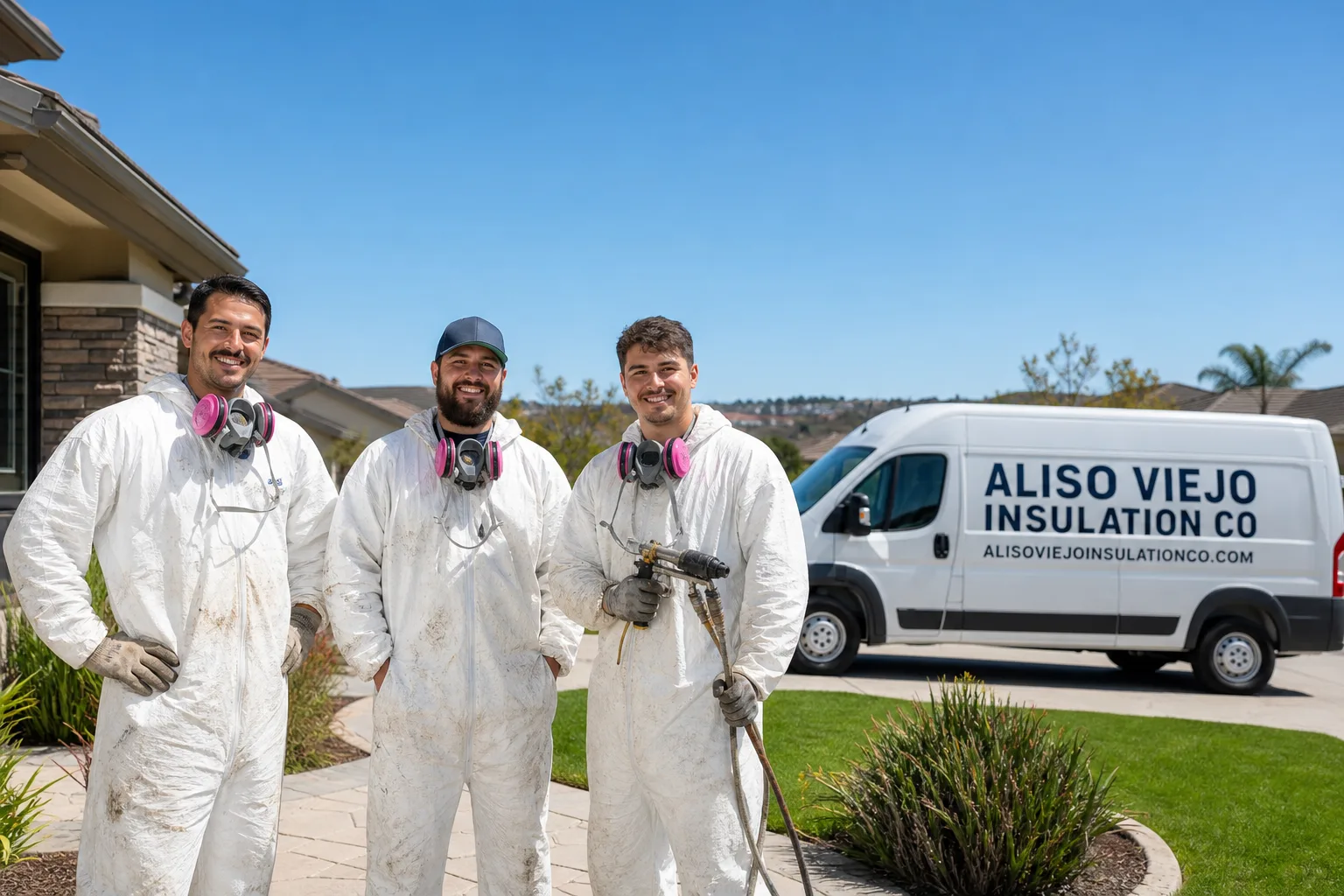
Fast, Reliable Spray Foam Insulation Across Portola Hills
Spray foam insulation in Portola Hills typically runs $2.75 – $7.50 per board foot installed, with most whole-attic projects landing between $4,500 and $11,000 depending on foam type and square footage. We’re in Portola Hills neighborhoods off Saddleback Ranch Road, Glenn Ranch Road, and Ridgeline every week, so we know exactly how these 1980s and 1990s tract homes behave when canyon winds hit them. If your attic bakes in August or your upstairs rooms stay cold all winter, give us a call at (877) 352-4780 and we’ll diagnose what’s actually going on.
Why Aliso Viejo Insulation Co Is Portola Hills’s Preferred Spray Foam Insulation Company
Portola Hills homeowners call us because we stock products from eight manufacturers and match the foam to the job, not to whatever’s on the truck. Nate Calloway has built the company around the fact that an open-cell Icynene job in a townhome party wall needs a completely different approach than closed-cell Demilec on a garage ceiling under a bonus room. Our Spray Foam Insulation specialists install both systems plus Rockwool mineral wool and GreenFiber cellulose, so when we tell you spray foam is or isn’t the right call here, that recommendation comes from building science, not a sales quota.
Our crews know the Portola Hills terrain: the graded hillsides, the low-pitch tile roofs, the attached townhome clusters where insulation boundaries get complicated. We’ve worked in 92610 long enough to know which tracts still have original fiberglass that’s settled to R-9 or worse. That local knowledge means we can usually tell you what you need over the phone, then confirm it from the attic.
Garage Spray Foam Insulation in Portola Hills
Garage Spray Foam Insulation in Portola Hills is one of the highest-return upgrades we do, because so many homes here have a bonus room above the garage that turns into an oven by 2 p.m. in July. The job involves spraying foam across the garage ceiling and rim joists, sealing the gaps where the garage slab meets framing, and sometimes treating the shared wall between the garage and living space. In Portola Hills we typically see garage ceiling projects run $1,800 – $3,800 for open-cell foam on a standard two-car garage, and $2,400 – $5,200 if closed-cell is needed for moisture control or added structural rigidity.
What Changes the Scope
Older Portola Hills garages often have recessed lighting, exposed plumbing, and open soffit gaps that have been pulling canyon air into the house for thirty years. We air-seal those penetrations before foam goes in. Skipping that step means you pay for R-value that leaks out through the holes.
Garage Ceiling vs. Garage Walls
If the space above the garage is a bedroom or playroom, the ceiling gets priority. If the garage itself gets used as a workshop or gym, we’ll treat the walls too. Many Portola Hills homeowners run heaters in the garage in winter, and without insulation that heat is gone within minutes once the unit shuts off.
Closed Cell Spray Foam Insulation in Portola Hills
Closed Cell Spray Foam Insulation in Portola Hills is what we recommend for rim joists, roof decks, and any area where canyon wind-driven moisture or ember exposure is a factor. Closed-cell foam cures to a rigid, water-resistant layer at roughly R-6.5 per inch, and in Portola Hills it typically runs $3.25 – $7.50 per board foot depending on depth and access. Given the low-pitch tile roofs and shallow attic cavities common throughout the 92610 tract sections, closed-cell is often the only foam that performs reliably in those tight, hot spaces.
Rim Joist Spray Foam
Rim joist sealing around the second floor framing is where Portola Hills homes lose a surprising amount of heat every winter night. We inject closed-cell foam along the entire perimeter where the floor framing meets the foundation. In a canyon microclimate where nighttime temps drop well below nearby Mission Viejo, that single detail can cut the draft feel almost immediately.
Roof Deck Application
For low-pitch tile roofs, we apply closed-cell directly to the underside of the roof deck to create an unvented attic assembly. This changes how the attic responds to the summer heat load. The key in Portola Hills is that the foam must seal completely or wind-driven dust and heat will find their way through any seam left open.
Trusted Brands We Service in Portola Hills
We’re authorized installers for both Icynene and Demilec spray foam systems, and we stock Johns Manville, Knauf, and CertainTeed products for the many Portola Hills homes where a hybrid approach makes more sense than full foam. Our material-agnostic position means we’re not married to one chemistry. We install open-cell where airflow and sound control matter; closed-cell where moisture, embers, and structural adhesion are the priorities. Because we keep materials for both systems in Aliso Viejo, most Portola Hills jobs don’t wait on shipping from a regional warehouse. We’ll have it on the truck when we show up.
Common Spray Foam Insulation Problems We See in Portola Hills Homes
- Foam shrinkage along framing members. The canyon’s temperature swings, hot days and cold nights, cause wood to expand and contract through a wide range. Cheap foam or poorly mixed batches crack and pull away from studs within a few seasons, which is why we run both Icynene and Demilec rather than one budget chemistry.
- Ember intrusion through unsealed vents. Santa Ana events push embers into soffit and ridge vents. Foam alone, no matter how thick, does not stop wind-driven embers. In the wildland-urban interface of Portola Hills, we always recommend pairing foam with ember-resistant vent mesh and sealing gaps where flames can find a path to framing.
- Delamination on dusty roof decking. Low-pitch tile attics collect dust, and closed-cell foam won’t bond properly to a dirty substrate. In the tract homes off Glenn Ranch Road, we see foam that was sprayed without proper prep peeling away within two years. It loses R-value and leaves the substrate exposed again.
- Settled original fiberglass misdiagnosed as an HVAC problem. Many Portola Hills homes still have the builder-grade R-19 batts from 1988. After decades of canyon wind infiltration through leaky top plates, that fiberglass sits at maybe R-9. Homeowners think their air conditioner is weak. The real issue is the attic has lost half its thermal resistance.
Pricing for Spray Foam Insulation in Portola Hills, CA
You can expect a garage ceiling in Portola Hills to run $1,800 – $5,200 depending on foam type and access. A full attic air-seal plus open-cell roof deck application typically lands between $5,500 and $9,900 for a 1,500-square-foot tract home. Rim joist projects run $1,200 – $2,800 for most two-story Portola Hills homes. Closed-cell runs higher per board foot but delivers double the R-value per inch, which matters in shallow roof cavities. We quote exact numbers before work starts. Call (877) 352-4780 for a free estimate that accounts for your specific roofline, access, and existing insulation condition.
We Also Serve Cities Near Portola Hills
Our crews cover Spray Foam Insulation in Portola Hills and the surrounding Saddleback Valley communities. We run daily routes through Foothill Ranch, Lake Forest, Mission Viejo, and Trabuco Canyon, so scheduling a Portola Hills job usually happens within a few days, not weeks. Same crew, same materials, same standard on every job.
Serving Portola Hills, CA — Our Local Coverage Area
We’re based in the Portola Hills area and know this community well. Use the map below to see our service coverage — if you’re nearby, we can almost certainly help.
FAQs About Spray Foam Insulation in Portola Hills
Spray foam itself does not block wind-driven embers. In Portola Hills, effective fire-hardening pairs closed-cell foam air-sealing with ember-resistant vent mesh and sealing of soffit and ridge vents. The foam’s role is to close gaps where embers and hot gases find their way to wood framing. Call (877) 352-4780 and we’ll check your venting when we quote the insulation.
Canyon winds push dust and air through every framing gap, compacting fiberglass and reducing its R-value over time. Portola Hills’ elevation and position in the Saddleback Valley foothills mean more wind-driven air exchange than flatland Lake Forest or Mission Viejo. That’s why air-sealing before insulating is non-negotiable here.
Yes, and we do it regularly. Closed-cell foam on the garage ceiling and rim joists stops the heat stack effect that turns the upstairs bonus room into an oven by mid-afternoon. Most garage ceiling projects in Portola Hills take one day to complete. Estimates are free.
Party walls between attached units are tricky because you’re working within a shared cavity. We typically recommend dense-pack cellulose or mineral wool for sound and thermal separation between units, and reserve spray foam for the exterior envelope, rim joists, and garages. The approach depends on whether your townhome has a common attic.
Closed-cell spray foam is the better fit for low-pitch, shallow tile roof attics because it delivers higher R-value per inch in a confined space. It also adheres to the underside of the roof deck, reducing radiant heat gain. The key is proper substrate prep, dust and oil must be cleaned off or the foam will delaminate.
If you’re dealing with a hot attic, cold rooms, or drafts that seem to come from everywhere along the canyon side of your home, call us at (877) 352-4780. We’ll inspect the existing insulation, identify what’s failed, and give you a straight answer about whether spray foam is the right move for your Portola Hills home. Free estimates, no pressure, and a recommendation grounded in what we’ve seen work in hundreds of these tract homes.
Written by Nate Calloway, Owner at Aliso Viejo Insulation Co, serving Portola Hills and the Saddleback Valley since the company’s founding.