
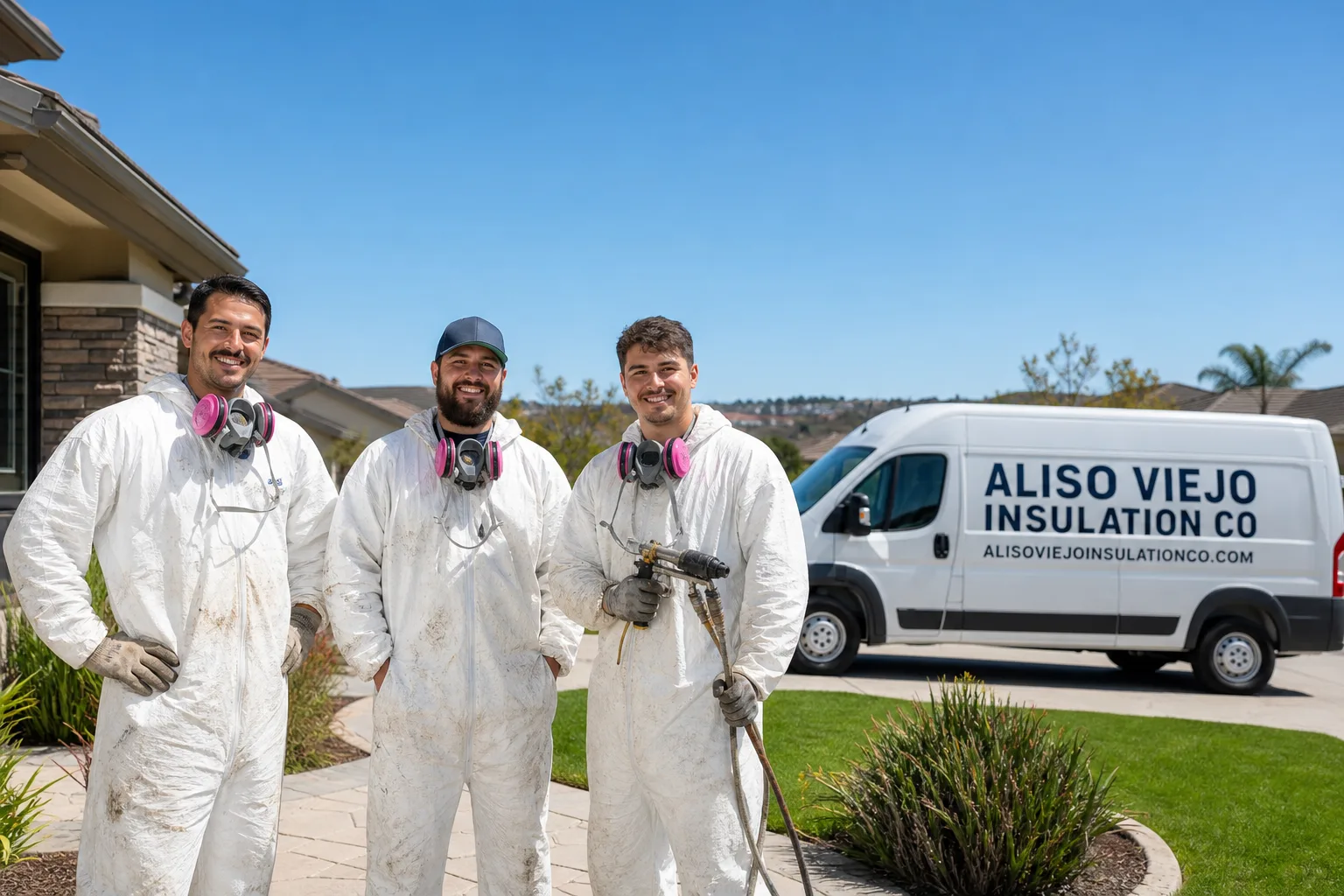
Fast, Reliable Spray Foam Insulation Across Santa Monica
Spray foam insulation in Santa Monica does something no fiberglass batt can do here: it seals the building envelope against the marine layer’s relentless moisture while insulating in tight, odd-shaped cavities that older coastal construction is full of. Most homes in Santa Monica’s 90401, 90402, 90410, and 90411 zip codes are fighting condensation more than temperature swings, and closed-cell foam is often the only material that handles both problems at once. We’re Aliso Viejo Insulation Co, led by Nate Calloway, and we’ve sprayed attics, rim joists, garage ceilings, and roof decks across Santa Monica for homeowners who were tired of damp walls and moldy attic sheathing. Call (877) 352-4780 for a free estimate, and we’ll tell you honestly whether spray foam is even the right material for your house.
Why Aliso Viejo Insulation Co Is Santa Monica’s Preferred Spray Foam Insulation Company
We’re not the contractor who shows up with one brand and one technique and calls it a solution. Our Spray Foam Insulation team works with both open-cell and closed-cell systems from Icynene and Demilec, and we stock fiberglass, mineral wool, and cellulose from Owens Corning, Johns Manville, Knauf, Rockwool, CertainTeed, and GreenFiber. That means when a homeowner north of Montana calls us about a 1920s bungalow with knob-and-tube wiring and no attic ventilation, we can tell them the truth: spray foam over that wiring is a code violation and a fire hazard, and the right first step is rewiring, not spraying. Nate Calloway built this company around that kind of straight answer.
Santa Monica homeowners call us because we understand the city’s specific building stock. We know the 1960s-70s apartment blocks along the 90404/90405 corridor have unvented attics that sweat in the morning fog. We know Ocean Park bungalows often have attic insulation that looks fine until you press on it and water pools around your fingers. We know parking on narrow streets off Ocean Park Boulevard or around the Third Street Promenade makes project logistics half the job. That’s why we schedule around alley access, coordinate with building managers, and show up with a plan that doesn’t block your neighbors’ garages.
We respond to Santa Monica service calls fast, and our installers arrive with everything needed to handle tight crawlspace and attic work without tearing up your property. Every quote is free, every recommendation is grounded in building science rather than brand loyalty, and every job starts with a moisture assessment, because in Santa Monica, moisture is the thing that ruins insulation.
Closed Cell Spray Foam Insulation in Santa Monica
Closed Cell Spray Foam Insulation is the workhorse for Santa Monica’s coastal climate. It’s dense, rigid, and acts as its own vapor barrier, which is exactly what an unvented attic or a garage ceiling exposed to marine-layer humidity needs. In Santa Monica, where the morning fog rolls in off the Pacific and saturates unsealed building cavities, closed-cell foam blocks both air movement and moisture migration. It also adds structural rigidity to older framing, which matters in pre-war bungalows where rafters have settled and sheathing has softened over 80 years of salt air.
Typical Applications in Santa Monica Homes
We use closed-cell foam on rim joists in crawlspaces under 1920s Ocean Park homes, where the damp earth below and the cool salt air above meet right at the band board. That intersection is where we find the worst rot and termite damage, and sealing it with closed-cell foam stops the moisture drive. We also spray it on unvented roof decks in the 90404/90405 apartment corridors, where adding soffit vents isn’t feasible and condensation is dripping onto insulation.
What Santa Monica Homeowners Should Expect to Pay
Closed-cell spray foam in Santa Monica typically runs $2.10 to $3.50 per board foot installed, with a 2-inch rim joist job in a standard crawlspace landing between $1,400 and $2,800. A full unvented roof deck in a 1,200-square-foot apartment attic runs $4,500 to $9,000 depending on access and how much old insulation has to come out first. These numbers reflect Santa Monica’s labor market and the extra time required for tight alley access and older framing.
Open Cell Spray Foam in Santa Monica
Open Cell Spray Foam has a place in Santa Monica homes, but it’s a narrower one. Open-cell foam is softer, expands more aggressively, and costs less per board foot, which makes it a good fit for interior walls and soundproofing applications in the denser multi-family buildings along Wilshire Boulevard and around Century City’s edge. But in Santa Monica’s unvented attics and crawlspaces with persistent humidity, open-cell foam absorbs moisture and loses R-value over time. We’ll only recommend it where the building envelope is already dry and vented, which in Santa Monica means it’s often the secondary choice behind closed-cell.
Where Open-Cell Works in Santa Monica
For interior partition walls in duplexes and townhomes, open-cell foam applies at $0.80 to $1.70 per board foot and does a solid job of sound deadening between units, which neighbors in tightly packed 90401 blocks genuinely appreciate. We’ve also used it in vented attics north of Montana where the homeowner wanted air sealing plus insulation at a lower material cost than closed-cell.
When We Steer Santa Monica Homeowners Away From It
If you’re in a 1960s apartment near Virginia Avenue Park with an unvented attic and no soffit vents, open-cell foam is the wrong call. The marine layer will condense inside the foam, degrade the R-value, and eventually drip back down through the ceiling. We’ll tell you that directly before we quote it, because installing the wrong foam in Santa Monica creates a mold problem that costs more to remediate than the insulation job itself.
Trusted Brands We Service in Santa Monica
We are authorized to install spray foam systems from Icynene and Demilec, two of the most respected names in closed-cell and open-cell chemistry. Our relationship with these manufacturers matters in Santa Monica because their formulations are tested for performance in high-humidity coastal environments, which is the exact condition your attic faces every morning between May and October. We also carry Owens Corning and GreenFiber products for hybrid jobs where spray foam pairs with blown-in cellulose or fiberglass, and we keep consistent stock of these materials available for Santa Monica projects so we’re not waiting on supply chains when your attic is opened up and exposed. Eight manufacturer brands, one objective recommendation: we choose the material that fits your building, not the truck.
Common Spray Foam Insulation Problems We See in Santa Monica Homes
- Closed-cell foam sprayed directly over knob-and-tube wiring in pre-war bungalows. We see this in homes north of Montana and in Ocean Park where the original wiring is still active. Foam encases the wires, prevents heat dissipation, and creates a fire hazard. The correct sequence is rewiring first, then spraying, no exceptions.
- Wet attic sheathing hidden under existing insulation in Ocean Park. The marine layer soaks fiberglass from below, and a contractor who sprays over that wet surface traps the moisture against the wood. Within a year, the sheathing rots and mold blooms inside the attic. Our crews strip and inspect before spraying anything.
- Open-cell foam used in unvented attics in the 90404 corridor. The foam absorbs the marine layer’s salt-laden humidity, loses R-value, and condensation forms on the underside of the roof deck. It’s a slow failure, but by the time you see the ceiling stains, the insulation is doing nothing.
- Ignoring the rim joist in raised-foundation bungalows near the beach. We find rim joists that were never insulated because a previous contractor didn’t want to crawl under the house. In Santa Monica, that band board is where cool ocean air meets warm interior air, and every unsealed rim joist is a condensation factory.
Pricing for Spray Foam Insulation in Santa Monica, CA
Spray foam insulation in Santa Monica costs more per board foot than it does inland because the labor market is tighter, parking and access are harder, and the work often requires removing degraded old insulation before spraying. Closed-cell runs $2.10 to $3.50 per board foot installed here. Open-cell runs $0.80 to $1.70. A typical rim joist job in a Santa Monica crawlspace lands between $1,400 and $2,800. A full unvented attic in a 1960s apartment building off Lincoln Boulevard can run $5,000 to $11,000 depending on square footage and how much prep the sheathing needs. The biggest cost variable in Santa Monica isn’t the foam, it’s what we find underneath the old insulation, and we’ll show you photos before we ask for a change order. Call (877) 352-4780 for a free estimate and we’ll give you a written number, not a ballpark.
We Also Serve Cities Near Santa Monica
Beyond Spray Foam Insulation in Santa Monica, our crews handle projects in Venice, Century City, Culver City, and Beverly Hills. Each of those areas has its own building quirks, but the same marine layer rolls through all of them, and the same moisture-first approach applies. Call (877) 352-4780 and tell us which city you’re calling from.
Serving Santa Monica, CA — Our Local Coverage Area
We’re based in the Santa Monica area and know this community well. Use the map below to see our service coverage — if you’re nearby, we can almost certainly help.
FAQs About Spray Foam Insulation in Santa Monica
Yes, and that’s one of the most common jobs we do in Santa Monica’s 90404 and 90405 corridors. Closed-cell spray foam is the right material for unvented attics because it acts as its own vapor barrier and doesn’t require soffit venting to manage moisture. In the 1970s townhomes off Ocean Park Boulevard, we’ve sprayed closed-cell directly on the underside of roof sheathing after removing wet batt insulation, and it stabilizes the attic environment within days. Call (877) 352-4780 for a free attic assessment.
The marine layer means your bungalow’s attic and wall cavities are damp for hours every morning, even in summer. Spray foam applied to a wet surface traps that moisture and accelerates wood rot. We inspect sheathing and existing insulation for hidden moisture before any foam goes on, and in Ocean Park bungalows where the old insulation is soaked from below, step one is always removal and air sealing before we spray. Call (877) 352-4780 and we’ll check the moisture levels in your attic with a meter, not a guess.
Closed-cell is the right choice for a 1960s apartment in 90404 if the attic is unvented or the building has persistent humidity problems. Closed-cell foam is denser, stops air and moisture movement, and won’t absorb the marine layer’s dampness. Open-cell is cheaper but absorbs moisture, which is a problem in Santa Monica’s coastal air. For interior soundproofing between apartment units, open-cell works fine. For attics and rim joists, closed-cell is the answer. Call (877) 352-4780 for a material recommendation based on your building’s specific conditions.
Yes, in most Ocean Park homes the old fiberglass is wet from the marine layer, and spraying foam over it seals that moisture against the framing. We remove the degraded insulation, inspect the sheathing for rot, and only then spray. The removal adds labor cost, but skipping it turns a $3,000 insulation job into a $15,000 mold remediation. Call (877) 352-4780 and we’ll explain exactly what we found in your attic before we quote anything.
We plan every Santa Monica project around access. In neighborhoods north of Montana and around Ocean Park, shared alleys and permit-parking streets mean our crews stage equipment in a single van, coordinate with building managers for locked gates, and schedule foam rigs to arrive after the morning traffic clears. We inform neighbors before occupying shared driveways, and we’ve sprayed townhomes off Ocean Park Boulevard where the only access was a 30-inch alley door. Call (877) 352-4780 and we’ll do a quick access assessment before scheduling.
Written by Nate Calloway, Owner at Aliso Viejo Insulation Co, serving Santa Monica and the surrounding coastal communities. We bring eight manufacturer brands and a moisture-first approach to every insulation project.