
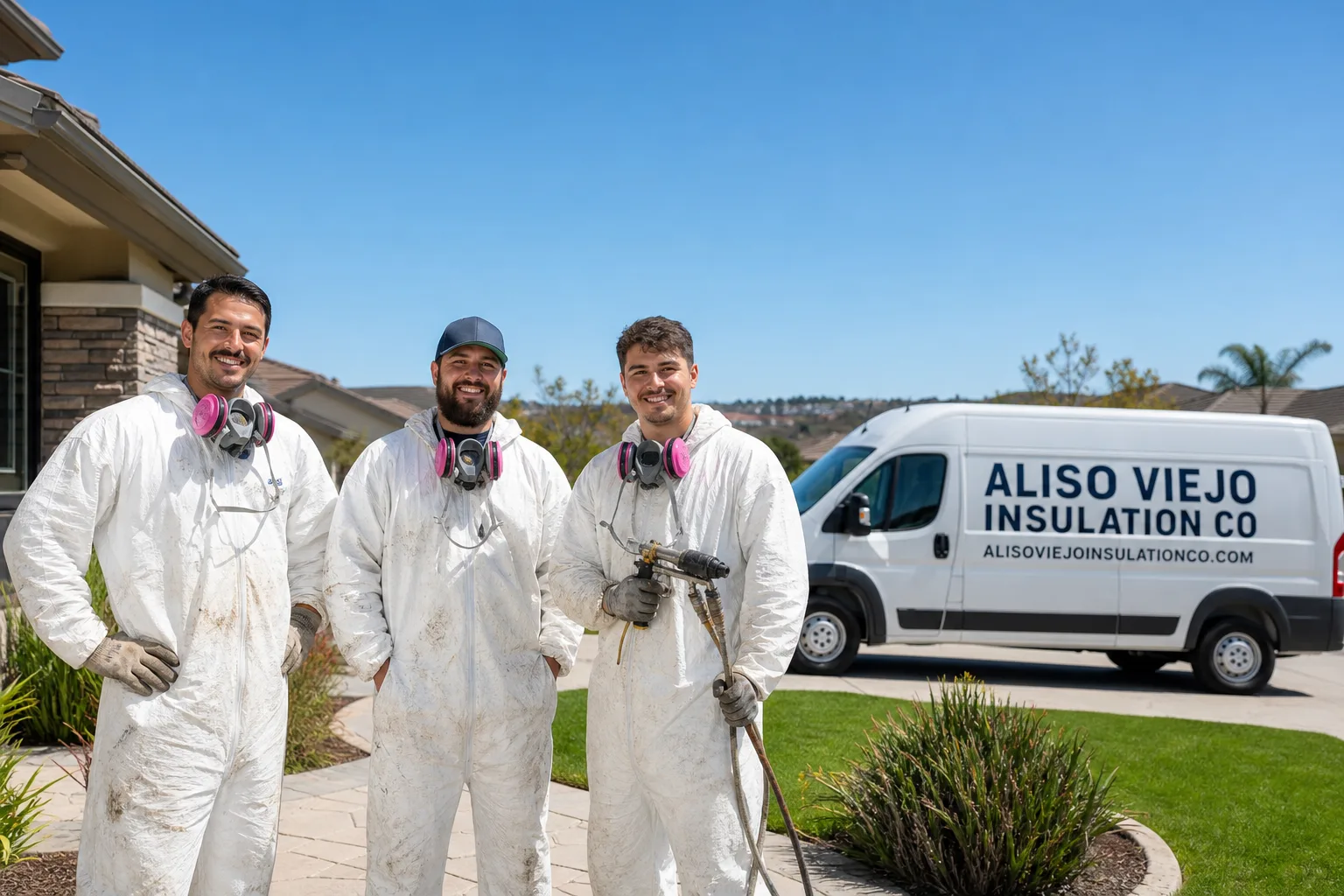
Fast, Reliable Attic Insulation Across Norwalk
If your Norwalk home runs hot upstairs every summer and your AC won’t shut off, the problem usually isn’t your HVAC. It’s what’s sitting, or what’s missing, in your attic. Most Norwalk houses went up between 1950 and 1975, which means the original rock wool or fiberglass up there has settled, compressed, and quietly lost the R-value it had when Eisenhower was president. We’re Aliso Viejo Insulation Co, and we fix that. Led by Nate Calloway, our team works in Norwalk regularly, and we know exactly what these older attics need. Call (877) 352-4780 for a free estimate and we’ll come take a look.
Why Aliso Viejo Insulation Co Is Norwalk’s Preferred Attic Insulation Company
We’re not a general contractor dabbling in insulation. We install attic insulation, spray foam, and blown-in insulation, and nothing else. That narrow focus matters in a city like Norwalk, where most of the housing stock is 1950s and 60s single-story tract homes with wood-frame construction and stucco exteriors. We know what’s hiding in those attics because we’ve been inside hundreds of them. We’ve seen the settled rock wool, the unsealed bypasses around ceiling fixtures, the attic hatches that act like open chimneys. Homeowners in the 90650, 90651, 90652, and 90659 zip codes call us because the recommendation they get is built around their actual structure, not around whatever product happens to be on a truck that day. That’s the difference between a contractor locked into one brand and a specialist who sources from eight manufacturers and lets the house decide.
Our Attic Insulation team treats every Norwalk job as its own diagnostic problem. We don’t roll in with a one-size-fits-all quote. We climb into the attic, measure what’s there, check for air leaks, and then recommend a specific material and method from our eight-brand roster. Sometimes that’s blown-in fiberglass. Sometimes it’s mineral wool. Sometimes closed-cell spray foam. The house tells us. Nate Calloway built this company around that principle, and it’s why so many of our Norwalk customers come from referrals.
Attic Insulation Removal in Norwalk
Attic Insulation Removal in Norwalk is a job we handle regularly, and honestly, it’s the step most homeowners skip that they shouldn’t. A lot of the attics we inspect around town still have the original 1950s rock wool or fiberglass batts, and after sixty-plus years of settling and absorbing dust, moisture, and the occasional rodent nest, that material isn’t doing much beyond taking up space. In Norwalk’s inland climate, where summer attics routinely hit 130 degrees, degraded insulation also traps heat and makes everything below it harder to cool. Removing old insulation runs roughly $1.50 to $3.50 per square foot in Norwalk, depending on attic access, depth, and whether there’s contamination from pests or old roof leaks. For a typical 1,200-square-foot Norwalk attic, that usually lands between $1,800 and $4,200.
When Removal Makes Sense
Removal is worth it when the existing material has compressed to less than half its labeled thickness, when there’s evidence of rodent activity or moisture damage, or when knob-and-tube wiring is present and needs to be assessed. In many 1950s Norwalk homes, the original insulation is so thin it’s effectively just a thermal break in name only. Pulling it out gives us a clean, visible surface to air-seal properly before anything new goes in.
The Right Sequence
The sequence matters more than the product. Air-seal first, then insulate. If we blow new fiberglass over an unsealed attic floor, the leaks around ceiling fixtures, top plates, and the attic hatch just keep pulling hot air into the living space. We’ve seen new insulation underperform badly in Norwalk because bypasses were never addressed. Removal might only take a morning. The sealing and upgrade usually takes a full day, sometimes less.
Insulation Contractors in Norwalk
When you’re comparing Insulation Contractors in Norwalk, the question to ask isn’t just “what do you charge per square foot.” It’s “what will you do about the air leaks before you add insulation?” That’s the question that separates a real specialist from a blow-and-go crew. We’re licensed to install products from eight manufacturers: Owens Corning, Johns Manville, Knauf, Rockwool, CertainTeed, Icynene, Demilec, and GreenFiber. That breadth means we’re not married to any single method. A Norwalk house with a low-slope roof and tight soffit access might get dense-packed cellulose. A newer infill home with an unvented attic might be better served by open-cell spray foam. We carry the full spectrum so you don’t have to compromise.
What a Norwalk Attic Inspection Looks Like
Every job starts with a walkthrough. We check the existing insulation depth across the whole attic floor, note the type and condition, inspect the attic hatch for weatherstripping and an insulated cover, and look for daylight coming through soffit gaps or top plates. In Norwalk’s tract homes, we’re especially careful around recessed lights and old ceiling boxes, which were rarely sealed when these houses were built. That inspection drives the material recommendation.
Custom Material Matching
If you’re in a 1960s stucco home with original blown rock wool and a composition roof, we might recommend removing it, air-sealing, and blowing in Owens Corning fiberglass to current code for Climate Zone 3B. If you’re in a newer home near the 605 and want to stop afternoon heat gain altogether, closed-cell spray foam against the roofline via Icynene or Demilec could be the better answer. The point is the house decides, not our inventory. That’s what material-agnostic advising actually looks like on a Norwalk job site.
Trusted Brands We Service in Norwalk
We install GreenFiber blown-in cellulose for Norwalk homeowners who want a sustainable, fire-resistant option made from recycled paper. We carry Owens Corning fiberglass for attic top-ups and batts. And we stock Johns Manville and Knauf products for jobs where a specific R-value-per-inch or facing type is required. Because we keep eight brands in our supply chain, including Rockwool mineral wool for fire resistance and sound attenuation and Icynene and Demilec for spray foam, turnaround in Norwalk is fast. We don’t wait on a single distributor. We pull from whoever has what your house needs, and we schedule the install as soon as the material lands.
Common Attic Insulation Problems We See in Norwalk Homes
- Settled original rock wool: In the 1950s and 60s tract homes near Norwalk Square and along Studebaker Road, the original rock wool often reads R-7 or less now. The label said R-19 in 1962. The house doesn’t know the label. It only knows the thickness that’s actually there, which might be 1.5 inches.
- Unsealed attic bypasses: Recessed lights, ceiling junction boxes, and top plates were rarely sealed when Norwalk’s original houses were built. These bypasses let conditioned air leak out and hot attic air pour in. New insulation on top of unsealed bypasses underperforms, sometimes badly.
- Builder-grade attic hatches: The plywood hatch panel in a Norwalk hallway ceiling is typically uninsulated and unsealed. Hot attic air radiates straight through it. A sealed and insulated hatch cover is a cheap fix we handle on nearly every retrofit.
- Knob-and-tube-era wiring: Some of the older homes in the 90650 and 90651 zip codes still have remnants of knob-and-tube or early Romex framing-era wiring. Before insulation goes in or on top, that wiring needs to be evaluated and protected so nothing gets buried in contact with an ignitable surface.
Pricing for Attic Insulation in Norwalk, CA
Here are honest Norwalk numbers, not “call for pricing” hand-waving. A simple blown-in attic top-up in a Norwalk tract home runs $1,500 to $2,800 for a typical 1,000- to 1,400-square-foot attic. Full removal of old rock wool plus air-sealing and new blown-in fiberglass to R-38 runs $3,500 to $7,500, depending on attic accessibility and how many bypasses need sealing. Spray foam, which we install using Icynene and Demilec systems, runs $2.50 to $5.50 per board foot for open-cell and $3.50 to $7.00 per board foot for closed-cell. The biggest cost variable in Norwalk is whether the attic has been air-sealed before. It usually hasn’t. And that’s part of what we quote for. Call (877) 352-4780 and we’ll give you an exact number after a walkthrough. Estimates are free.
We Also Serve Cities Near Norwalk
Our Norwalk crews also cover Cerritos, Artesia, Bellflower, and Santa Fe Springs. If you’re a few minutes over the city line, you’re still in our service area. The same eight-brand lineup applies, the same air-seal-first standard applies, and the same free estimate does too.
Serving Norwalk, CA — Our Local Coverage Area
We’re based in the Norwalk area and know this community well. Use the map below to see our service coverage — if you’re nearby, we can almost certainly help.
FAQs About Attic Insulation in Norwalk
You can, but we usually recommend against it. The original rock wool in most Norwalk homes has settled to 1.5 inches or less and is often dust-laden and contaminated from decades of attic heat cycling. More importantly, the attic floor is almost certainly unsealed around ceiling fixtures, top plates, and the hatch. Blowing new insulation over unsealed bypasses means you’ll spend money on R-value that hot air just routes around. The better sequence is removal, air-sealing, then new insulation to current code. Call (877) 352-4780 and we’ll do a free inspection so you know exactly what you’re working with.
Yes. Knob-and-tube and period-correct early Romex wiring can’t simply be buried under insulation, especially not cellulose or spray foam. In Norwalk homes that still have this wiring, we coordinate with an electrician or flag the issue during the walkthrough so the wiring can be assessed and, where needed, protected or replaced before insulation goes in. We won’t blow insulation over exposed knob-and-tube. A proper attic retrofit in an older Norwalk house sometimes means the wiring gets handled first, and the insulation goes in afterward.
For Norwalk’s inland Southeast LA County climate, a minimum of R-38 is the right target, and some homeowners push to R-49 when the budget allows. The DOE’s Zone 3 guidance aligns with what we see in the field here: the dominant problem is radiant heat gain through the roof on summer afternoons, not winter heat loss. That’s also why air-sealing matters so much in Norwalk. R-38 with sealed bypasses outperforms R-49 with gaps around every ceiling fixture.
Newer Norwalk homes, including infill builds from the last twenty years, typically have more insulation by code but the same weak points: builder-grade attic hatches that are unsealed, pull-down stairs treated like a finished lid when they’re actually a thermal hole, and recessed lights that spew conditioned air upward. The fix in a newer home is often more surgical: seal and insulate the hatch, replace or cap the recessed lights, and either top up to R-38 or, in some cases, convert the attic to a sealed, conditioned space with spray foam. In older tract homes, the job is usually removal first. In newer infill homes, it’s usually sealing and top-up.
We do when the existing insulation is degraded, compressed, pest-contaminated, or blocking access to the air-sealing work. In Norwalk’s 1950s and 60s tract homes, that’s the majority of cases we see. Removal adds cost and time, but it lets us do the job correctly: clean surface, sealed bypasses, then new insulation with a known R-value. For a quote on removal versus a straight top-up, call (877) 352-4780. We’ll tell you what your attic actually needs, not what’s easiest to sell.
Written by Nate Calloway, Owner at Aliso Viejo Insulation Co, serving Norwalk and surrounding cities since founding the company on the principle that the right insulation is the one the house asks for.