
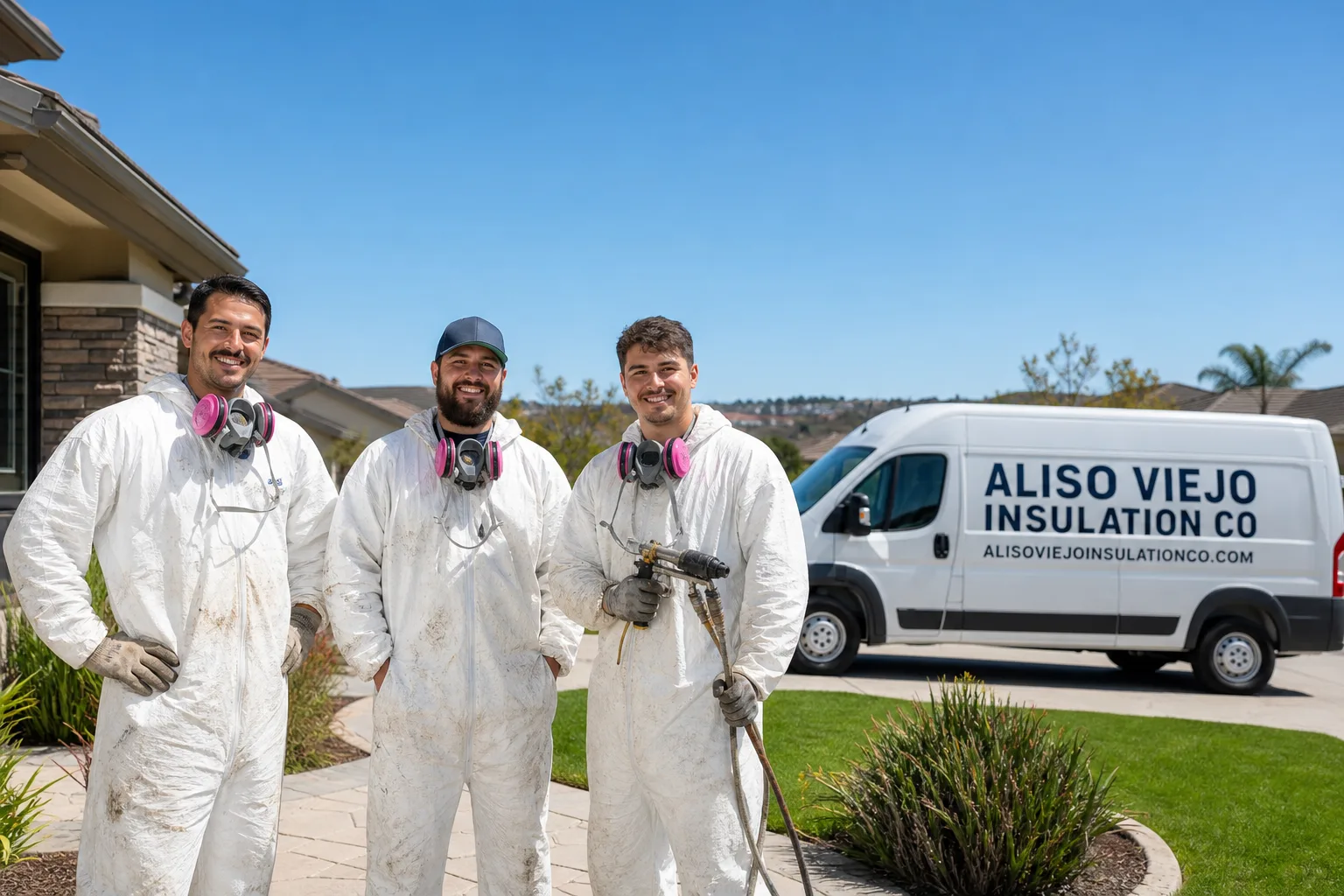
Fast, Reliable Spray Foam Insulation Across San Joaquin Hills
Spray foam insulation in San Joaquin Hills typically runs $2.50 to $6.50 per board foot for installed closed-cell, with most whole-garage or attic-deck projects landing between $3,400 and $9,800 depending on square footage and access. We’re Aliso Viejo Insulation Co, and our crews work throughout the 92657 zip code weekly. Our Spray Foam Insulation team knows the hillside homes here, the HOA expectations, and the specific thermal challenges that come with canyon-ridge sun exposure and marine layer swings. Call (877) 352-4780 and we’ll have someone to your home within 24 to 48 hours for an estimate.
Why Aliso Viejo Insulation Co Is San Joaquin Hills’s Preferred Spray Foam Insulation Company
Homeowners in San Joaquin Hills call us because we understand the compliance side of insulation work here, not just the application. Communities like Crystal Cove require architectural review for any visible change to a structure. Closed-cell spray foam, with its clean monolithic finish, often passes review more easily than traditional batting because there are no seams, no sagging edges, and no visible fasteners. We’ve guided dozens of hillside homeowners through that process. Our installers know what reviewers look for: clean perimeter lines, properly recessed foam depth, and paint-matched penetrations around can lights and vents.
We carry both Icynene and Demilec spray foam systems, so we can match open-cell or closed-cell chemistry to what your home actually needs. That matters in San Joaquin Hills, where a 1990s Mediterranean with original single-pane glazing has different thermal requirements than a 2015 contemporary with high-performance windows. You don’t get a one-product pitch from us. You get a material recommendation based on your roof deck, your wall cavities, your garage configuration, and your HOA’s finish requirements.
Response time to San Joaquin Hills from our Aliso Viejo shop is typically 24 to 48 hours for estimates. Emergency foam work, like a failed rim joist seal during heat waves, can often be scheduled same week. Call (877) 352-4780 and ask for Nate Calloway. He’s the owner and the person who will walk you through the technical side of the bid.
Garage Spray Foam Insulation in San Joaquin Hills
Garage Spray Foam Insulation in San Joaquin Hills homes solves a problem most people don’t realize they have until the July heat settles in. Detached garages here, especially on canyon-ridge lots, absorb direct sun all afternoon. The roof deck radiates that heat into the garage, and if the garage shares a wall with living space or sits under a bonus room, that heat migrates into the house. Closed-cell foam applied to the garage ceiling and the shared wall interrupts that thermal bridge. A typical two-car garage ceiling in San Joaquin Hills costs $2,800 to $5,400 installed, depending on whether we’re foaming the roofline or the ceiling joists.
HOA-Compliant Garage Finishes
In communities like Crystal Cove, garage ceilings that face the street or are visible through carriage doors often need architectural review. Closed-cell foam leaves a flat, uniform surface that painters can match to the approved trim color. We tape and seal the perimeter so the finished edge reads clean, then coordinate with your painter or apply the approved color ourselves if it’s specified in the review documents.
Dust and Wind Sealing
Older homes in San Joaquin Hills, particularly late-90s builds with original batting, often suffer dust infiltration when afternoon canyon winds push against garage door seals and soffit gaps. Spray foam at the rim joist and around garage door framing stops that air movement. We recently completed a closed-cell spray foam application in a Crystal Cove home where the original batting had settled and dust was infiltrating through the attic. Using Demilec closed-cell foam, we sealed the garage ceiling and vaulted great room walls, then matched the HOA-approved paint color on all penetrations. The homeowner passed their architectural review without any corrections, and the afternoon winds no longer drive heat into the living space.
Closed Cell Spray Foam Insulation in San Joaquin Hills
Closed Cell Spray Foam Insulation in San Joaquin Hills is the right call for most hillside applications because it delivers roughly R-7 per inch where open-cell delivers about R-3.7. That matters on canyon ridges where afternoon sun loads are intense and attic temperatures routinely hit 140°F in August. Closed-cell also acts as an air barrier and a vapor retarder, which handles the marine layer moisture swings that open-cell doesn’t manage as well in exterior wall cavities. Expect to pay $2.50 to $4.50 per board foot for closed-cell in standard wall and roof deck applications. Vaulted ceilings and hard-to-reach knee walls run toward the higher end.
Vaulted Ceilings and Architectural Review
San Joaquin Hills’ custom Mediterranean and contemporary homes often have vaulted great rooms with exposed beams or complex ceiling geometry. Closed-cell foam conforms to those irregular cavities and leaves a surface that takes paint cleanly. If your HOA requires review for insulation changes, the monolithic finish typically gets approved faster than visible batting, which reviewers in Crystal Cove and similar communities tend to reject for aesthetic reasons. We document the foam depth and final surface in photos for your review package.
Ignition Barrier Requirements
Building code requires spray foam in attached garages and habitable attics to be separated from living space by an ignition barrier. In San Joaquin Hills, we regularly see older homes where a prior insulation job skipped this step, leaving raw foam exposed. That’s a code violation and a fire safety issue. We install approved intumescent coatings or drywall as required, and we flag any missed ignition barriers during our initial walkthrough so your HOA final inspection doesn’t catch it first.
Trusted Brands We Service in San Joaquin Hills
We’re authorized to install products from eight manufacturers, and for spray foam work in San Joaquin Hills we lean on Icynene and Demilec systems specifically. Both carry ICC-ES reports that meet California Title 24 requirements, which matters for your HOA documentation. For jobs where spray foam isn’t the right fit, like certain attic retrofits, we also work with Owens Corning, Johns Manville, Knauf, and Rockwool products. Stocking access to all these brands means we quote the right material for your roof deck, not whatever is on the truck that day. Nate Calloway runs the product approvals himself, so when you call (877) 352-4780, you’re talking to someone who can explain the chemistry difference between an open-cell Icynene application and a closed-cell Demilec application in plain English.
Common Spray Foam Insulation Problems We See in San Joaquin Hills Homes
- Foam expansion cracking exterior stucco or architectural finishes. Closed-cell foam expands as it cures. If applied too thick in a single pass inside a wall cavity, it can stress exterior stucco or trim details that HOA reviewers care about. We apply in controlled lifts and monitor cavity pressure on older San Joaquin Hills homes.
- Missed ignition barriers on garage ceilings. Code requires a thermal or ignition barrier between spray foam and occupied space. We find raw, exposed foam in detached garages and under-roof decks in hillside homes where a previous contractor cut corners. It’s a fire hazard and a violation your HOA will catch.
- Moisture trapped behind closed-cell in wall cavities. The marine layer here means walls see humidity swings. If passive ventilation details like weep screeds and soffit vents get foamed over, moisture can collect behind the foam in the wall cavity. On Crystal Cove and other coastal-adjacent properties, we map ventilation before we spray and preserve those paths.
- Settled batting left in place under new foam. We’ve seen homes where someone sprayed foam over old fiberglass that had already slumped. The old batting compresses, blocks the foam’s adhesion, and creates air channels. In 1990s San Joaquin Hills builds, that original batting is almost always compromised. We pull it before we spray.
Pricing for Spray Foam Insulation in San Joaquin Hills, CA
Here’s what homeowners in the 92657 zip code should expect to pay. Garage ceiling spray foam runs $2,800 to $5,400 for a standard two-car detached garage. Closed-cell roof deck applications on vaulted great rooms run $4.50 to $6.50 per board foot depending on rafter depth and access. Open-cell wall cavity work runs $1.80 to $3.20 per board foot. Rim joist sealing along a typical hillside foundation runs $800 to $2,200. Factors that move the number: whether your HOA requires a specific finish, whether we need to remove old batting first, and how steep the roof access is. Estimates are free. Call (877) 352-4780 and we’ll walk your property, check the existing insulation, and give you a written number with the exact foam system specified.
We Also Serve Cities Near San Joaquin Hills
Our crews run this entire stretch of the Orange County coast and foothills. We handle San Joaquin Hills jobs weekly, and that same schedule covers Aliso Viejo, Newport Beach, Laguna Beach, and Irvine. If you’re in any of those neighboring communities and need a spray foam estimate, call (877) 352-4780 and expect the same 24 to 48 hour response.
Serving San Joaquin Hills, CA — Our Local Coverage Area
We’re based in the San Joaquin Hills area and know this community well. Use the map below to see our service coverage — if you’re nearby, we can almost certainly help.
FAQs About Spray Foam Insulation in San Joaquin Hills
Yes, closed-cell spray foam is frequently approved in San Joaquin Hills communities including Crystal Cove because the finished surface is flat, seamless, and paintable to match HOA-approved trim colors. Reviewers typically accept it where visible batting would be rejected. We provide photo documentation of foam depth and final finish to include in your architectural review package, and we’ve had homeowners pass review without corrections after our full process. Call (877) 352-4780 to discuss your specific HOA’s requirements before you file.
Closed-cell foam manages both. Its R-7 per inch resists afternoon sun heat gain on canyon-ridge homes where attic temperatures climb past 140°F in summer. As a vapor retarder, it also handles the humidity swings from the marine layer, which open-cell foam doesn’t manage as well in exterior wall cavities. For San Joaquin Hills specifically, we recommend closed-cell on roof decks, vaulted ceilings, and any wall adjacent to unvented attic space. Open-cell has its place in interior sound-control applications, but the coastal-adjacent climate here usually points to closed-cell.
In most San Joaquin Hills communities with active architectural review, yes, any change to visible ceiling or roof structure requires prior approval, even interior work that affects the roofline. Vaulted ceiling foam applications change the thermal profile of the roof assembly, and some HOAs want to review the material and finish spec before work begins. We can prepare the technical submittal, including the foam system’s ICC-ES report and the planned finish. Call (877) 352-4780 if you want help with the paperwork.
Demilec closed-cell is our most common recommendation for the Mediterranean and contemporary homes in San Joaquin Hills because it handles high heat loads, delivers a clean paintable finish, and carries the California code approvals your HOA will want to see. For interior sound attenuation between rooms or around home theaters, we sometimes specify Icynene open-cell instead. The brand follows the application. Nate Calloway can walk you through the difference and why it matters for your specific roofline when you call (877) 352-4780.
We mask and tent every spray area, including windows, floors, and any finished surfaces within ten feet of the application zone. Overspray lands on the masking, not your walls. For San Joaquin Hills homes where driveways and hardscaping sit close to the work area, we use negative pressure containment on open door and window penetrations so foam particles don’t drift. Cleanup includes a full sweep and surface check before we leave, and any overspray on exterior stucco or trim is removed the same day. Call (877) 352-4780 with specific questions about your property’s layout.
Ready to get an honest recommendation for your San Joaquin Hills home? Call (877) 352-4780 for a free estimate. We’ll inspect your existing insulation, review any HOA requirements you’re working within, and give you a written quote with the exact foam system specified. No brand pushing, no one-size-fits-all pitch.
Written by Nate Calloway, Owner at Aliso Viejo Insulation Co, serving San Joaquin Hills and surrounding communities.