
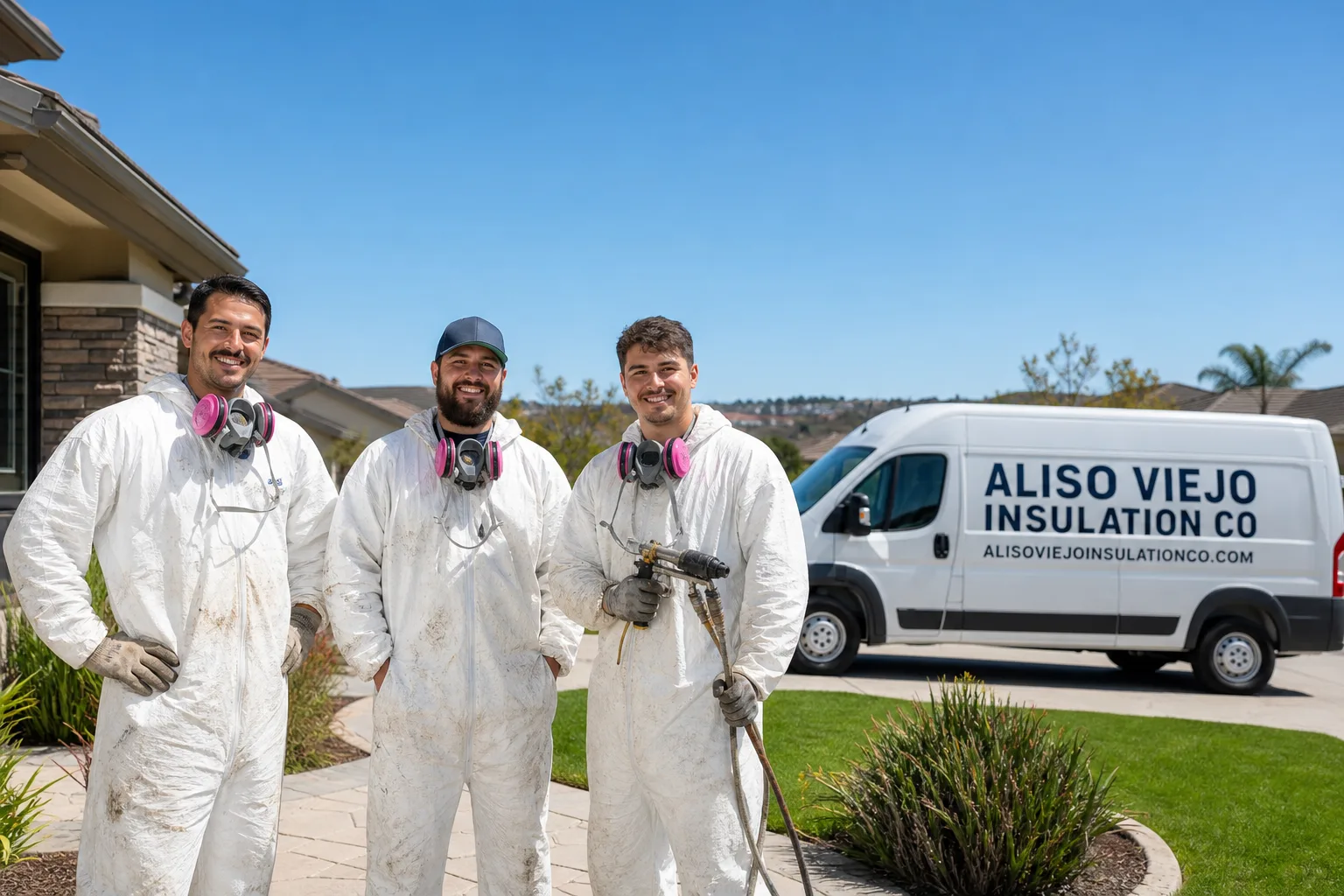
Fast, Reliable Attic Insulation Across Lakeland Village
Attic insulation in Lakeland Village usually costs between $1,800 and $4,600 depending on attic size and the method needed, and most jobs are finished in one day. We know this community’s homes better than most: the converted lake cabins off Grand Avenue, the 1970s ranchers near Highway 74, the cedar-sided houses tucked against the Santa Ana Mountains. If your ceiling is hot to the touch by 3 p.m. or your AC runs nonstop from June through September, the problem is probably above your head. Call (877) 352-4780 and we’ll climb up, measure the actual rafter depth, and tell you exactly what will fix it.
Why Aliso Viejo Insulation Co Is Lakeland Village’s Preferred Attic Insulation Company
Homeowners here deal with a specific set of attic problems that a generic insulation crew won’t recognize. Lakeland Village isn’t a tract-home suburb. It’s a patchwork of 1950s cabins that became full-time residences, 1960s wood-frame ranches, and a few newer builds mixed in. Each era has its own failure mode. We know from working the area that a 1,100-square-foot cabin near the lake often has rafter bays too shallow for a standard R-38 blown-in blanket. We know that homes along the Highway 74 corridor frequently have insulation that’s been pulled up and never reset after decades of roof patches.
Nate Calloway built this company around one principle: the right insulation depends on the structure, not on what’s sitting in the warehouse. That’s why we work with eight manufacturer brands including Johns Manville, Knauf, Rockwool, CertainTeed, and the spray foam systems from Icynene and Demilec. We’re not tied to pushing one product. We’re tied to solving the actual heat-transfer problem in your attic.
Response time to Lakeland Village is typically same-week, and for homes with exposed ceiling cavities or active rodent damage we can usually get a crew out within 48 hours. Our Attic Insulation team has worked on dozens of homes between Grand Avenue and the lake, and we’ve developed a reputation for being straight about what needs addressing and what can wait.
Attic Insulation Removal in Lakeland Village
Attic Insulation Removal in Lakeland Village is the starting point for most older homes here, especially the converted cabins and 1960s ranchers where the original material has been compressed, contaminated, or scattered by rodents. We vacuum out the old insulation, inspect the decking and wiring, and prep the cavity for whatever comes next. In Lakeland Village, removal typically runs $900 to $1,800 for an average attic, depending on depth, accessibility, and whether we’re dealing with blown material, batts, or a mix of both.
Old Cabin Remediation
Homes built as lake cabins in the 1950s and 1960s often have original fiberglass batts that have collapsed to a fraction of their rated R-value. Decades of heat cycling, roof leaks, and rodent activity mat the fibers down. We remove it all, exposing the top plates and wiring so we can air-seal before anything new goes in.
Contaminated or Pest-Damaged Material
When rodents nest in attic insulation, the material is not just ineffective; it’s a health concern. We see this constantly in Lakeland Village, where the mix of older wood-frame construction and nearby open space gives rats and squirrels easy access. Removal is the only correct fix. You can’t simply blow new insulation over contaminated batts and call it resolved.
Insulation Contractors in Lakeland Village
Finding insulation contractors in Lakeland Village who understand this specific housing stock makes a measurable difference in the outcome. This isn’t standard suburban attic work. Shallow rafter bays, original cedar ceilings, unvented roof assemblies, and decades of owner modifications create conditions that require real diagnosis before installation. A typical full attic insulation project in Lakeland Village runs $2,200 to $4,600, with the final number driven by attic square footage, method, and how much prep work the structure needs.
Material-Matching Approach
Because we install fiberglass, mineral wool, cellulose, and both open- and closed-cell spray foam, we’re not forcing one answer onto every house. A 1960s cabin with 2×4 rafters gets a different spec than a 1980s ranch with standard trusses. That flexibility is the point. Eight manufacturer brands, one objective recommendation.
Single-Source Installs
If your project needs attic batts plus spray foam on the kneewalls plus an air-sealing pass, it’s all under one roof with us. No coordinating three contractors. No finger-pointing when something’s off. One crew, one standard, one warranty.
Trusted Brands We Service in Lakeland Village
We’re authorized installers for eight insulation manufacturers, which gives Lakeland Village homeowners options most contractors simply don’t carry. We stock Johns Manville Formaldehyde-free fiberglass batts and Knauf EcoBatt for standard rafter bays. Rockwool mineral wool is available for homes where fire resistance matters, particularly in the older wood-frame construction north of Grand Avenue. CertainTeed blown-in fiberglass is a common choice for attics with deeper, accessible cavities. And GreenFiber recycled cellulose serves homeowners who want a sustainable option with strong air-sealing performance. Because we maintain relationships across all these brands, we can order quickly for Lakeland Village jobs and we’re never stuck telling you to accept a product you don’t want.
Common Attic Insulation Problems We See in Lakeland Village Homes
- Compressed original batts from cabin-era construction. The 1950s-1970s cabins that started as weekend lake homes were insulated to minimal standards if at all. What’s up there now is often matted to half its original thickness and doing very little.
- South- and west-facing roof planes cooking bedrooms. Because Lakeland Village sits in a hot inland valley with intense afternoon sun, the roof planes facing that sun transfer heat straight through under-insulated cavities. Homeowners blame windows and AC; the attic is usually the culprit.
- Rodent tunneling and nesting. The proximity to open hillsides and older wood-frame construction gives pests constant access. We regularly find insulation with tunnels carved through it, and the fix requires removal, sanitizing, and air-sealing entry points before new material goes in.
- Displaced insulation from roof repair history. Homes along the Highway 74 corridor tend to have patch repair histories. Every time a roofer works on the decking, insulation gets pulled and sometimes isn’t reset properly. We find bare spots directly over bedrooms where the deck was patched.
Pricing for Attic Insulation in Lakeland Village, CA
Attic insulation in Lakeland Village runs $1,800 to $4,600 for a complete job on a typical single-story home, with attic size and prep work driving the range. Here’s how it breaks down: attic insulation removal alone is $900 to $1,800. Air-sealing top plates, can lights, and penetrations adds $400 to $900. Blown-in insulation for a 1,000-1,500 square foot attic runs $1,400 to $2,800. Batt insulation sized to shallow rafter bays runs $1,200 to $2,500. Spray foam is higher, from $3,200 to $6,500 for a typical Lakeland Village attic, because of the material and labor involved. Call (877) 352-4780 for a specific quote. Estimates are free, and we’ll give you exact numbers based on what’s actually in your attic.
We Also Serve Cities Near Lakeland Village
Our crews work throughout the Lake Elsinore basin and the surrounding foothill communities. In addition to Lakeland Village, we serve Sedco Hills, Canyon Lake, Meadowbrook, and Wildomar. If you’re on the edge of town or in an unincorporated pocket, give us a call and we’ll confirm coverage for your street.
Serving Lakeland Village, CA — Our Local Coverage Area
We’re based in the Lakeland Village area and know this community well. Use the map below to see our service coverage — if you’re nearby, we can almost certainly help.
FAQs About Attic Insulation in Lakeland Village
Air-sealing is the single highest-impact prep step for older Lakeland Village homes, because gaps around top plates, can lights, and plumbing penetrations let conditioned air escape into the attic while pulling hot attic air into your living space. In the converted cabins and 1960s wood-frame homes common here, those gaps are everywhere: original construction had no sealing at all. Insulation slows heat transfer; it doesn’t stop air movement. Without sealing first, you’re paying to insulate a leaky box. Call (877) 352-4780 and we’ll include an air-sealing scope in your free estimate.
In almost every case we see in Lakeland Village, yes. When the sun beats on an unshaded south- or west-facing roof plane for hours, the heat radiates through the decking and into whatever insulation is below it. If that insulation is thin, compressed, or missing over patched decking, the bedroom below absorbs that heat. The fix usually involves air-sealing, replacing or supplementing insulation, and in many Lakeland Village homes adding radiant-barrier sheathing under the hottest roof sections. We diagnose this exact problem regularly. Call us and we’ll take thermal readings and show you where the heat is entering.
Absolutely, and we see it constantly. Lakeland Village’s older wood-frame homes near open hillsides give rats, mice, and squirrels easy access through gaps in eaves, vents, and roof junctions. Once inside, they tunnel through batts, nest in blown insulation, and contaminate the material with droppings and urine. The affected insulation loses effectiveness and becomes a health issue. The correct fix is full removal, sanitizing, air-sealing entry points, and installing fresh insulation. This is one of the most common jobs we do in the 92530 ZIP code.
Not necessarily, and this is where a lot of generic advice goes wrong. Lakeland Village is a cooling-dominated climate. Your attic’s problem is radiant heat from the sun, not cold temperatures above. What matters most here is proper air-sealing, adequate ventilation, and filling the cavity you actually have, which in many older cabins is shallow. A 2×4 rafter bay in a converted lake cabin physically cannot hold R-38. Squeezing in the highest R-value possible isn’t the goal. The goal is stopping heat transfer through the actual structure you own. We’ll spec insulation that fits your rafter depth and your roof orientation, not a number off a national chart.
We install products from eight manufacturers: Owens Corning, Johns Manville, Knauf, Rockwool, CertainTeed, Icynene, Demilec, and GreenFiber. That spans fiberglass batts, mineral wool, blown cellulose, and both open- and closed-cell spray foam. For Lakeland Village homes specifically, we often recommend Knauf or Johns Manville batts for shallow rafter bays, CertainTeed blown-in for accessible attics, and Icynene or Demilec spray foam when air-sealing and insulation need to work as one assembly. The brand follows the building science, not the other way around. Call (877) 352-4780 and we’ll tell you which product fits your attic and why.
Written by Nate Calloway, Owner at Aliso Viejo Insulation Co, serving Lakeland Village and the Lake Elsinore basin with material-agnostic attic insulation since day one.