
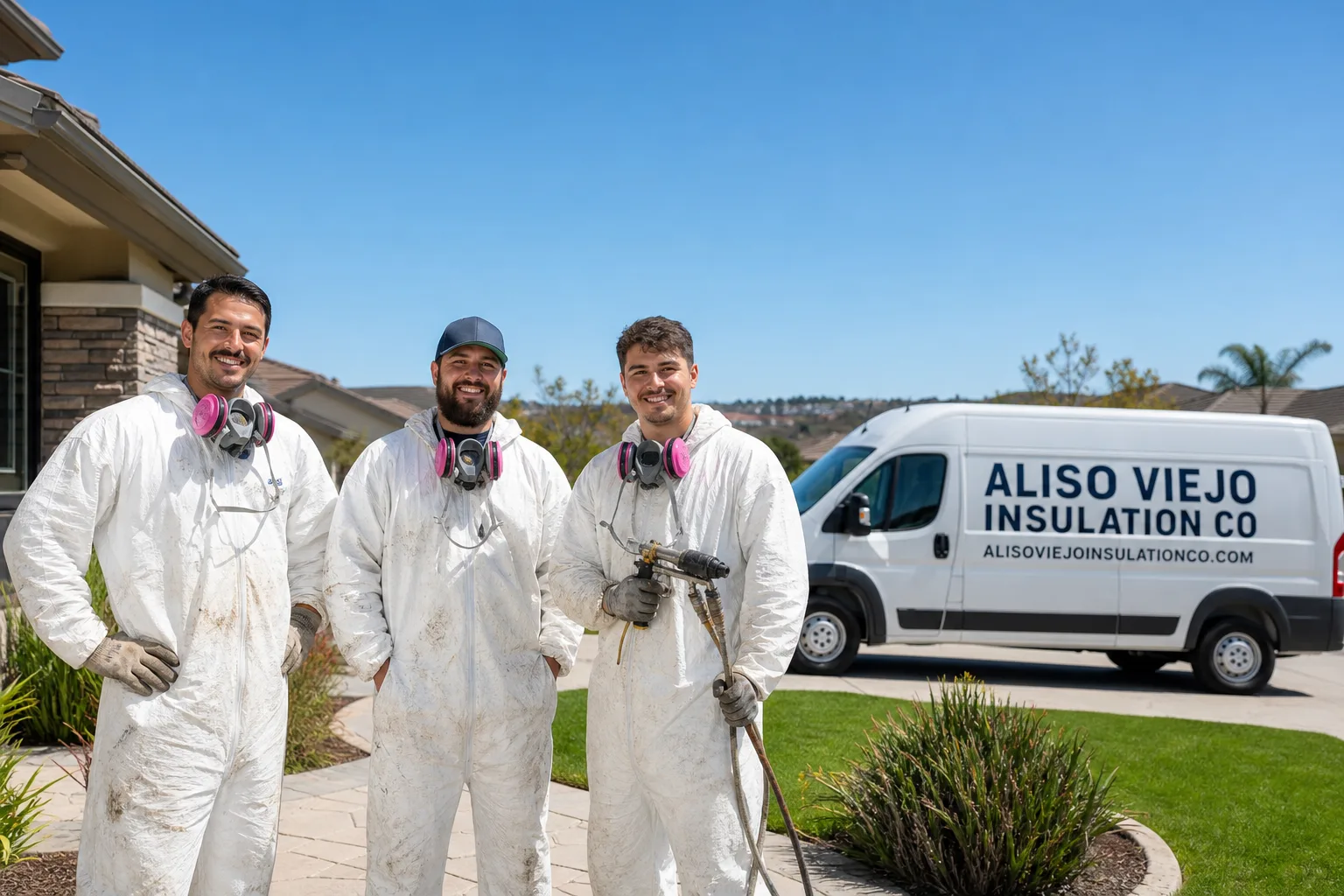
Fast, Reliable Spray Foam Insulation Across Glendora
Spray foam insulation in Glendora has to fight two things most cities don’t: brutal foothill sun that turns uninsulated garage ceilings into 130-degree heat boxes, and morning moisture that settles into hinges and tracks. We know this because we’ve worked the 91740 and 91741 ZIP codes long enough to recognize the pattern on sight. If your air conditioning runs nonstop from June through October, or your garage feels like a kiln by 2 p.m., the problem is rarely your HVAC. It’s the thermal envelope. Call (877) 352-4780 and we’ll diagnose it properly.
Why Aliso Viejo Insulation Co Is Glendora’s Preferred Spray Foam Insulation Company
We’re a full-method insulation contractor, not a single-product shop. That matters in Glendora because the right answer for a 1960s single-story ranch off Foothill Boulevard isn’t always the right answer for a newer two-story development near the 210. We source from eight manufacturers, including Johns Manville, Knauf, and Rockwool, so our recommendation comes from what the house needs, not what’s loaded on the truck. Our team has worked enough attics and garage ceilings in Glendora to know exactly where the heat hangs and how much foam it takes to stop it.
Nate Calloway leads our crews, and he’s the one who set the standard for how we approach foothill-facing homes across the San Gabriel Valley. The reviews say the same thing: we show up when we say we will, we keep the workspace clean, and we don’t push insulation you don’t need. We can’t publish a star rating here, but our Glendora customers tend to call us back when they buy a second property or finally tackle the garage.
Crawl Space Spray Foam Insulation in Glendora
Crawl Space Spray Foam Insulation in Glendora is a job we recommend for homes where the vented crawl space is pulling hot, dry air up through the floor all summer and letting conditioned air leak out. Most older Glendora homes have unsealed crawl spaces with fiberglass batts that have slumped, been shredded by rodents, or simply were never enough. We seal the rim joist, spray closed-cell foam across the subfloor, and in many cases encapsulate the crawl space so the home stops breathing outside air.
A typical crawl space spray foam job in Glendora runs from $3,200 to $6,800, depending on square footage, access height, and whether we’re also replacing failed vapor barrier. It’s not the cheapest option, and that’s the point. The cheapest option is re-batting and hoping. Foam actually stops the air movement.
Rim Joist Sealing
In Glendora crawl spaces, the rim joist is where we find the biggest air leaks. Gaps around the foundation sill let 100-degree outside air pour into the crawl space in summer and pull heated air out in winter. We spray the rim joist with closed-cell foam, which air-seals and insulates in one pass. It’s the highest-value single upgrade for most older crawl spaces.
Rodent and Pest Control Benefits
Closed-cell spray foam won’t stop a determined rat from chewing through, but it removes the gaps and fiber nesting material that make crawl spaces inviting. After we foam a Glendora home, homeowners consistently tell us the critter noise stops within weeks. The foam fills entry paths and leaves nothing to burrow in.
Garage Spray Foam Insulation in Glendora
Garage Spray Foam Insulation in Glendora is the signature job for this city, because the foothill-facing garage doors and ceilings take an abuse pattern you don’t see in Pasadena or Arcadia. The afternoon sun smashes into the garage door and roof, the uninsulated ceiling radiates that heat down all evening, and then morning moisture condenses on everything metal. The result is a garage that holds 120 to 140 degrees most of the afternoon, corroding springs, hinges, tracks, and opener chains from above and below. We spray the garage ceiling and shared walls with closed-cell Icynene, and we recommend upgrading door hardware at the same time.
Expect to pay between $2,100 and $4,500 for a single-car Glendora garage ceiling and shared wall, with two-car garages running $3,800 to $7,200. That range reflects whether the ceiling is open joists, partly drywalled, or has existing batts that need removal first.
Foam Thickness That Survives Foothill Heat
Closed-cell foam under two inches is doing almost nothing in a Glendora garage ceiling. The radiant load off a hot roof deck is too intense. We spray a minimum of two inches, and on west-facing or southwest-facing garages we routinely go to three. Anything less and you’re still cooking your springs and chain.
Hardware Protection During Application
When we foam a Glendora garage, we don’t spray over corroded fasteners and call it done. We inspect the hinges, tracks, and anchor points first. If corrosion has already started, we recommend replacing those fasteners before the foam goes on, because trapping moisture behind closed-cell foam on already-rusting hardware causes hidden rust jacking that loosens the track anchors later.
Trusted Brands We Service in Glendora
We’re authorized to install Icynene and Demilec spray foam systems, plus materials from Johns Manville, Knauf, Rockwool, and CertainTeed. For Glendora garages and crawl spaces, we lean closed-cell Icynene because the vapor and thermal performance matches what foothill heat and morning moisture require. Since we don’t answer to a single manufacturer, we can tell you honestly when Rockwool mineral wool or a Johns Manville fiberglass product is actually the better call. And if you already have a specific foam or batt brand installed, we can match the warranty and performance profile instead of ripping it out. Our Spray Foam Insulation team stocks the materials we’d need for most Glendora call-outs, so turnaround is days, not weeks.
Common Spray Foam Insulation Problems We See in Glendora Homes
- Under-thickness garage ceiling foam. Contractors who spray half an inch to an inch and call it “done” leave Glendora garages still hot enough to bake springs. We’ve measured 115+ degree garage interiors after thin foam installs. The foam needs real thickness to work.
- Rust from trapped moisture on old fasteners. Closed-cell foam sprayed directly over corroded hinges or track bolts seals the moisture in. Within six months, rust jacking pushes the hardware loose. We prep or replace fasteners before we ever spray.
- Open-cell foam in the wrong location. Open-cell is great for sound control, but in a Glendora garage ceiling under a hot roof deck, it doesn’t block the radiant transfer the same way closed-cell does. We match the cell structure to the surface, not to what’s easiest.
- Unsealed rim joists in older ranch homes. The 1950s-70s tract homes throughout Glendora were built with wide-open rim joists. Air pours through all summer. Foam at the rim joist is almost always the first fix we recommend, before touching the attic.
Pricing for Spray Foam Insulation in Glendora, CA
You’re going to see more to-the-dollar honesty than you’d get from a single-line estimate over the phone. That’s because every Glendora house hits different. A two-car attached garage ceiling with open joists, two inches of closed-cell, plus shared-wall coverage runs $4,400 to $7,200. A detached single with a partly finished ceiling starts lower, around $2,100. Crawl spaces in the 91740 ZIP run $3,200 to $6,800, and rim joist-only sealing on a 1,100 square foot ranch is often $1,300 to $2,400. Every estimate is free and itemized, and we’ll walk you through the reasoning behind the number. Call (877) 352-4780 and we’ll schedule a walkthrough at your convenience.
We Also Serve Cities Near Glendora
Our crews cover the entire foothill corridor from Glendora outward. We’re regularly in Azusa, Citrus, Covina, and Irwindale, handling the same garage and crawl space problems those cities share. If you’re just outside the city line, the odds are we already have a crew scheduled nearby.
Serving Glendora, CA — Our Local Coverage Area
We’re based in the Glendora area and know this community well. Use the map below to see our service coverage — if you’re nearby, we can almost certainly help.
FAQs About Spray Foam Insulation in Glendora
Yes, and the mechanism is direct. Closed-cell foam on the garage ceiling and shared wall cuts the radiant heat load, which prevents the day-night temperature swings that drive condensation and corrosion. In a Glendora garage, the pattern is heat during the day, cooling at night, and morning moisture settling on the metal. When the foam stops the heat box, the condensation stops with it. Pairing the foam with galvanized or stainless hardware makes the fix durable. Call (877) 352-4780 and we’ll inspect your current setup and tell you exactly what’s needed.
Because Glendora sits at the base of the San Gabriel Mountains, where late-afternoon sun and trapped attic heat hit hard. Pasadena’s southern edge gets marine-layer cooling, and Arcadia sits closer to that influence too. Glendora doesn’t. The uninsulated garage ceilings on our 1950s-70s ranch and tract homes add a second heat source from above, so springs, hinges, and opener chains get baked all afternoon and then hit with morning moisture. That’s the accelerated corrosion pattern our crews see on nearly every older foothill-facing street in the city.
You can absolutely start with the garage ceiling, especially if the garage is the room that’s making you miserable and the door hardware is rusting. But the crawl space is where your house loses conditioned air and pulls in hot outside air, so if your energy bills are climbing and the floors feel warm in summer, the crawl space is the source. We don’t push two jobs when one will fix the problem. We’ll measure both, show you what’s leaking, and let the building science decide the order.
Two inches of closed-cell minimum, and we go to three inches on west-facing and southwest-facing garages. In Glendora, the late-day sun off the mountains radiates straight into those roof decks, and one inch of closed-cell simply won’t hold back the heat load. We’ve measured the difference. If you’re deciding between contractors, ask them straight what thickness they’re proposing and why. Anyone quoting half an inch to an inch for a Glendora garage ceiling is guessing, not measuring.
No, spray foam on the ceiling and walls doesn’t void a garage door opener manufacturer’s warranty. The opener mounts to brackets on the structure, not to the foam, and the foam doesn’t interfere with the motor or the track. What does damage openers is the heat stress that accelerates circuit-board and sensor failure. We’ve seen openers die in three or four summers in uninsulated Glendora garages. Foam actually extends opener life by keeping the ambient temperature sane. If your opener’s under warranty, we’ll work around the manufacturer’s installation clearances so nothing is compromised.
Written by Nate Calloway, Owner at Aliso Viejo Insulation Co, serving Glendora since 2015.